We are leaving Philokalia for a while to re-read the Ladder of Divine Ascent by St. John Climacus. With the exception of the Bible, writes Bishop Kallistos Ware in the introduction of this book, there is no other book as influential and foundational for Orthodox spirituality as the Ladder of Divine Ascent by St. John Climacus. While addressed to monastics, it embodies the transformational journey that all Christians are capable of, and have a right to, from the tumult of passions and fragmentation to wholeness, inner stillness and unity with God.
On Placidity and Meekness (step 8)
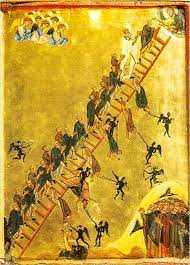
“As the gradual pouring of water on a fire puts out the flame completely so the tears of genuine mourning can extinguish every flame of anger and irascibility.” This is how step 8 begins as the natural continuation of the previous step on mourning.
Meekness for me used to imply failure! People who let others step on them! Starting with my early teens, I scorned anything that resembled meekness, moderation, timidity, quietness. I defined myself through rebellion and excess. Unlike the faceless “meek” that stay in their little boxes, I was going to change the world and defy categories. Little did I know then that the appearance of strength does not signify true, inner strength! Quite the contrary! Keeping up the trappings of strength and power and avoiding quietude through noise—outrage, anger, talkativeness—are often indications of fear and emptiness.
Meekness for St. John and other ascetics most certainly does not imply weakness. On the contrary, while anger is “an easily changed movement of one’s disposition” and the “disfigurement of the soul,” meekness is a “permanent condition;” unaffected by either praise or insult. It is, in fact, “a triumph of one’s nature.” This is the most profound and insightful differentiation I have seen. Anger, however noble or justifiable we want to believe it is, is “movable;” something you can neither rely on nor control. It is a flash in time; a reaction rather than action, lacking permanence and substance. Meekness, on the other hand, is a hard-won spiritual state that deliberately, rather than reactively, cultivates virtues and resists temptations that threaten the inner stillness it has created. The difference between anger and meekness that John conjures up is one between a spoiled baby and a highly trained Olympic athlete. Clearly he does not use the term to signify weakness.
There is a practical, “how to” dimension in John’s Ladder that is rooted in deep understanding of human psychology and the depths of the soul. He knows that, even as we desire the inner stillness of meekness, it will go against engrained habits and we will resist it. This is why he reminds us continuously that virtues are achieved in stages in a lifelong spiritual warfare and walks us through the steps. First he advise us to learn how to keep “the lips silent when the heart is stirred” – go through the motions even if your heart is not yet open to it. Once you achieve this, the next step is to also “keep your thoughts silent when the soul is upset.” Reaching the next and final step is when you are so unaffected by anger that your soul isn’t even stirred by insult or injustice against you.
Vainglory, conceit, remembrance of past wrongs, self-justification, hate are among the passions that stir anger. Yet, “just as darkness retreats before light, so all anger and bitterness disappear before the fragrance of humility,” John writes. Meekness is the foundation on which we can anchor the virtue of humility. We will know that we have fully ascended the step of meekness when, instead of anger at someone who caused us harm, we feel compassion and love. Unless we root out anger and replace it with meekness and humility, there will simply be no space for the Holy Spirit to enter.
 Readings in Philokalia