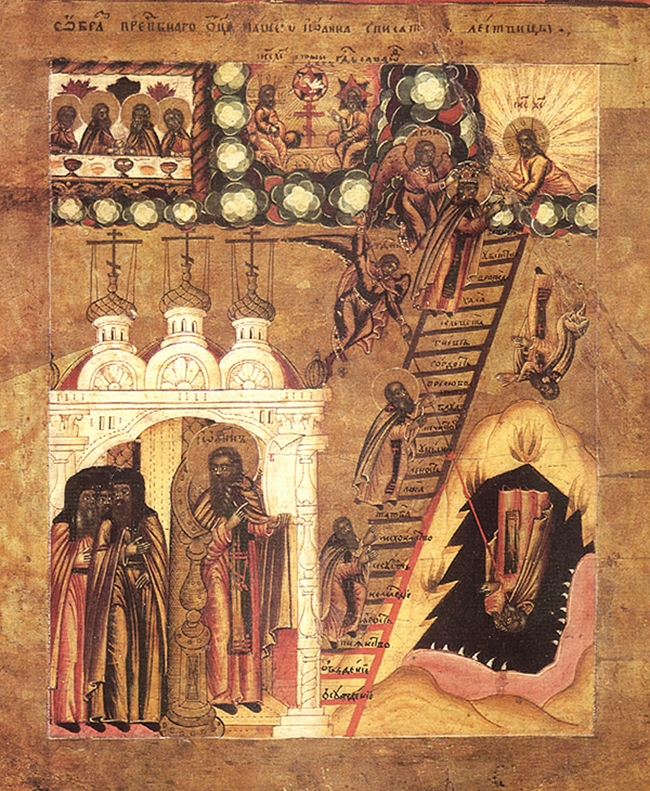
“By dispassion, I mean a heaven of the mind within the heart which regards the artifice of demons a contemptible joke” says John in the beginning of step #29, as he brings us to the last rung of the ladder before reaching the summit.
Very early in our journey, on step 3, we were introduced to the principle of detachment-turning away from earthly passions. Dispassion, however, goes beyond struggling to detach from destructive passions, to inner transformation! We have already broken free from the dominance of passions and temptations and we now experience our lives as transformed.
“Its effect,” John reports from accounts of those who have reached a state of dispassion, “is to sanctify the mind and detach it from material things, and it does so in such a way that, after entering this heavenly harbor, a man, for most of his earthly life is enraptured, like someone already in heaven, and he is lifted up to the contemplation of God.” Through dispassion, we are afforded a foretaste of a sanctified life in which “the artifice of demons,” instead of tempting us, appear so contemptible we are reduced to laughter.
Dispassion is calmness in the face of turbulence. Dispassion, John reminds us, is also the strength to “keep thoughts under control in the face of praise.” The latter is much harder than the former. The highest “state of dispassion is when one is in such close union with God that he is oblivious to any evil around him and there is longer a necessity to control evil thoughts. At this point he cannot separate himself from God…The will of God becomes for him as sort of inner voice through illumination.”
“Think of dispassion,” John asks, “as a celestial palace with numerous mansions. Think of the forgiveness of sins as being the fortifying wall of Jerusalem.” If we falter or fail, we can still recapture the palace as long as we make sure that we at least remain within these walls. Forgiveness, therefore, is a basic pre-requisite—even if we have lost everything else. As long as anger, bitterness, hatred and countless of petty grudges cloud our soul, nothing else can enter. To be whole, John urges us to break that wall of separation. He ends with a ray of hope as he reminds that reaching dispassion and sampling the joy of the Resurrection are achievable and within our nature as children of God and that God Himself is dispassion.
Be still and know that I am God and am Dispassion (Ps 45:11)
 Readings in Philokalia