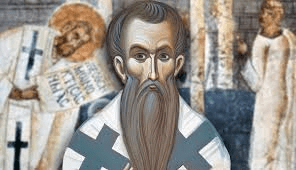
St. Basil was an early Christian cleric who served as Bishop of Caesarea in Cappadocia for 8 years, until his death (370-378).
He is one of the pillars of Orthodox theology, known for his support of the Nicene Creed and his battles against the heresies of the time. He was an influential theologian, renowned for his ideas, writings and preaching. Of the homilies he delivered, only about 50 survive today, including his Homily on the Holy Birth of Christ.
In addition to his work as a theologian, Basil was known for his care of the poor and powerless.
St. Basil begins this homily by yanking us out of our comfort zone—our iron-clad habits, beliefs, assumptions and patterns of thinking. Before he even mentions the birth of Christ, he warns us that we are incapable of understanding it solely based on our limited, human thinking.
Our first step toward understanding is humility–accepting that the concept of the birth of Christ is “incomprehensible” to humans. It exists beyond the confines of our human experiences, logic and verbal expressions. Christ’s birth, he tells us, is a mystery and, hence, it cannot be captured through words. Terms such as “eternal” or “ineffable birth” are woefully inadequate to capture the essence of that miracle.
In a way, we must detach from all that we take for granted, and approach the holy birth naked and child-like.
St. Basil asks us to forget all rules of cause-and-effect relationships, synthesis and antithesis.
He uses the metaphor of iron and fire to explain how limited linear oppositions are. While iron is cold and fire is hot, he tells us, iron becomes hot when put in the fire, taking on the outwards characteristics of fire.
“The iron glows in the fire, yet the fire is not blackened. The iron is set ablaze, yet it does not cool the flame.”
“Are you puzzled,” he then asks, “how the easily corruptible nature can have incorruptibility through its communion with God? Realize that it’s a mystery. God is in flesh so that he may kill the death that lurks therein.”
St. Basil continues with a catalogue of concepts that are accepted as truth by the church, even though they appear to be impossible within the laws of nature. He lists, and argues for, foundational beliefs about Christ’s birth that, at the time, were challenged by various heresies. For example, the virgin birth, Mary’s eternal virginity that continues after the birth, and the nature of the pregnancy, that is that Christ was placed in the womb fully formed—“perfect”—without undergoing the stages of development from fertilized egg to a fully formed child.
The basis of his arguments was the impossibility to understand a mystery with tools that pertain to the physical world.
St. Basil displays enormous mastery of science, theology and history. He rejects the notion that astrology explains the rising of the star as this implies that “each person’s life is caused by a particular configuration of the stars.”
St. Basil sees the birth of Christ as causing a cosmic shift in the world by freeing from the grips of pagan rules and worldview which dominated thought and culture.
Having warned us of the inadequacy of human thought and expression to grasp the mystery of the birth of Christ, St. Basil shows that spiritual understanding is not merely intellectual but experiential. One arrives at it through participation in, rather than descriptions of, the mystery. An outstanding writer, St. Basil ends the chapter with lyrical accounts of his immersion in the mystery itself:
Let us celebrate the salvation of the world, the birthday of humanity.
My heart is alive and well, and my mind is overflowing, but the tongue is deficient and words insufficient to proclaim such great glory.
For the divine power has been manifested through the human body as light through vitreous membranes, and shines upon those who have the eyes of their hearts purified. May we also be found among them , with “unveiled face beholding the glory of the Lord” so that we too can be transformed “from glory to glory” by the glory of our Lord Jesus Christ and his love of humanity.
 Readings in Philokalia