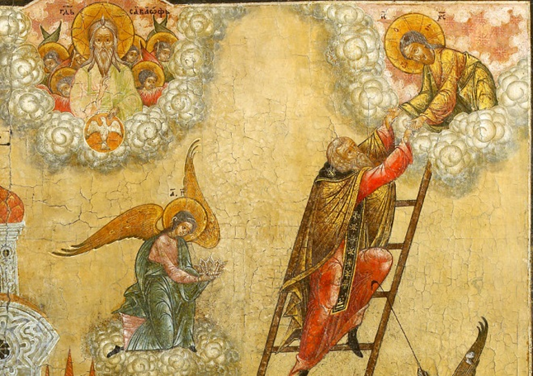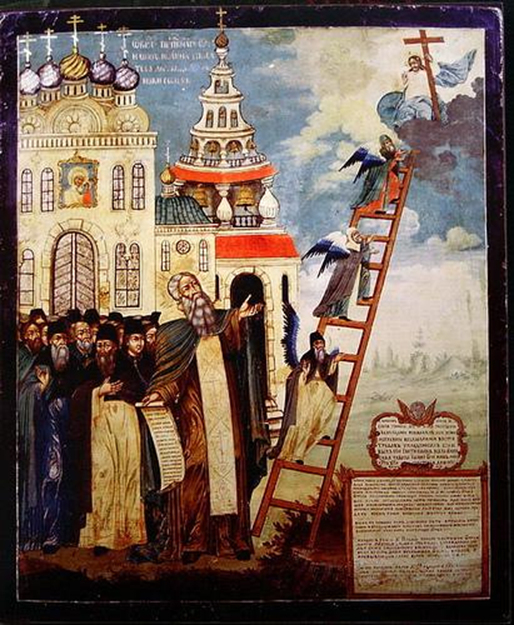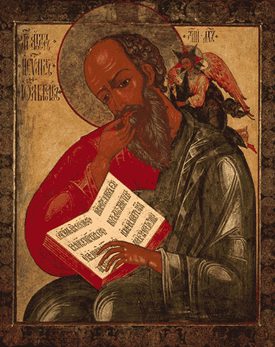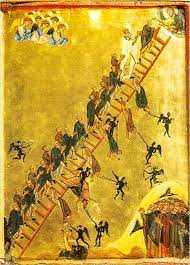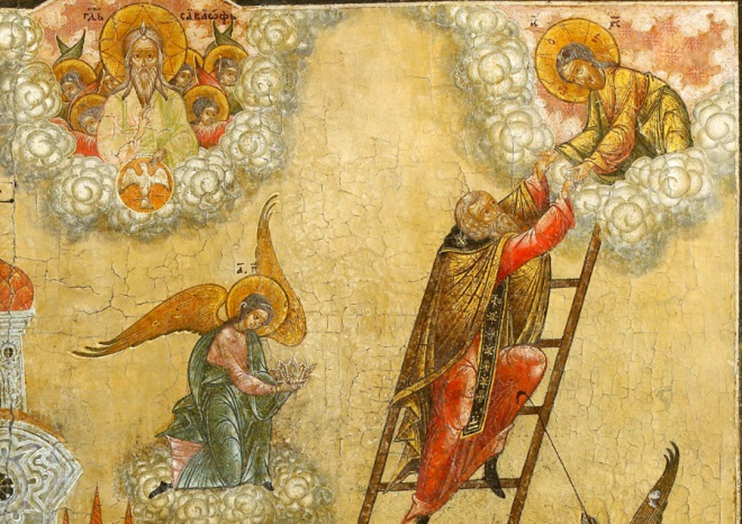
On Faith, Hope and Love, The Ladder of Divine Ascent, step #30

All that remains,” the last chapter begins, “is the triad of faith, hope and love to be fully united to God.” 

At the 30th and last step of the ladder, we have  finally arrived at the summit: theosis or union with God.

When I was younger, I would have expected something rare and powerful at the very top of the Ladder. Infinite wisdom, perhaps; eternal life on earth, immediate sainthood, power over others, miracle-granting authority! Extraordinarily, at the very top of the Ladder is a triad of virtues, with the highest among them being love. Instead of magic powers, we achieve a spiritual state that, though hard, is possible to be achieved by all.

The purpose of all the battles against passions and the cultivation of virtues along  our long ascent on the ladder was to finally experience love in its fullness. Since God is love, we become one with Him. 

To understand the concept of love in the writings of the desert fathers, we must banish our associations with romantic love or obsessive passion. Christian love is not  selective or conditional. It does not ebb and flow with circumstances or mood. Having shed our passions through our ascendance on the ladder, we are free from the blindness of personal agendas, resentments, jealousies, recrimination, desire to control and all the other passions that separate us from God. We are now able to see the image of God in others, regardless of their behavior, flaws, circumstances or mood.

Having achieved the ability to love fully we have not simply acquired a virtue, but become transformed in God’s image:

Love is by its nature resemblance of God, insofar as this is humanly possible.

Achieving theosis is a state beyond words or actions, a true “inebriation of the soul.” When your heart is filled with love, it transforms the way you see and experience the world.

Love grants prophecy, miracles. It is an abyss of illumination, a fountain of fire, bubbling up to inflame the thirsty soul. It is the condition of angels and the progress of eternity. You cannot love God and hate your neighbor because you now see God in him.

You experience love’s “distinctive character,” and thus become “a fountain of faith, an abyss of patience, a sea of humility.” Fear disappears when love consumes you.

Fear shows up when love departs.  Lack of fear means that you are either filled with love or dead in spirit, John observes.

A metaphor often used to communicate the intensity of our love for God is that of a person deeply in love. Just as someone besought with erotic love can think of nothing but the object of that love, those who ascend to the top of the ladder are so consumed by divine love that they may forget to eat and are unaware of physical needs.

Yet unlike bodily passions love of God is not uncontrollable, suffocating and destructive. It does not obliterate our identity and sense of self. Christ gave up his life out of love but retained his personhood.  Instead of consuming and destroying, love of God transforms.

Hope is the power behind love. When hope goes, so does love. “Hope comes from the experience of the Lord’s gifts, and someone with no such experience must be ever in doubt.”  Hope is destroyed by anger.

John’s last admonition is also a glorification: 

We are here at the summit,” he reminds us. “Let the ladder teach us the spiritual unity of these virtues so the “grossness of the flesh” will not hold us back.  And the chapter ends with an unequivocal declaration.

Remaining now are faith, hope and love, these three. But love is the greatest of them all.” (1 Cor. 13:13)
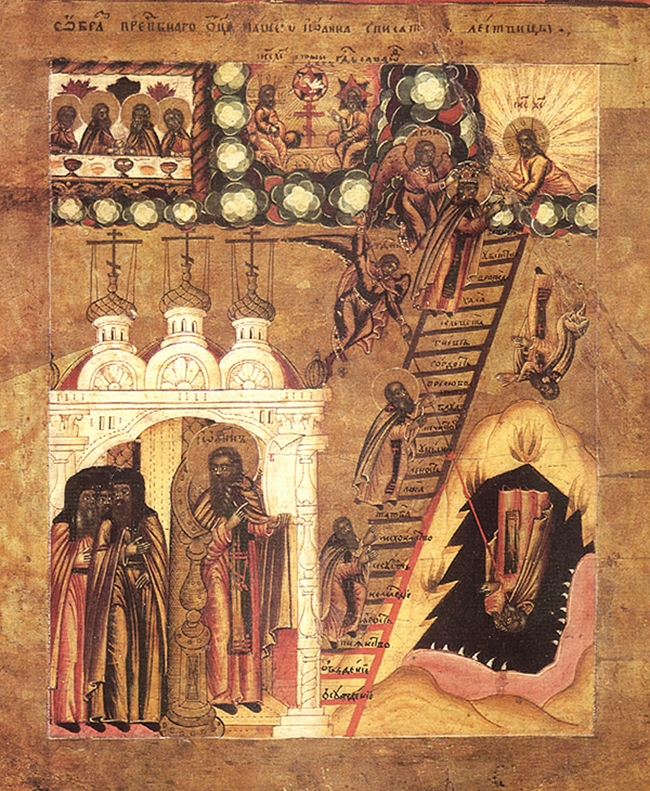
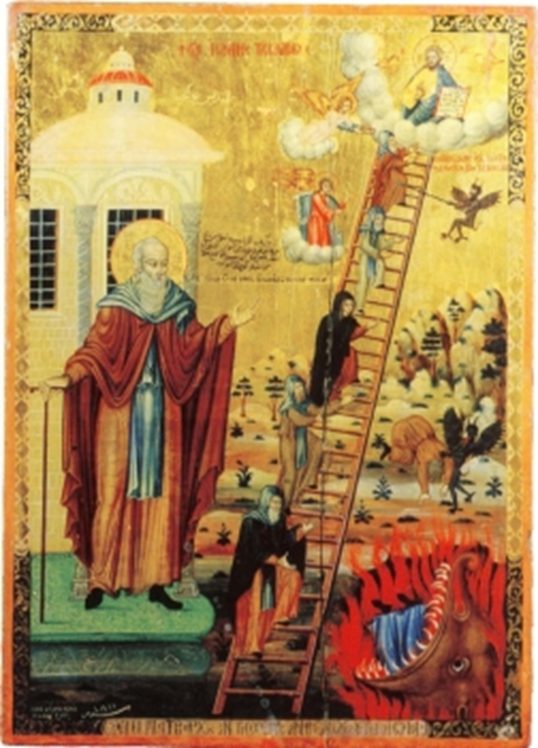
THE LADDER OF DIVINE ASCENT BY JOHN CLIMACUS: ON DISPASSION (step 29)

“By dispassion, I mean a heaven of the mind within the heart which regards the artifice of demons a contemptible joke” says John in the beginning of step #29, as he brings us to the last rung of the ladder before reaching the summit.

Very early in our journey, on step 3, we were introduced to the principle of detachment-turning away from earthly passions.  Dispassion, however, goes beyond struggling to detach from destructive passions, to inner transformation!  We have already broken free from the dominance of passions and temptations and we now experience our lives as transformed.  

“Its effect,” John reports from accounts of those who have reached a state of dispassion, “is to sanctify the mind and detach it from material things, and it does so in such a way that, after entering this heavenly harbor, a man, for most of his earthly life is enraptured, like someone already in heaven, and he is lifted up to the contemplation of God.”  Through dispassion, we are afforded a foretaste of a sanctified life in which “the artifice of demons,” instead of tempting us, appear so contemptible we are reduced to laughter.  

Dispassion is calmness in the face of turbulence.  Dispassion, John reminds us, is also the strength to “keep thoughts under control in the face of praise.”  The latter is much harder than the former.  The highest “state of dispassion is when one is in such close union with God that he is oblivious to any evil around him and there is longer a necessity to control evil thoughts.  At this point he cannot separate himself from God…The will of God becomes for him as sort of inner voice through illumination.”

“Think of dispassion,” John asks, “as a celestial palace with numerous mansions. Think of the forgiveness of sins as being the fortifying wall of Jerusalem.”  If we falter or fail, we can still recapture the palace as long as we make sure that we at least remain within these walls. Forgiveness, therefore, is a basic pre-requisite—even if we have lost everything else.  As long as anger, bitterness, hatred and countless of petty grudges cloud our soul, nothing else can enter.  To be whole, John urges us to break that wall of separation.  He ends with a ray of hope as he reminds that reaching dispassion and sampling the joy of the Resurrection are achievable and within our nature as children of God and that God Himself is dispassion.  

Be still and know that I am God and am Dispassion (Ps 45:11)

THE LADDER OF DIVINE ASCENT BY JOHN CLIMACUS: On Prayer (step 28)

“Prayer,” John tells us in the beginning of this chapter, “is future gladness, action without end, wellspring of virtues, source of grace, hidden progress, food of the soul, enlightenment of the mind, an axe against despair, hope demonstrated, sorrow done away with.”  This stream of lyrical metaphors establishes an important theme: prayer is not a discrete act, strictly confined to a specific place and time.  It is nourishment to our souls; the personal experience of God’s presence which can dwell ceaselessly within us.

John leads us to gradually deeper stages of prayer from simply keeping physical prayer routines to transforming your entire life into ceaseless prayer.

The first step is to prepare for prayer through purification:   

The beginning of prayer is the expulsion of distractions from the very start by a single thought.

Prayer is tarnished when we stand before God, our minds seething with irrelevancies. It disappears when we are led off into useless cares. (p.277)

Distractions from mundane cares and seething passions are likened to imprisonment, keeping us from the shining freedom achieved through prayer.

If you are clothed in gentleness and in freedom from anger, you will find it no trouble to free your mind from captivity (p. 276)

Simplicity and submission are the antidotes to distraction: “Pray in all simplicity,” John tells us. ”Avoid talkativeness lest your search for just the right words distracts you.” In fact, “when a man has found the Lord, he no longer has to use words when he is praying …”

You truly pray when you ask for understanding of His and submerge your  ego to it.   “While we are still in prison, let us listen to him who told Peter to put on the garment of obedience, to shed his own wishes and, having been stripped of them, to come close to the Lord in prayer, seeking only His will.

The Fire that Resurrects Prayer

It is easy to forget that prayer is a gate to the presence of God and begin to see our daily prayer rituals as chores or even disruptions to our busy lives. John reminds us that prayer is not an opportunity to make requests but a reward unto itself as a vehicle for uniting with God. 

“What have I longed on earth besides you? Nothing except to cling always to you in undistracted prayer!”

The stage of unity of God is not one of passive submission but of spiritual transformation. John uses the metaphor of fire to describe it: “When fire comes to dwell in the heart,” he says, “it resurrects prayer.”

Such an ecstatic state is not achieved on demand. We live in a time when service or information on demand, anytime, anywhere, is considered our birthright and the natural course of events. Yet, reaching this mystical, prayerful state cannot be achieved through our own efforts and at our chosen time, but only through God’s Grace. This is why when, by God’s Grace, our souls are suddenly gifted with a moment of true prayer, we must not let anything interfere with it. “Do not stop praying as long as, by God’s grace, the fire and the water have not been exhausted (as long as fervor and tears remain), for it may happen that never again in your whole life will you have such a chance to ask for the forgiveness of your sins.

One of the greatest dangers in our time is to look for shortcuts to ecstatic communion with God, replacing the fire of God’s presence in prayer with the superficial “high” of excess or addiction—whether it is drugs, extreme sports, workaholism or other compulsion.  The danger for us, practicing Christians, is to transfer this attitude to our prayer life, seeking “highs” in our prayer and worship experiences and judging their quality of the basis of the emotions we believe we should be feeling.  Forcing the emotions  we think we should be feeling in worship and judging rather than submitting to prayer and worship—leads some to constantly “shop” around for churches or for rapturous worship experiences which, ironically, does not give them the inner stillness needed to truly pray.  

We shouldn’t confuse the fire that is stoked by the labor of ascending the Ladder and emptying ourselves from passions, with artificially induced emotions.  The fire that comes to dwell in the heart and engenders true prayer is achieved through the Grace of God rather than our will and through spiritual warfare. Above all it transforms rather than to simply excite  or entertain us.  

Prayer as Transformation

John places a great deal of weight on the transformative role of prayer. He considers those who emerge from prayer without having experienced [illumination, joy or peace] to have prayed bodily rather than spiritually. “A body changes in its activity as a result of contact with another body. How therefore could there be no change in someone who with innocent hands has touched the Body of God?” 

John, however, is a pragmatist and wants us to at least adhere to the discipline of prayer routines, even when our hearts are closed and are not participating in the prayer. Committing to these routines eventually allows our hearts to follow our bodies.

For those who have achieved the higher level of true prayer, prayer is no longer a distinct activity but a continuous spiritual state.

John tells us that we should aspire to this state of continuous prayers. In is living life as prayer than our lives are transformed. We experience life—even its most insignificant moments or mundane elements —as “as sacrament” (as Schmemann puts it).  Life is lived as whole; there is separation between sacred and secular; worldly and prayer life. We may have a set time for prayer, but we are already prepared for it by “unceasing prayer in [the] soul.”

THE LADDER OF DIVINE ASCENT BY JOHN CLIMACUS: On Stillness (Step 27)

We are like purchased slaves, like slaves under contract to unholy passions” John writes in the beginning of the chapter.   The metaphor compares lives filled with passions to slavery.  John’s mastery of the human soul shows another, more insidious dimension of this slavery—the longer we stay in it the less we desire freedom because we can neither remember nor imagine what freedom looks, feels and tastes like.  Isn’t it why abused wives, addicts or abusers stay in destructive relationships, even though the right choice seems so logical and simple to those on the outside?  Abuse, violence and dysfunction become the norm after a while, and they can no longer remember or envision what health looks    like.

Not so long ago, I would have been dismissive of anything resembling silence.  How boring! Who would actually pursue it?  For most of us, living with noise and inner clutter is all we have known and defines normal. The Fathers, however, considered the practice of inner stillness an essential foundation of spiritual life.  Being silent is not the same as practicing inner silence. You can be quiet on the outside but tortured by the constant noise of racing thoughts and lingering resentments on the inside. 

Metropolitan Jonah defines inner stillness as “conscious communion’ with God.” He continues: “Inner stillness is not merely emptiness. It is a focus on the awareness of the presence of God in the depths of our heart. One of the essential things we have to constantly remember is that God is not out there someplace. He’s not just in the box on the altar. It may be the dwelling place of His glory. But God is everywhere. And God dwells in the depths of our hearts. When we can come to that awareness of God dwelling in the depths of our hearts, and keep our attention focused in that core, thoughts vanish.

How do we do this? In order to enter into deep stillness, we have to have a lot of our issues resolved. We have to have a lot of our anger and bitterness and resentments resolved. We have to forgive. If we don’t we’re not going to get into stillness, because the moment we try our inner turmoil is going to come vomiting out. This is good – painful, but good. Because when we try to enter into stillness and we begin to see the darkness that is lurking in our souls, we can then begin to deal with it. It distracts us from trying to be quiet, from trying to say the Jesus Prayer, but that’s just part of the process. And it takes time.”

John emphasizes the role of despondency in preventing us from union with God. To achieve stillness, we must be driven by love for God and the desire to experience the joy and sweetness of his presence. This spiritual state requires that any trace of despondency be shed from our soul. “For to link despondency to the loving of God,” John writes, “is rather like committing adultery.

John talks about the clarity we achieve through inner stillness and silence:  ‘Stillness of the soul is the accurate knowledge of one’s thoughts and is an unassailable mind.”  He writes:

 “The start of stillness is the rejection of all noisiness as something that will trouble the depths of the soul….Close the door of your cell to your body, the door of your tongue to talk, and the gate within to evil spirits.” Yet being quiet or away from noise in nature does not necessarily imply stillness. Inner stillness is practiced “in the deep spaces of the heart.” 

When you have arrived at the” final point,” however, fear and rejection of noisiness are no longer concerns because you are immune to them and cannot even detect them.

The Ladder of Divine Ascent by John Climacus: ON DISCERNMENT (Step 26)


Acquiring virtues, rung by rung in the Ladder, is not a simple, linear act. In this chapter, John explores the complexity of virtues; the thin and changeable boundaries that sometimes barely distinguish them from passions.  We have reached a higher level of spiritual growth at this stage that requires more than fighting passions—the understanding of the nuances of truth and the ability to clarify even the subtlest shades of ambiguity. This is why discernment, in addition to hard labor, is necessary at this rung of the Ladder. John highlights some of ambiguities and nuances of situations we should be aware of.

For one thing, the struggle for spiritual ascent is not uniform. John recognizes that virtues like silence, humility and temperance may come easily to some personalities while others have to struggle against their own natures to achieve them. Because the latter clearly have to work harder, John (somewhat reluctantly) considers their achievement to be a little higher than the others’.

Another complexity is that virtue is often mingled with malice and requires discernment and alertness to detect the dividing line between them. Love may conceal lust; hospitality, gluttony; discernment, cunning manipulation of a situation; hope, laziness; tranquility, despondency. To make this message clearer, John likens it to drawing water from a well and accidentally bringing up a frog with it. 

Over-achievement of virtues or pursuing them to earn praise is a grave danger that is no different from  the soul-destroying addictions of our own times–obsession with achievement and professional status; addictions to ambitions that turn us into workaholics; and lives spinning out of control by stretching our budgets, habits or expectations beyond what we can afford or deliver, plunging us into constant anxiety, fear and, eventually, despair.

John probes even more deeply into the risks of delusion and calls for extraordinary and finely hewn ability for discernment. “Monks should spare no effort in becoming a shining example in all things,” he states. Yet even when reaching for heaven we may be in danger of spreading ourselves too thinly, and “have our wretched souls be pulled in all directions, to take on, alone, a fight against a thousand upon thousands and ten thousands upon ten thousands of enemies, since the understanding of their evil workings, indeed even the listing of them, is beyond our capacities.”   I can’t imagine a more accurate description of men and women in our time–the modern professional, driven executive or ambitious soccer mom with a management agenda for her children’s lives.  The alternative is to discern God’s will for the right balance. “Instead, let us marshal the Holy Trinity to help us” John advises. Yet it takes humility to give us the discernment to acknowledge the reality of our limitation and need for God’s help.  And it takes patience to discern God’s will:

Discernment will also help us make a crucially important distinction—that between God’s will and timing and delusion and false timing, forced by our own will. “If God, who made dry land out of the sea for the Israelites to cross, dwells within us, then the Israel within us, the mind that looks to God, will surely make a safe crossing of this sea…”  And John adds:  if God “has not yet arrived in us, who will understand the roaring of the waves, that is, of our bodies?   Let’s pray for God to dwell in us and for humility to discern his will.

The Ladder of Divine Ascent by John Climacus:ON HUMILITY (Step 25)

Do you imagine that plain words can precisely or truly or appropriately or clearly or sincerely describe the Love of the Lord, humility, blessed purity, divine enlightenment, fear of God and assurance of the Heart?” John asks at the beginning of this chapter. “If you think so,” he continues, “then you will be like a man who, with words and examples, tries to convey the sweetness of honey to those who never tasted it.” And this is how John introduces us to a virtue that is the foundation of all others and the antidote to all passions.  

In this chapter we are ascending the top rungs of the ladder. We have battled destructive passions and are now concentrating on acquiring virtues. We are entering a deeper level of communion with God that cannot be easily captured in words or images. True humility can only be experienced.  It is a treasure that “eludes adequate description,” we are told. “Humility is a grace of the soul and with a name known only to those who have had experience of it.” It cannot be acquired through persuasion.  Neither, as John tells us, can it be learned from books, men or angels but only from Christ who dwells inside of us.  

The path to humility is long and achieved through the same stages all spiritual travelers pass through on their journey: Purification, Illumination and Theosis.  While it different for each of us, the destination is the same. “The appearance of this sacred vine is one thing in the winter of passions, another in the springtime of flowering and still another in the harvest time of all the virtues.” Yet all stages have one thing in common: joy and signs of the harvest to come.

A Parent of young children among us asked whether the path to humility posed a dilemma to parents today. Do we guide our children toward humility and detachment or toward aggressiveness and competitiveness, she wanted to know. Aren’t these two necessary for career success?  We decided that there was no contradiction there.  Ascending the Ladder is not a path to weakness but to inner strength.

The struggle, perseverance and discipline it takes to go against our very nature and seize control from destructive passions nurtures true inner strength.  Conversely being controlled by passions and disguising pride, envy or fear under superficial aggressiveness sap our strength and soul. Living in Christ and guided by virtues rather than torn by passions is the strong foundation on which everything else, including academic or professional achievements, can be built and sustained.

The Ladder of Divine Ascent by John Climacus:ON PRIDE (Step 23)

It is said that, if you are in a hurry to fill yourself with all the passions at once, all you have to do is to submit to one of them, Pride.  It is your one-stop-shopping passion that opens the gate to all the rest, and hence the gravest of all sins!

John does not mince words in describing the gravity of this sin: Pride is “the offspring of praise” and, therefore, “the denial of God, an invention of the devil, contempt for men.” It does not stem from anything real (hence John’s metaphor of pride as the “invention of the devil.”)  It puffs us up through the significance we read into our achievements, possessions or talents, though these are merely gifts from God. Pride fills us with a false sense of importance because of the weight we attribute to the praise or recognition we get from others.  It displaces our center of value from God to external and temporary symbols of status. Resting on such flimsy foundations, our puffed-up egos can easily burst, dropping us from the heights of self-satisfaction into the pit of despair in a minute’s time. The higher the need for external praise and recognition, the greater the fall from superiority to hopelessness if we lose these tentative holds on what we defined as a life worth living. 

John keeps uncovering layer upon layer of the real toll the self-inflicted torment of pride exacts from our soul.  John calls pride the “shameless parading of our achievements, complacency and unwillingness to be found out.”  This last one is especially poignant.  Pride has a way of trapping us in the very fantasies we create about who we are, as we become increasingly convinced that without the fantasy, we will not be able to garner external validation and, hence, live lives worth living.  We often feel fake and inauthentic.

This is why we spend lives consumed with efforts to maintain the world of appearances we are convinced is the reason we will be loved and respected.  Pride dooms us to living lives of secrecy, falsehood and constant anxiety over being found out as less than our advertising campaigns promise.  Living prideful lives is living lives of fear. We are afraid of living our lives authentically and simply, and experiencing our true selves without false adornments, lest they are not adequate to elicit praise and admiration. As long as we exhaust ourselves on this treadmill of endlessly feeding our  pride we will be unable to experience the inner stillness we need to become one with God. 

Blasphemy

Have you ever felt shocked and horrified by a shameful, unimaginable thought that suddenly popped into your mind at the most inappropriate moment? Maybe it was a sudden mental picture of the executive interviewing you without his clothes on during the interview of your life. Sex, murder, incest, torture, mayhem…the most unthinkable thoughts that you would never entertain in your conscious mind, sometimes invade our minds violently and unexpectedly, even if it is for just a few minutes. John does not hesitate to bring them out of the hiding place we assigned them to and into the uncomfortable light of the day.  These are the thoughts that John calls “blasphemy” in this section. And if you think such occasions are embarrassing to discuss or farfetched, take note of how matter-of-factly he refers to them.

“This “atrocious foe,” he tells us “has the habit of appearing during the Holy Services and even at the awesome hour of the Mysteries, blaspheming the Lord and the consecrated elements…”  Blasphemy haunts everybody– rich and poor, layman and monastic.  Yet it is not blasphemous thoughts that endanger our soul here, but how we choose to respond to them. Christ suffered all temptations after all.  We are vulnerable not to the presence of thought but the temptation to hold on to it by hiding it and attempting to control it on our own, through sheer will power and intellect.

Blasphemous thoughts are so fleeting and startling that they are hard to make sense of them, let alone articulate. Our first reaction may be confusion and disbelief. “What is this horrible thought? Where did it come from? Did I really think of it?”  The harm to our souls begins when we allow shame to overcome us and pride to lead us to secrecy and lying.  “What does this all mean? What does it say about me? Could it be that I have a dark rotten core in me? How embarrassing if all these people who respect me knew what just went through my mind.”  

Dwelling on blasphemy is the first step to surrendering to it. Once we have engaged in it, it is no longer a fleeting thought. It becomes a preoccupation and path to action. We are too ashamed to acknowledge or confess it and act to prevent others from “finding out.” We may overcompensate by fasting, over-achieving, or reinforcing our identity as Christians, brilliant employees, assets to our community. Secrecy traps us in an inauthentic double life and eventually plunges us into despair. 

What John does here is show us how to stare the darkest and most embarrassing dimensions of our being in the face and for what they are, and then let them go without engaging them.  He asks us to confront shameful thoughts simply and humbly without allowing our imagination and intellectual interpretations to magnify their importance and make them a permanent fixture in our souls.  Resigning to a life of shame, secrecy and lies is a greater sin than the blasphemous thought that gave rise to them. 

The Ladder of Divine Ascent by John Climacus:On Unmanly Fears (Step 21)

No gentle acknowledgments of fear or gradual empowerment of self into fearlessness in John’s 21st step! He doesn’t mince words. Fear, he tells us, is outright “unmanly;” it is nothing else but “cowardice, the child of vainglory, the daughter of unbelief.” 

Fear is not one-dimensional.  This short, 2-page chapter uncovers different manifestations of fear in our souls and shows the price it exacts from our lives.

“Fear is danger tasted in advance,” we are told.  How many of our daily anxieties stem from our thoughts getting ahead of us– anticipating, imagining or fleshing out different scenarios of future humiliation and failure– until our mental constructs become the reality we inhabit? John is light years ahead of psychotherapy and other treatments of mental disorders, including more recent specializations in anxiety disorders and phobias.  He sees fear as stemming from faulty thought processes that treat imagined truths as actual truths. Yet precisely because fear is generated by something that does not actually exist in the present, John stares it in the face rather than cajoling it, and calls it an act of cowardice.  

In most steps, John prescribes “treatments” for passions and demonstrates what freedom from them is like through a series of paradoxes.  Just as, in a previous chapter, the poor man  was shown to be actually rich because he was freed of cares, the man who fears God is not afraid of anything other than Him, while the man who is not afraid of God is afraid of his “own shadow.”  The fear of God frees us from fear.

Fear is the result of faithlessness, we are told.  Without faith we assume full responsibility for outcomes that matter to us, and live in constant anxiety over the possibility of our failure.  We don’t have to go far. As parents, many of us anxiously look for opportunities to deliver lectures, make hints, and push conclusions in conversations with our children.   How could we possibly relax into the experience of just loving them when it is clearly up to us to steer them in the right career path or opinion? Or how can anyone settle down in a conversation and actually listen to what others are saying , when so much care must be taken to ensure that we make the right impression and not let others get the upper hand? The greater our investment in outcomes, and the greater our belief in our power to control them, the greater our fear of failure!  Living in fear and anxiety casts a shadow over our ability to love fully, unconditionally and in the present.

This is why vainglory is a spring of constant fear.  If our happiness depends on praise, admiration, status, material possessions and other external manifestations of value, our soul becomes the breeding ground of fear; fear of losing or never achieving them can dominate our lives.  Cowards, above all, are vainglorious.

All previous chapters echo in various ways the contrast between passions and freedom.  In the chapter on poverty we are told that “poverty “is resignation from care….  It is life without anxiety and travels light, far from sorrow and faithful to the commandments…A poor man is lord of the world”(p. 189).”  The virtue of chastity gives us “holy simplicity [as] a breastplate against the cunning of evil demons” (p. 183).  If we have nothing, there can be no temptation of attachment or fear of loss.  Fear in this step is not exactly a passion but the result of passions like vainglory and pride. To root it out you have to trace its origins in the darkest crevices of your soul and confront them head on.

John’s advice on how to confront our fears fully resonates with modern psychology: “Do not hesitate to go in the dark of the night to those places where you are normally frightened. The slightest concession to this weakness means that this childish and absurd malady will grow old.”  But there are also major differences between psychology and ascetic spirituality with interesting implications.

Overcoming Fear

Unlike modern psychology, however, we don’t just draw on our own resources to fight it. Instead, we “put on the armor of prayer” and clothe ourselves with trust in God. Once again, John shows a connection between the spiritual and physical dimensions of prayer to God, conjuring up an image of child-like surrender: “when you reach the spot, stretch out your hands and flog your enemies with the name of Jesus…He who has conquered cowardice has clearly dedicated his life and soul to God.” 

Moreover, unlike modern psychology, fear is not simply a mental disorder to be treated but a moral and spiritual illness to be conquered: “…it is the barrenness of soul [and not] the darkness or the emptiness of place which gives the demons power over us.” And it is in the soul that healing takes place. John’s compassionate view of mankind, however, always reminds us that we don’t have to aim at instantaneous transformation but accept a path of small and gradual steps: “If your soul is unafraid even when the body is terrified then you are close to being healed. “

A quote from a different translation of the Ladder in a footnote gives us a vision of what total freedom from fear is like; not only freedom from expectations but eagerly embracing  “all unexpected events with a contrite heart. “

THE LADDER OF DIVINE ASCENT BY JOHN CLIMACUS: The Things that Deaden our Soul

The conventional understanding of “sin” is that of transgression of very concrete rules and laws.

This is how Wikipedia defines it:

Among some scholars, sin is understood mostly as legal infraction or contract violation of non-binding philosophical frameworks and perspectives of Christian ethics, and so salvation tends to be viewed in legal terms.

It continues with the relational definition of sin:

Other Christian scholars understand sin to be fundamentally relational—a loss of love for the Christian God and an elevation of self-love…

Hesychasts built on the relational definition of sin but delved to an unprecedented depth into the effects of the loss of love of God. In this sense, their profound understanding of the intricacies of the human soul, and the difference between healthy and unhealthy spiritual states, predates psychology and the steps to mental health that behavioral psychology espouses.

In step 18, St. Johns talks about insensibility “that is, deadening of the soul and the death of the mind before the death of the body.”

Have you had moments when the horrors shown on TV stir up indignation but do not touch your heart or bring tears to your eyes? Or when you are shocked to realize that at a particular moment, while you know you love your family, your heart is closed, and your feelings are frozen?  The Ladder recognizes these moments of spiritual paralysis and their consequences on our salvation:

 Insensibility both in the body and in the spirit is a deadened feeling, which from long sickness and negligence lapses into loss of feeling.

The word for insensitivity in the original Greek is anaesthisia—the same root as in “unaesthetic;” – loss of sensation, deadening of the senses.

Αναισθησία και στα σώματα και στις ψυχές είναι απονεκρωμένη αίσθησις, η οποία από χρονία ασθένεια και αμέλεια κατέληξε να αναισθητοποιηθή.

St. John forces us to face the consequences of insensitivity. Occasional insensitivity will become a habit causing “benumbed thought; the birth of presumption; a snare for zeal; the noose of courage; ignorance of compunction; a door to despair; the mother of forgetfulness, which gives birth to loss of the fear of God. And then she becomes the daughter of her own daughter.”

Insensitivity, constant sleepiness or dullness often hides a deeper attempt to escape into fantasy, apathy and sloth so we will have to face and engage with reality.  Alertness, on the other hand, gives us a fighting chance to resist evil and withstand misfortune.  It gives us clarity of mind and full presence in the moment to discern the glory of God all around us.

A state of alertness, John tells us, “is a quenching of lust, deliverance from fantasies in dreams, a tearful eye, a heart made soft and gentle, thoughts restrained  food digested , passions tamed spirits subdued, tongue controlled, idle imaginings banished.”

Without alertness, our life slips through our fingers like a dream, and we are unable to be in the presence of God.

How many times are we absent from our own lives in mental and emotional “sleepiness?”  Maybe we are too tired to engage with our family, opting to lay half- asleep in front of the TV with a bottle of beer. Or our minds are so cluttered with lists of chores to be done, worries about our next day’s presentation  at a meeting,  anger about perceived insults, that we barely take note of the beautiful spring day outside. Our senses and feelings have been so dulled that while we register others’ pains and sufferings and sympathize in our minds, our hearts cannot be engaged no matter how much we try to push our feelings. 

Indulging in sleep or, as John calls it, a state of somnolence is “stealing half our life time or more.”  

Alertness is focus; sharpness; full presence in the moment; a kind of spiritual transparency that allows God to enter unencumbered.

Fear (step 21) is another thief of souls. St. John, calls it “unmanly… a childish disposition in an old, vainglorious soul.”

Fear of course stems from focusing on what might happen in the future and prevents us from living life in the present. St. John goes further, however, to link fear with pride and vainglory.

If we didn’t think we deserved more than we had, we would not be afraid of loss. If we did not live to gain others’ acceptance and impress them with our wealth, position, looks and other material things, we would not spend our days in fear of rejection, disrespect or humiliation. If we think that we, alone, can battle to save ourselves, fear can grow into despair.

Cowardice is a falling away from faith that comes of expecting the unexpected. Fear is a rehearsing of danger beforehand; or again, fear is a trembling sensation of the heart, alarmed and troubled by unknown misfortunes. Fear is a loss of conviction. A proud soul is a slave of cowardice; it vainly trusts in itself and is afraid of any sound or shadow of creatures.

THE LADDER OF DIVINE ASCENT BY JOHN CLIMACUS: CHASTITY & SIMPLICITY

John brings the topic of chastity to a close in the final three pages of this chapter. He has already exposed the deceptiveness of passions and their devious progress in our souls. He has broken down and demystified the stages of their slow progress and shown us how we can choose to stop them at any stage. 

He now muses about their origins. How is a passion generated? Is it because our body is somehow wired to respond to certain triggers? Is it the context? Is it the environment?  He doesn’t feel pressed to provide an answer. What really matters is not to underestimate them. We should remember that a flickering spark– smell, sight or touch—can grow into a raging fire in no time.   

What is the antidote for being tempted by the thrill of fire? John brings up the role of simplicity as a “breastplate against the cunning evil of the demons.”  He refers to it as “Holy Simplicity.”  Simplicity leads to humility and will guard us against delusion and false pride. It will afford us an uncluttered, clear mind that can detect dangerous passions before they spread.  With simplicity and humility we will not be tempted to overestimate our own power and underestimate the first traces of a passion in our soul, certain that we will be able to stop and control it at will.

Those who are vainglorious, he continuous further down, are particularly prone to priding themselves for rooting out passions through prayer and fasting, unaware of new passions that have taken their place.  Chastity and humility acknowledge our human weakness in being tempted by passions and God’s grace in overcoming them.