BECOMING A TREE OF LIFE: Nikitas Stithatos

Philokalia, vol. 4, On the Inner Nature of Things and on the Purification of the Intellect:
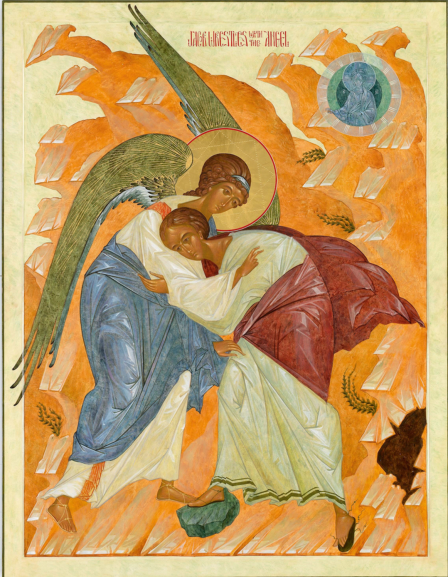
Nikitas Stithatos paints a lyrical image of the state of theosis, that is, union with God:

When you have reached this state, you enter the peace of the Spirit that transcends every dauntless intellect (cf.Phil. 4 : 7) and through love you are united to God.”

Getting there, however, is not a linear path.

Pride for your spiritual achievements, for example, often creeps in, disrupting contemplation. The tranquility you achieved is shaken as you slip back into wanting to control, draw conclusions and make presumptions on your own. Such self-centered state of mind prevents you from seeing the inner nature of all things through God’s eyes.

Stithatos makes clear that nothing remains static in this process of spiritual ascendance, including the role of the penitent.

God does not want us always to be humiliated by the passions and to be hunted down by them like hares, making Him alone our rock and refuge (cf. Ps. 1 04 : 1 8);”

God, then, wants us to be in a cooperative relationship with him.

Accordingly, simply resisting the passions is not enough for salvation. Nikitas Stithatos’s emphasis is on the transformation of passions into virtuous energies (rather than their mere annihilation).

To better illustrate this point, he brings up the metaphor of a deer eating snakes (don’t look for scientific evidence here).

“But He wants us to run as deer on the high mountains of His commandments (cf. Ps. 1 04 : 1 8. LXX), thirsting for the life creating waters of the Spirit ( cf. Ps. 42 : 1 ). For, they say, it is the deer’s nature to eat snakes; but by virtue of the heat they generate through being always on the move, they strangely transform the snakes’ poison into musk and it does them no harm. In a similar manner, when passion-imbued thoughts invade our mind, we should bring them into subjection through our ardent pursuit of God’s commandments and the power of the Spirit, and so transform them into the fragrant and salutary practice of virtue. In this way we can take every thought captive and make it obey Christ ( cf. 2 Cor. 1 o : 5).”

The spiritual application follows the deer analogy:

The Process of Transformation given by Stithatos

  • Invasion of Thoughts: “Passion-imbued thoughts” will inevitably enter the mind [1]. The goal is not necessarily to avoid these thoughts entirely, but to actively confront them.
  • Active Subjection: Through “ardent pursuit of God’s commandments and the power of the Spirit,” the negative thoughts are engaged and brought “into subjection” [1].
  • Spiritual Alchemy: The “poison” of the passion is not just neutralized; it is “transformed them into the fragrant and salutary practice of virtue” [1]. The energy of the passion, when channeled correctly through spiritual discipline, becomes something positive and holy (musk).

Free will, then, is not passive but has agency of its own to discern,  edit, re-direct and transform.

This “dynamic path” is a key feature of the broader Eastern Orthodox concept of theosis, which involves a synergistic process of human effort and divine grace.

The state of passivity or action, surface or depth depends on the level of engagement we have with God.

Simply disciplining the body is not sufficient for achieving theosis. It is literal and one-dimensional. Yet, “we are meant for more than we can literally imagine,” writes Stithatos. Remaining on the surface–Christians in name only– means that we are simply treading water and we will experience no progress:

A person who keeps turning round and round on the same spot and does not want to make any spiritual progress is like a mule that walks round and round a well-head operating a water-wheel.”

Becoming one with God in every way is not achieved simply by adhering to technical details.

In the book, Everywhere Present, by Stephen Freeman, the central metaphor is the contrast between a “two-storey” and a “one-storey” universe. The “two-storey” view, which Freeman argues is the prevailing mindset in secular society, relegates God and all spiritual matters to an unreachable “upstairs” realm. This effectively banishes God from everyday existence, making faith a distant, theoretical concept. The “one-storey universe,” in contrast, recognizes that God is “everywhere present and filling all things” in the here and now.

This metaphor bears similarity to Stithatos’ contrast between passivity and total engagement, running in circles and ascending upwards.

Freeman’s book advocates for a faith that changes how one perceives and interacts with the entire world and sees God’s presence in all things.  

Stithatos’ path to theosis is similarly a transformative process by which a veil is lifted, and we can suddenly see the world around us with new eyes. We are able to discern God’s presence under the surface of even the most insignificant things and, hence, comprehend their true essence.

But true devotion of soul attained through the spiritual knowledge of created things and of their immortal essences is as a tree of life within the spiritual activity of the intellect

WHO AM I?

Nikitas Stithatos

Philokalia, vol. 4, On the Inner Nature of Things and on the
Purification of the Intellect:
One Hundred Texts

Who am I when no one is watching? When I’m not striving for success, frantically checking items off to-do-lists,  or managing the impression I make on others? What remains of me if I lose my job, professional status, perfect performance of tasks or others’ admiration?

Suppose you are successful at your work, have received promotions, met important people and were awarded several awards. Suppose also that you have failed to complete projects you started, and you were fired once. Consider finally where, in your perception of your successes, you place your daily virtues, such as loving and nurturing your children or your willingness to sacrifice yourself for others.

Most of us, consciously or unconsciously, construct a “public self”  that highlights our successes, skips the failures and discounts the everyday virtues and domestic joys that we believe are not spectacular enough to impress.

Our self-presentation often conceals perceived shortcomings or simple pleasures that we don’t believe would be recognized as accomplishments by others.

Such presentation of ourselves leaves in the shadows supposed failures or ordinary virtues and joys we don’t believe others see as accomplishments, creating an internal friction between the self we present and the one we possess.

Curating a version of ourselves based on what we believe others value is exhausting.  Yet most of the time we are hardly aware of the editing process we automatically undertake. This is because we are convinced that our story for ourselves is true. The constant work of hiding the discarded parts of our identity, however, breeds a profound, anxious disconnect.

Nikitas Stithatos emphasizes the importance and, indeed, necessity of knowing ourselves.

To know oneself is the goal of the practice of virtues.” Nikitas Stithatos tells us.

True knowledge of ourselves will free us from our “addiction to success, ”(as Arthur C. Brooks calls it, in his book From Strength to Strength), and from the burden of constantly curating our persona so that it elicits the maximum praise and admiration.

Knowledge of our true self can  only be achieved through humility. Conversely, humility can be only achieved and maintained by cutting through delusions and cravings for admiration and understanding who we really are.

For if you do not yet know yourself you cannot know what humility is and have not yet embarked truly on the task of cultivating and guarding. To know oneself is the goal of the practice of virtues.

The more we recognize our weakness, the stronger we will be in spiritual warfare and  the freer we will feel from our attachment to the stories we construct for ourselves.  

We live authentically when we stop being driven by the quest for others’ approval and seek, instead, an understanding of who God, and not man, wants us to be.

One way to judge our ability to live authentic lives in humility is by examining the “fruits” of our labor, not just our own rhetoric and conclusions. Our claim of satisfaction and success, for example, seems hollow when we feel discontent, spend sleepless nights agonizing, miss out on things we claim are important or look at the future with fear and dread.   

Stithatos is clear about the true fruits of the Holy Spirit and those that uncover “vanity and pretentiousness of soul.”

The fruits of the Holy Spirit are love, joy, peace, goodness, long-suffering, kindness, faith, gentleness, self-control ( cf. Gal.5″ : 2 2-23). The fruits of the spirit of evil are hatred, worldly despondency, restlessness of soul, a troubled heart, guile, inquisitiveness, negligence, anger, lack of faith, envy, gluttony, drunkenness, abusiveness, censoriousness, the lust of the eyes (cf. 1 John 2 : 1 6), vanity and pretentiousness of soul. By these fruits you may know the tree (cf. Matt. 1 2 : 3 3), and in this way you will certainly recognize what kind of spirit you have to deal with…

God looks not at the outward form of what we say or do, but at the disposition of our soul and the purpose for which we perform a visible action or express a thought. In the same way those of greater understanding than others look rather to the inward meaning of words and the intention of actions, and unfalteringly assess them accordingly.

Man looks at the outward form, but God looks on the heart,” Stithatos points out and quotes cf. I Sam.I 6 ; 7.

We need to focus on cultivating the heart, building lives of inner contentment, love and faith rather than those of achievements and external admiration.

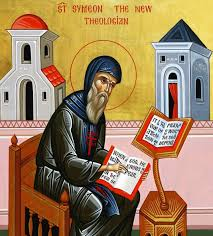
Symeon the New Theologian: How to See the Divine Light in Daily Life 

St. Symeon (949–1022), was a monk, thinker and poet, known as the “new theologian.” He spoke about his own mystical experience and believed that all humans had the capacity to ascend the ladder to God and experience his presence directly. In this essay in Philokalia IV, St. Symeon patiently demonstrates to monastics how to uderstand and apply mystical theology to the practicalities of everyday life.

While monks are his immediate audience, his astonishing insights into the human heart and the anxieties and struggles that plague us are highly relevant to us in the times we live.    

So how does St. Symeon’s practical theology apply to our daily lives?

Five steps struck me as dominant in this chapter and could be adapted to our own daily lives.

RENUNCIATION

Renunciation of the world,” St. Symeon says, includes “self-alienation from all material things, from the modes, attitudes and forms of this present life, as well as the denial of one’s own body and will.” It is a tough call, but he believes that it is far better than the alternative because “a person full of anxiety about worldly things is not free. He is dominated and enslaved by this anxiety, whether it is about himself or about others. “  

We are not unlike the monks in St. Symeon’s world as we are similarly tormented by constant anxiety, festering resentment, self-pity, emotional or physical addictions, endless speculations about what if and how come that have our mind spinning in circles.

Twelve-step programs modify the concept of monastic renunciation to help addicts and their families achieve emotional detachment from turmoil and destructive urges.  The concepts of dispassion and self-restraint are more easily applicable to us.

Detachment and renunciation are not equivalent to indifference or resignation. While the monk’s renunciation frees him from “worldly concerns, he will not be idle, or neglect even the most insignificant and trivial details; but all he does he will do for the glory of God, accomplishing everything in his life without anxiety. “

Those with a loved one who is an addict can empathize, grieve and  take action, yet without being drawn into his downward spiral and losing themselves.    

REPENTANCE AND TEARS

Symeon stresses the need for repentance as the foundation of a life in Christ and inner peace.  It takes humility and detachment to truly see your flaws without justifying and minimizing them. This is why true repentance brings tears, as you become deeply aware of all that was lost through sin.

The tears of repentance are purifying.

For he who through many tears has purified his intellect and has received the illumination of the divine light – light that would grow no less even if everyone received it – will dwell spiritually in the age to come.

TRANSFORMATION

Repentance is much more than an admission of guilt and an apology. It heals only through transformative action– the ability to turn your life around.   

For the kingdom of heaven,” St. Symeon says,“  is entered forcibly.

He does not mean forcing your will on others. He is referring, instead, to the force  you need to exert on yourself to refrain from falling back into old habits, resist the lure of destructive passions and immediate pleasure, deny the temporary relief of anger, resentment and self-pity and taking on the role of spiritual warrior.  

Laziness, then, is not just an annoying or unproductive habit but saps our energy, diminishes hope and gets us stuck on a downward spiral.  

49· Bodily listlessness and torpor, which affect the soul as a result of our laziness and negligence, not only make us abandon our normal rule of prayer but also darken the mind and fill it with despondency.

Instead of allowing anxious, self-serving and negative thoughts to overwhelm and define us, we engage in nourishing contemplation and readings, St. Symeon advises.

Transformation affects a powerful  reorientation from self to God

LOVE

The ultimate state of one’s ascendance to God is love. Love in Christ goes beyond the relatively easier type of love  we may have for our family, friends and those who support and admire us. Christian love recognizes the humanity of all beings, no matter how destructive, and can perceive God’s presence in them under the most repulsive words or actions. .

If you truly love and pray for those who slander and maltreat you, who hate and defraud you, you will make rapid progress, for when your heart is fully aware that this is happening, your thoughts and, indeed, your whole soul with all its three powers are drawn down into the depths of humility and washed with tears.

Symeon asks us to go beyond curtailing our drive to judge and criticize others. He asks us, instead,  to look at our peers and superiors as saints and ourselves as sinners.

You should look on all who are in the monastery as saints.

Love rises above even the strictest monastic rules and practices. Even when a monastic is consumed by devotional practices, he can pause his meditation to care for another human being.

If someone wants to contact you, do not spurn him on the grounds that he disturbs your devotions.

Even if someone is fasting, it is better to partake of a meal prepared for him than to hurt another person.

And if someone offers you a rich meal, not realizing that you are fasting, you should eat what is put in front of you, no matter what it is; and take wine with uncomplaining self-restraint.

Yet, this is not the sentimental notion of love as “being nice to all” or trying to please everybody. Instead, St. Symeon applies a type of “tough love.”

Part of our transformative change through repentance is a reorientation by which we abandon our habit of negative thoughts that, over time, become the norm,  and replace them with hope, faith and love. We should therefore distance ourselves from those who may derail us from our course.  

… you may find yourself hampered by someone who sows tares of despondency. He tries to prevent you from climbing to such heights of holiness by discouraging you with various thoughts…

In the same way, we should not allow a disruptor to derail the course of a well-functioning group.

62. A person false through hypocrisy, or culpable because of his actions, or easily shattered by some passion, or who lapses slightly through negligence, must not be left in the company of those who are working together in harmony. On the contrary, he must be excluded from their society as still corrupt and reprobate. Otherwise at some crucial moment he might break their chain of union, causing division where there should be none and distress both to those who are at the head of the chain – for they will be grieved for those who follow after them – and to those at the tail of the chain, who will suffer because they are cut off from those in front of them.

LIGHT

Without this inner transformation our vision is clouded,  and we are unable to see the divine light.

They cannot see the marvels it contains; they regard as deluded those who dwell in that light and see and teach others about what is within it. On the contrary, it is they themselves that are deluded, not having tasted the ineffable blessings of God.

Through renunciation, repentance and love we ascend to a new and higher spiritual space.  Our clouded and deluded vision is cleared, and we can now see the divine light.

…if he does this and with unhesitating faith allows himself to be led by those wise in divine matters, he will enter with them into the city of the living God. Guided and illumined by the divine Spirit, he will see and learn what others cannot ever see or learn. He will then be taught by God (cf. John 6 : 45}  

St. Basil of Caesarea:How to Live a Life of Gratitude

From his homily “On the Martyr Julitta (and on Giving Thanks) in the book On Fasting and Feasts

Is it possible to be always grateful, and “give thanks in all circumstances’’ even in the face of pain, loss and even death?

St. Basil’s answer is a resounding yes. A constant state of gratitude is in fact our path to salvation and union with God. He begins this homily with a tribute to St. Julitta.

St. Julitta, we are told, had a lawsuit against a powerful and greedy man who had robbed her of her considerable property. Because of a corrupt court that sided with her opponent, St. Julitta lost the lawsuit. Yet St. Basil declares her the real winner of this case as the spiritual battle she waged was far more important than the loss of physical property.

On the material level, St. Julitta stood her ground during the trial and refused to be intimidated by her opponent and the biased judge. She eloquently presented her case and brought tangible and undeniable evidence of the violence and injustice done to her. Yet the court ordered that the young woman would not only lose her property but also her very life because she boldly refuted the false claims and refused to renounce Christ.

Instead of despairing, however, St. Julitta embraced her legal defeat as a spiritual victory and an opportunity for salvation. Instead of cowering in fear, she eagerly and joyfully jumped into the flames of the fire that was to burn her alive.

This is why St. Basil concludes that, while she has a woman’s body, she has the  courage and spirit of a man. He means that her moral strength and courage had defied any biological or cultural category and rendered hollow the decisions of legal authorities.

Why is Basil using Julitta’s story as the jumping point to a homily of gratitude?

In a life of continuous prayer, he says, you “do everything for the glory of God.”  This means that everything—pleasant or unpleasant, satisfactory or painful, expected or unexpected—can be a window to the glory of God and a vehicle for experiencing it. St. Julitta discerned God’s glory in the pain of her martyrdom.

Everything contains a pointer to God’s glory and, hence, can become a source of gratitude, he tells us.

But the Apostle says: ‘Give thanks in all circumstances.’ ”

Yet St. Basil asks the question most of us would ask: How is it possible to maintain gratitude in the face of soul-crushing circumstances, untold acts of violence, loss and deprivation?

It is a difficult task to convince a widow or mother of a dead child that even when finding themselves in such circumstances, they can dig deeper, beyond the pain, and still perceive the glory of God and believe in His purpose.

He proceeds gently but steadily.

First, there is an implicit distinction in his homily between grief and despair. In Orthodox Christianity one faces grief head-on, without sugar-coating it or suppressing it, yet without being subsumed by it. One example is the lamentations of the Virgin in the Holy Friday hymnology which, following the secular oral poetic traditions, freely express pain, disbelief and even anger toward the departed.   

The Church doesn’t hurry past the passion of Christ to the Resurrection. It celebrates each day or even hour of his passion, it lingers on every wound and humiliation suffered by Christ, and allows us to experience the physicality of pain. In the same vein, the hymnology of funeral services also faces openly and directly the physical toll of death on the departed and the deep pain of the mourners.

Grief, however, does not relinquish hope, as despair does. Unlike despair, it does not explode into anger, bitterness and hatred, all of which would prevent comfort, reconciliation and even gratitude.

Secondly, the key to gratitude is acceptance of God’s will and freedom from your own set expectations. This means renunciation of control over your and others’ lives.  

In today’s business terms, willingness to abandon set plans and expectations and openness to embracing a radically new direction, is called “pivoting.” The leadership of an organization, for example, recognizes that their original plan is not bringing desired results. Instead of clinging to their initial expectations and plans, they “pivot”—reframe their position and value proposition and dramatically change strategy and direction.

Acceptance is clearly not passivity. St. Julitta fought a hard fight against the injustice done to her. Yet, accepting that the result was not within her control, she transformed defeat into victory.

“Why not let ourselves yield entirely to the action of such a wise master rather than complaining when we are robbed as if it is our property, and pitying the dead as if they have suffered some great disaster” rather then being “returned” to God, St. Basil asks.

Acceptance and freedom from your own script for life bring about inner peace and the defeat of fear.

Proceed with this principle as a guide for your soul , a guard over every thought , so that you cannot be shaken by what happens in life; instead, your mind will be like a rock in the sea, one that endures the wind and waves without moving.”

 This is what St. Julitta did and why her example prefaces a homily on living a life of perpetual gratitude.

But let us not grieve for what we do not have. Let us learn to give thanks for the present…

St. Basil of Caesarea: Meditation on the Birth of Christ

St. Basil was an early Christian cleric  who served as Bishop of Caesarea in Cappadocia for 8 years, until his death (370-378).

He is one of the pillars of Orthodox theology, known for his support of the Nicene Creed and his battles against the heresies of the time. He was an influential theologian, renowned for his ideas, writings and preaching.  Of the homilies he delivered, only about 50 survive today, including his Homily on the Holy Birth of Christ.

In addition to his work as a theologian, Basil was known for his care of the poor and powerless.  

St. Basil begins this homily by yanking us out of our comfort zone—our iron-clad habits, beliefs, assumptions and patterns of thinking. Before he even mentions the birth of Christ, he warns us that we are incapable of understanding it solely based on our limited, human thinking.

Our first step toward understanding is humility–accepting that the concept of the birth of Christ is “incomprehensible” to humans. It exists beyond the confines of our human experiences, logic and verbal expressions. Christ’s birth, he tells us, is a mystery and, hence, it cannot be captured through words. Terms such as  “eternal” or “ineffable birth” are woefully inadequate to capture the essence of that miracle.

In a way, we must detach from all that we take for granted, and approach the holy birth naked and child-like.

St. Basil asks us to forget all rules of cause-and-effect relationships, synthesis and antithesis.

He uses the metaphor of iron and fire to explain how limited linear oppositions are. While iron is cold and fire is hot, he tells us, iron becomes hot when put in the fire, taking on the outwards characteristics of fire.

The iron glows in the fire, yet the fire is not blackened. The iron is set ablaze, yet it does not cool the flame.”

Are you puzzled,” he then asks, “how the easily corruptible nature can have incorruptibility through its communion with God? Realize that it’s a mystery. God is in flesh so that he may kill the death that lurks therein.”

St. Basil continues with a catalogue of concepts that are accepted as truth by the church, even though they appear to be impossible within the laws of nature. He lists, and argues for, foundational beliefs about Christ’s birth that, at the time, were challenged by various heresies.  For example, the virgin birth, Mary’s eternal virginity that continues after the birth, and the nature of the pregnancy, that is that Christ was placed in the womb fully formed—“perfect”—without undergoing  the stages of development from fertilized egg to a fully formed child.

The basis of his arguments was the impossibility to understand a mystery with tools that pertain to the physical world.

St. Basil displays enormous mastery of science, theology and history. He rejects the notion that astrology explains the rising of the star as this implies that “each person’s life is caused by a particular configuration of the stars.”

St. Basil sees the birth of Christ as causing a cosmic shift in the world by freeing from the grips of pagan rules and worldview which dominated thought and culture.

Having warned us of the inadequacy of human thought and expression to grasp the mystery of the birth of Christ, St. Basil shows that spiritual understanding is not merely intellectual but experiential. One arrives at it through participation in, rather than descriptions of, the mystery. An outstanding writer, St. Basil ends the chapter with lyrical accounts of his immersion in the mystery itself:

Let us celebrate the salvation of the world, the birthday of humanity.

My heart is alive and well, and my mind is overflowing, but the tongue is  deficient  and words insufficient to proclaim such great glory.

For the divine power has been manifested through the human body as light through vitreous membranes, and shines upon those who have the eyes of their hearts purified. May we also be found among them , with “unveiled face beholding the glory of the Lord” so that we too can be transformed “from glory to glory” by the glory of our Lord Jesus Christ and his love of humanity.

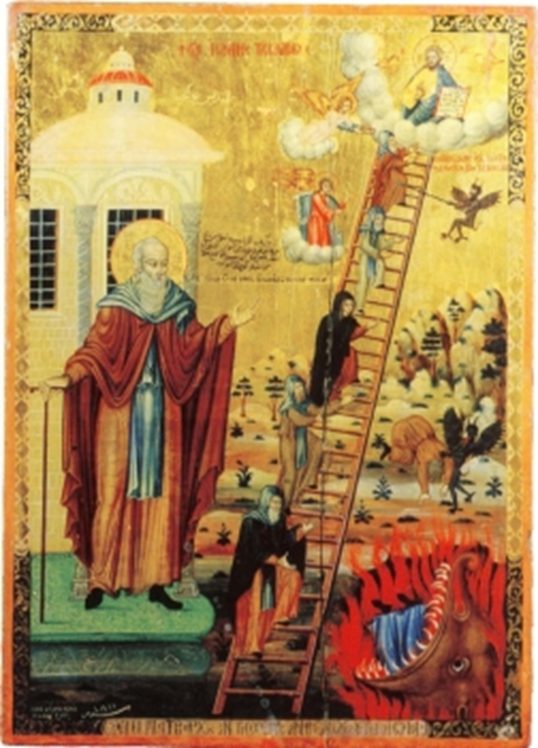
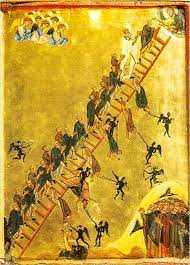
THE LADDER OF DIVINE ASCENT BY JOHN CLIMACUS: On Prayer (step 28)

“Prayer,” John tells us in the beginning of this chapter, “is future gladness, action without end, wellspring of virtues, source of grace, hidden progress, food of the soul, enlightenment of the mind, an axe against despair, hope demonstrated, sorrow done away with.”  This stream of lyrical metaphors establishes an important theme: prayer is not a discrete act, strictly confined to a specific place and time.  It is nourishment to our souls; the personal experience of God’s presence which can dwell ceaselessly within us.

John leads us to gradually deeper stages of prayer from simply keeping physical prayer routines to transforming your entire life into ceaseless prayer.

The first step is to prepare for prayer through purification:   

The beginning of prayer is the expulsion of distractions from the very start by a single thought.

Prayer is tarnished when we stand before God, our minds seething with irrelevancies. It disappears when we are led off into useless cares. (p.277)

Distractions from mundane cares and seething passions are likened to imprisonment, keeping us from the shining freedom achieved through prayer.

If you are clothed in gentleness and in freedom from anger, you will find it no trouble to free your mind from captivity (p. 276)

Simplicity and submission are the antidotes to distraction: “Pray in all simplicity,” John tells us. ”Avoid talkativeness lest your search for just the right words distracts you.” In fact, “when a man has found the Lord, he no longer has to use words when he is praying …”

You truly pray when you ask for understanding of His and submerge your  ego to it.   “While we are still in prison, let us listen to him who told Peter to put on the garment of obedience, to shed his own wishes and, having been stripped of them, to come close to the Lord in prayer, seeking only His will.

The Fire that Resurrects Prayer

It is easy to forget that prayer is a gate to the presence of God and begin to see our daily prayer rituals as chores or even disruptions to our busy lives. John reminds us that prayer is not an opportunity to make requests but a reward unto itself as a vehicle for uniting with God. 

“What have I longed on earth besides you? Nothing except to cling always to you in undistracted prayer!”

The stage of unity of God is not one of passive submission but of spiritual transformation. John uses the metaphor of fire to describe it: “When fire comes to dwell in the heart,” he says, “it resurrects prayer.”

Such an ecstatic state is not achieved on demand. We live in a time when service or information on demand, anytime, anywhere, is considered our birthright and the natural course of events. Yet, reaching this mystical, prayerful state cannot be achieved through our own efforts and at our chosen time, but only through God’s Grace. This is why when, by God’s Grace, our souls are suddenly gifted with a moment of true prayer, we must not let anything interfere with it. “Do not stop praying as long as, by God’s grace, the fire and the water have not been exhausted (as long as fervor and tears remain), for it may happen that never again in your whole life will you have such a chance to ask for the forgiveness of your sins.

One of the greatest dangers in our time is to look for shortcuts to ecstatic communion with God, replacing the fire of God’s presence in prayer with the superficial “high” of excess or addiction—whether it is drugs, extreme sports, workaholism or other compulsion.  The danger for us, practicing Christians, is to transfer this attitude to our prayer life, seeking “highs” in our prayer and worship experiences and judging their quality of the basis of the emotions we believe we should be feeling.  Forcing the emotions  we think we should be feeling in worship and judging rather than submitting to prayer and worship—leads some to constantly “shop” around for churches or for rapturous worship experiences which, ironically, does not give them the inner stillness needed to truly pray.  

We shouldn’t confuse the fire that is stoked by the labor of ascending the Ladder and emptying ourselves from passions, with artificially induced emotions.  The fire that comes to dwell in the heart and engenders true prayer is achieved through the Grace of God rather than our will and through spiritual warfare. Above all it transforms rather than to simply excite  or entertain us.  

Prayer as Transformation

John places a great deal of weight on the transformative role of prayer. He considers those who emerge from prayer without having experienced [illumination, joy or peace] to have prayed bodily rather than spiritually. “A body changes in its activity as a result of contact with another body. How therefore could there be no change in someone who with innocent hands has touched the Body of God?” 

John, however, is a pragmatist and wants us to at least adhere to the discipline of prayer routines, even when our hearts are closed and are not participating in the prayer. Committing to these routines eventually allows our hearts to follow our bodies.

For those who have achieved the higher level of true prayer, prayer is no longer a distinct activity but a continuous spiritual state.

John tells us that we should aspire to this state of continuous prayers. In is living life as prayer than our lives are transformed. We experience life—even its most insignificant moments or mundane elements —as “as sacrament” (as Schmemann puts it).  Life is lived as whole; there is separation between sacred and secular; worldly and prayer life. We may have a set time for prayer, but we are already prepared for it by “unceasing prayer in [the] soul.”

The Ladder of Divine Ascent by John Climacus:ON HUMILITY (Step 25)

Do you imagine that plain words can precisely or truly or appropriately or clearly or sincerely describe the Love of the Lord, humility, blessed purity, divine enlightenment, fear of God and assurance of the Heart?” John asks at the beginning of this chapter. “If you think so,” he continues, “then you will be like a man who, with words and examples, tries to convey the sweetness of honey to those who never tasted it.” And this is how John introduces us to a virtue that is the foundation of all others and the antidote to all passions.  

In this chapter we are ascending the top rungs of the ladder. We have battled destructive passions and are now concentrating on acquiring virtues. We are entering a deeper level of communion with God that cannot be easily captured in words or images. True humility can only be experienced.  It is a treasure that “eludes adequate description,” we are told. “Humility is a grace of the soul and with a name known only to those who have had experience of it.” It cannot be acquired through persuasion.  Neither, as John tells us, can it be learned from books, men or angels but only from Christ who dwells inside of us.  

The path to humility is long and achieved through the same stages all spiritual travelers pass through on their journey: Purification, Illumination and Theosis.  While it different for each of us, the destination is the same. “The appearance of this sacred vine is one thing in the winter of passions, another in the springtime of flowering and still another in the harvest time of all the virtues.” Yet all stages have one thing in common: joy and signs of the harvest to come.

A Parent of young children among us asked whether the path to humility posed a dilemma to parents today. Do we guide our children toward humility and detachment or toward aggressiveness and competitiveness, she wanted to know. Aren’t these two necessary for career success?  We decided that there was no contradiction there.  Ascending the Ladder is not a path to weakness but to inner strength.

The struggle, perseverance and discipline it takes to go against our very nature and seize control from destructive passions nurtures true inner strength.  Conversely being controlled by passions and disguising pride, envy or fear under superficial aggressiveness sap our strength and soul. Living in Christ and guided by virtues rather than torn by passions is the strong foundation on which everything else, including academic or professional achievements, can be built and sustained.

THE LADDER OF DIVINE ASCENT BY JOHN CLIMACUS: The Things that Deaden our Soul

The conventional understanding of “sin” is that of transgression of very concrete rules and laws.

This is how Wikipedia defines it:

Among some scholars, sin is understood mostly as legal infraction or contract violation of non-binding philosophical frameworks and perspectives of Christian ethics, and so salvation tends to be viewed in legal terms.

It continues with the relational definition of sin:

Other Christian scholars understand sin to be fundamentally relational—a loss of love for the Christian God and an elevation of self-love…

Hesychasts built on the relational definition of sin but delved to an unprecedented depth into the effects of the loss of love of God. In this sense, their profound understanding of the intricacies of the human soul, and the difference between healthy and unhealthy spiritual states, predates psychology and the steps to mental health that behavioral psychology espouses.

In step 18, St. Johns talks about insensibility “that is, deadening of the soul and the death of the mind before the death of the body.”

Have you had moments when the horrors shown on TV stir up indignation but do not touch your heart or bring tears to your eyes? Or when you are shocked to realize that at a particular moment, while you know you love your family, your heart is closed, and your feelings are frozen?  The Ladder recognizes these moments of spiritual paralysis and their consequences on our salvation:

 Insensibility both in the body and in the spirit is a deadened feeling, which from long sickness and negligence lapses into loss of feeling.

The word for insensitivity in the original Greek is anaesthisia—the same root as in “unaesthetic;” – loss of sensation, deadening of the senses.

Αναισθησία και στα σώματα και στις ψυχές είναι απονεκρωμένη αίσθησις, η οποία από χρονία ασθένεια και αμέλεια κατέληξε να αναισθητοποιηθή.

St. John forces us to face the consequences of insensitivity. Occasional insensitivity will become a habit causing “benumbed thought; the birth of presumption; a snare for zeal; the noose of courage; ignorance of compunction; a door to despair; the mother of forgetfulness, which gives birth to loss of the fear of God. And then she becomes the daughter of her own daughter.”

Insensitivity, constant sleepiness or dullness often hides a deeper attempt to escape into fantasy, apathy and sloth so we will have to face and engage with reality.  Alertness, on the other hand, gives us a fighting chance to resist evil and withstand misfortune.  It gives us clarity of mind and full presence in the moment to discern the glory of God all around us.

A state of alertness, John tells us, “is a quenching of lust, deliverance from fantasies in dreams, a tearful eye, a heart made soft and gentle, thoughts restrained  food digested , passions tamed spirits subdued, tongue controlled, idle imaginings banished.”

Without alertness, our life slips through our fingers like a dream, and we are unable to be in the presence of God.

How many times are we absent from our own lives in mental and emotional “sleepiness?”  Maybe we are too tired to engage with our family, opting to lay half- asleep in front of the TV with a bottle of beer. Or our minds are so cluttered with lists of chores to be done, worries about our next day’s presentation  at a meeting,  anger about perceived insults, that we barely take note of the beautiful spring day outside. Our senses and feelings have been so dulled that while we register others’ pains and sufferings and sympathize in our minds, our hearts cannot be engaged no matter how much we try to push our feelings. 

Indulging in sleep or, as John calls it, a state of somnolence is “stealing half our life time or more.”  

Alertness is focus; sharpness; full presence in the moment; a kind of spiritual transparency that allows God to enter unencumbered.

Fear (step 21) is another thief of souls. St. John, calls it “unmanly… a childish disposition in an old, vainglorious soul.”

Fear of course stems from focusing on what might happen in the future and prevents us from living life in the present. St. John goes further, however, to link fear with pride and vainglory.

If we didn’t think we deserved more than we had, we would not be afraid of loss. If we did not live to gain others’ acceptance and impress them with our wealth, position, looks and other material things, we would not spend our days in fear of rejection, disrespect or humiliation. If we think that we, alone, can battle to save ourselves, fear can grow into despair.

Cowardice is a falling away from faith that comes of expecting the unexpected. Fear is a rehearsing of danger beforehand; or again, fear is a trembling sensation of the heart, alarmed and troubled by unknown misfortunes. Fear is a loss of conviction. A proud soul is a slave of cowardice; it vainly trusts in itself and is afraid of any sound or shadow of creatures.

THE LADDER OF DIVINE ASCENT BY JOHN CLIMACUS: STEP 10, SLANDER

We are leaving Philokalia for a while to re-read the Ladder of Divine Ascent by St. John Climacus. With the exception of the Bible, writes Bishop Kallistos Ware in the introduction of this book, there is no other book as influential and foundational for Orthodox spirituality as the Ladder of Divine Ascent by St. John Climacus. While addressed to monastics, it embodies the transformational journey that all Christians are capable of, and have a right to, from the tumult of passions and fragmentation to wholeness, inner stillness and unity with God.

On Slander: Step 10

At first glance, it is easy to assume that we already know the topic of this chapter. “What’s there to say? Slander is bad. We get it!”  Yet, as always, we are humbled by the twists and brand-new insights that St. John brings to the topic, making it new.

Curiously, John doesn’t address the propriety of the act or its effect on others. He concentrates on its root causes of slander—hatred, self- love, hypocrisy, brooding over past injuries, contempt for others, and desire for self-promotion– and emphasizes their destructive effect on our souls.  

What is insidious about slander is the ease with which it can masquerade its intentions as innocent or even noble, hiding their dark underside: “I am only criticizing you out of love.”  “It doesn’t bother me at all that you are fat. I strongly believe that all sizes are beautiful. I am just so concerned for your health.”  John calls it:  “a leech in hiding and escaping notice.”    

Being tempted by slander should serve as a warning sign for us; an opportunity to examine our own soul rather than compile lists of others’ flaws. 

Think of the first thoughts that come to mind before you resort to slander —focusing on someone’s flaws, remembering offenses against you, reliving a moment of humiliation over and over again until you are livid with “justifiable” anger,” honing and practicing smart and revengeful responses against “offenders.” You can hardly contain yourself. You are bursting with the desire to share your anger with others and get their support for the condemnation of the offender.

While by slandering others we may achieve a few seconds of relief and a sense of superiority, we are left wallowing in self- justification, seething at perceived offenses and stuck in isolation from others.

John calls for restraint at the first impulse to focus on others’ flaws and offenses against us.  We should, instead, redirect our attention to ourselves.  What do these thoughts of slander say about our own state of mind and the passions simmering in our heart?  Are we lashing out at someone to avoid the pain of facing the reality of our sins?

“Those who pass speedy and harsh judgments on the sins of their neighbors,” John tells us, “fall into this passion because they, themselves, have failed to achieve a complete and unceasing memory of and concern for their sins. Anyone untrammeled by self- love and able to see his own faults for what they are would worry about no one else in this life.”

What are our lives like when we have rid ourself of the need to slander and removed the underlying causes?  We are told that our hearts would then be open to love, effortlessly and immediately by looking for the good in others rather than judging and probing to identify the bad. 

The temptation to slander stems from the temptation to look for, and focus on, flaws rather than virtues.  It implies a spiritual state of inner turmoil, discontent and ingratitude that makes it difficult to achieve the humility to repent.

You cannot “mix judgement of others with the desire to repent.”

If we are prone to slander, we have put ourselves in automatic judgment mode, maintaining a sense of control but keeping love at bay.

As St. John tells us, “a charitable and grateful mind  takes careful notes of the virtues it observes in another while the fool goes looking for faults and defects.”

He gives the example of the grape picker.

“A good grape picker chooses to eat ripe grapes and does not pluck what is unripe. A charitable and sensible mind takes careful note of the virtues it observes in another, while the fool goes looking for faults and defects…Do not condemn. Not even if your very eyes are seeing something, for they may be deceived.”

The tendency to slander implies a mind constantly holding itself above others and ensconced in anger and ingratitude.

Again, John focuses on the offender rather than the offended showing that the path of judgment and slander of others leads to spiritual death.

They searched out iniquity and died in the search ( ps. 63:7

THE LADDER OF DIVINE ASCENT BY JOHN CLIMACUS. STEP 7

We are leaving Philokalia for a while to re-read the Ladder of Divine Ascent by St. John Climacus. With the exception of the Bible, writes Bishop Kallistos Ware in the introduction of this book, there is no other book as influential and foundational for Orthodox spirituality as the Ladder of Divine Ascent by St. John Climacus. While addressed to monastics, it embodies the transformational journey that all Christians are capable of, and have a right to, from the tumult of passions and fragmentation to wholeness, inner stillness and unity with God.

Mourning as Gateway to Life

We live our lives trying to minimize discomfort and avoid sorrow. We consider our happiness, safety, achievements, comfort and others’ respect as our indisputable rights. This shared worldview makes sense to us.

The world seen through the eyes of God, however,  applies a different kind of logic that turns the logic of the world upside down.  If you think that modern schools of thought, like nihilism or deconstructionism, are revolutionary, think again.

Mourning, John tells us in the beginning of this chapter, could be a melancholy of the soul, an anguished heart; futile longing for something that will never be obtained.  This sounds logical to us. But then John suggests a different possibility for viewing it. “Alternatively,” he tells us: “mourning is a golden spur within a soul that has been stripped of all bonds and ties, set by holy sorrow to keep watch over the heart.” (p. 136, Penguin edition)

What does this mean? Instead of spelling it out, John relies on a series of paradoxes to gradually reveal its significance and implications. True mourning is the gateway to love and freedom, while the single-minded pursuit of bodily pleasures leads to emptiness and despair. Mourning, paradoxically,

We live our lives trying to minimize discomfort and avoid sorrow. We consider our happiness, safety, achievements, comfort and others’ respect as our indisputable rights. This shared worldview makes sense to us.

The world seen through the eyes of God, however,  applies a different kind of logic that turns the logic of the world upside down.  If you think that modern schools of thought, like nihilism or deconstructionism, are revolutionary, think again.

Mourning, John tells us in the beginning of this chapter, could be a melancholy of the soul, an anguished heart; futile longing for something that will never be obtained.  This sounds logical to us. But then John suggests a different possibility for viewing it. “Alternatively,” he tells us: “mourning is a golden spur within a soul that has been stripped of all bonds and ties, set by holy sorrow to keep watch over the heart.” (p. 136, Penguin edition)

What does this mean? Instead of spelling it out, John relies on a series of paradoxes to gradually reveal its significance and implications. True mourning is the gateway to love and freedom, while the single-minded pursuit of bodily pleasures leads to emptiness and despair. Mourning, paradoxically, cleanses us and opens our hearts so that delight and a spirit of celebration arrive unexpectedly to fill our daily lives. Conversely those who pursue shallow pleasures through indulgence, glory or material goods can never satisfy their thirst and are led to despair. Achievement and status can only bring about shallow, inauthentic and passing moments of pleasure if we have not acknowledged, and repented for, the destructive passions that still weigh on our souls. Contrition paves the way to real, deep and unforced joy.

Groans and sadness cry out to the Lord, trembling tears intercede for us and the tears shed out of all holy love show that our prayer has been accepted.” P. 137

Mourning is not antithetical to joy. Surprisingly, those unable to mourn cannot experience true, inner joy.

The man who mourns constantly in a way that pleases God does not seize to celebrate daily, but tears without end are in store for him who him who does not abandon bodily celebration. P. 140

Mourning requires humility; surrender of the heart to God rather than intellectual understanding of Him.  Theology and mourning do not go together, according to John. One sits on a professorial chair and the other “passes his days in rags on a dung heap.”   Christ did not teach us from the heights and safety of heaven. He became one of us and willingly experienced the full extent of suffering as a man to save us.  Through mourning we go from talking the talk to walking the walk, and from the head to the heart.

Mourning is, in fact, a gateway to life.

“If you find yourself unable to mourn, then lament that very fact,” John tells us. 

This is a powerful image and a stunning possibility to contemplate. Can you imagine living without the capacity for empathy that would allow you to be touched by others’ struggles and experience love and sorrow for them? Or being unable to experience regret and, hence, to find redemption and experience transformation?  This is why the ability to mourn is a gift:

True mourning penetrates the depths of our soul, freeing us from the need to show off, control or yearn for wealth and prestige that block us from openness to love and union with God:

 He who has the gift of spiritual tears will be able to mourn anywhere. But if it is all outward show, there will be no end to his discussion of places and means.

Tears alone do not constitute mourning, however. There are, in fact, good tears and  bad tears. We may cry because of a sense of entitlement and self-pity for lacking the rewards we feel entitled to.  Or good tears may turn into bad tears when we become proud of them and feel superior to others.

Silly men take pride in their tears, and this is why some are not granted the gift of mourning…”  When mourning is deep-rooted, it leaves no room for efforts to garner raise or reap rewards from God. Paradoxically, this is exactly when Christ comes uninvited to a heart that is open and cleansed through mourning.

Mourning, John tells us, is freedom from passions and anguish, a state of humility and inner stillness, an experience of love and union with God and man.   

 When the heart is filled with sorrow and weeps, it is full of tenderness and all this without having striven for it. …”the Lord has arrived uninvited and is holding out to us the sponge of loving sorrow, the cool waters of blessed sadness with which to wipe away the sadness of our sings.