THE LADDER OF DIVINE ASCENT BY JOHN CLIMACUS

Step 4 On blessed and ever-memorable obedience
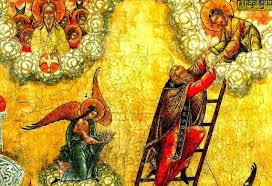
Having renounced the world, St. John asks us to renounce ourselves in order to ascend the next rung in the Ladder.

Obedience is absolute renunciation of our own life, clearly expressed in our bodily actions.

How can we, as modern men and women, view the concept of obedience which is such a fundamental requirement to your ability to ascend the Ladder? After all, questioning authority, challenging boundaries and deconstructing received truths are part of the definition of the modern hero. Are we called to dutifully obey all those with authority over us? Is our ideal self, someone like Dilbert, mindlessly performing menial tasks and unable to form a single thought independently? Are there limits to obedience? Should you obey an abusive husband or boss for example? Or comply with the requests of someone whose judgment is impaired?

To grasp the meaning of “obedience” in ascetic life, we must first drop all familiar associations.

Let’s first consider the context. “Obedience” in ascetic spirituality refers to the relationship of a monastic to his spiritual director. Hence, obedience is exercised within an agreed upon relationship and assumes a consensual framework. Without mutual agreement and consent you have tyranny rather than obedience. For example, spiritual directors use their authority on those who have willingly entered the monastery and, hence, have already accepted a life of obedience. Conversely, the directors have accepted responsibility for guiding the souls of those in obedience to them, to lead them to salvation.

Christianity is practiced in community. No man is an island.

The concept of obedience is not alien to the modern world. The journey of healing in all 12-step and similar programs that fight addiction begins with humility and obedience. You must admit that you are powerless over a habit or addiction and seek a guide for your recovery journey. The concept of mentorship exists in multiple realms of   life—from sports to business, artistic and trade apprenticeships.

Mother Raphaela, of the Holy Myrrhbearers monastery points out that the roots of the word “obedience” are in the Latin obaudire which means to listen. In that sense, relationships between husband and wife, parents and children are built on a construct of obedience in that they all involve mutual “listening” — mutual obligations and responsibilities for the salvation of the relationship rather than the fulfillment of one’s own will.

Ironically, as in the case of detachment, obedience becomes a gateway to freedom by releasing us from the tyranny of our own will. Self-will, which we often mistake for freedom, tethers our lives to the unceasing need to control and impose on others our script for how the world should run. It usually results in conflict, disappointment and bitterness as the world constantly falls short of our expectations. St. John shows us that faith and trust are gateways to obedience:

Obedience is the tomb of the will and the resurrection of humility…You who are therefore trying to lay your own burden on Another’s shoulders, you who are hastening to sign a pledge that you are voluntarily surrendering yourself to slavery, and in return want freedom written to your account, you who are being supported by the hands of others as you swim across this great sea—

Levels of Obedience and Surrender

To show us how obedience becomes the bridge to salvation, St. John tells a story as an example.

A repentant robber seeks to enter a monastery John was visiting. As a prerequisite to being admitted, the Abbott asks him to confess his sins before the brothers as an indication of his penitence. The robber complies, but the Abbot is still not convinced of the sincerity of his repentance. The robber next dons a hair shirt and ashes, has his hands tied behind him and appears humbled before 230 brothers at the monastery. The Abbot knows that, while he said the right things, he has not yet experienced true mourning. Eager to be admitted, the robber raises the bar and offers to confess his sins in the middle of the city square as an indication of his humility. Yet the Abbott still does not deem him worthy of admission. Suddenly, struck by a new awareness of his sins and filled with remorse, the robber drops to the ground, sheds real tears and confesses all his sins (pp. 94-95}. At that moment, he is probably not even worrying about the impression he  makes on the Abbot or what he has to do to convince him. I picture him so crushed by a fresh awareness of the magnitude of his sins and the state of his soul that he has no interest in impressing others. The Abbott recognizes the sincerity of his repentance and admits him.

He later explains to St. John his reasons for making the robber wait for that long: had he admitted him before the robber fully faced his past and repented with his whole heart, he would have doomed him to a life of torment with his past sins still dwelling in him unresolved, and gnawing at his soul. Another consideration, the Abbot continued, was the opportunity to give an example to the brothers.

This pastor understood that public confession or displays of humility did not go far enough to render the robber completely transparent to God and the brothers. True repentance has to engage the heart completely without a shred of deception or attempts to hold back.

How often do we think we have forgiven or accepted something, mistaking what is only intellectual understanding for deep commitment of the heart? During moments when we are suddenly able to peel the last layer of the onion of our consciousness and our hearts are touched by love or grief, we just know it. There are no doubts or ambiguities; and the world looks different, even for a moment, as we experience it authentically.

The Abbot recognized that the robber’s repentance had not yet reached the heart and pushed him to the fullness of being through surrender to true mourning. Yet it was obedience–the robber’s willingness to put his complete trust in the pastor and dig deeper into his soul than he thought necessary-that enabled salvation and forgiveness.

This is the ideal of obedience. We do not achieve salvation alone and on our terms, but through communion with others and, especially, relationships bound by obedience to a spiritual director.

THE LADDER OF DIVINE ASCENT BY JOHN CLIMACUS

STEP #3: EXILE

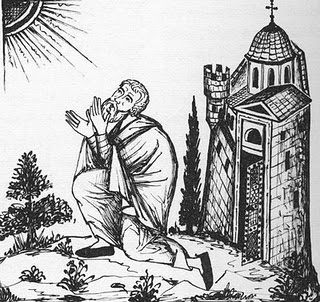
The concept of exile takes us even beyond renunciation and detachment.

Exile goes beyond just leaving material things behind. It is a state of mind and manner of living in which “we live “a hidden life, an invisible intention, unseen meditation, desire for humiliation, longing for hardship, constant determination to love God, abundance of charity, renunciation of vainglory, depth of silence.”

Exile is not the result of anger, bitterness, or despair.

 It is not from hatred that we separate ourselves from our own people or places (God forbid!), but to avoid the harm which might come to us from them.

“Exile” means having a hidden life that is so different than the lives of most others, that we feel like we are speaking a foreign language.

He is an exile who, having knowledge, sits like one of foreign speech amongst people of another tongue.

An exile is a fugitive from every attachment to his own people and to strangers.

This is a step that seems difficult to put into practice because it requires us to renounce relationships that are precious to us. However, let’s consider than St. John addressed monks. Let us also consider that such texts employ narrative conventions we would call rhetorical exaggerations to make the point of their critical importance.

How do we apply these principles?

We are asked not to “associate with people of the world or approach them.” He admonishes us that even our “attachment either to some particular relative or to strangers is dangerous. Little by little it can entice us back to the world, and completely quench the fire of our contrition.”

It seems extreme but isn’t this what AA and other addiction treatment programs advise? The first step is humility in recognizing that you are powerless over substances, things, feeling, behavior, or people you have an unhealthy attachment to. Having recognized that you are vulnerable to temptation, you deliberately avoid it. You stop going to bars, hanging out with those addicted to alcohol, drugs, or unhealthy behavior. You change your habits and way of thinking step by step.

A state of exile grows out of our admission of vulnerability. In other words, it requires humility.

We have no problem in understanding physical addiction, yet isn’t sin an addiction—a state when passions drive your life and you are no longer in control of your body and soul?

St. johns advies:

“Run from places of sin as from the plague, for when fruit is not present, we have no frequent desire to eat it.”

The hardest part for us to accept is the need to renounce your family.

Look, beware, lest you be exposed to the deluge of sentiment through your attachment to the things of your home, and all that you have be drowned in the waters of earthly affection. Do not be moved by the tears of parents or friends; otherwise you will be weeping eternally. When they surround you like bees, or rather wasps, and shed tears over you, do not for one moment hesitate, but sternly fix the eye of your soul on your past actions and your death, that you may ward off one sorrow by another.

Monastics, of course, must leave their family behind and renounce the world. Yet St. John is not asking us to literally hate and abandon our families but to prioritize our values. Christians are asked to love God above all else.

The last step in the Ladder of Divine Ascent is faith, hope and love. Once you have achieved this ultimate level of complete union of God, you are capable of true love, not sentimental or romantic love. You are in a state of inner stillness in which we can truly see, listen to and love others.

Putting God first does not mean abandoning the children but, for example, facilitating their salvation rather than pushing them to pick the most prestigious college or job or to succeed a level above their peers,

St. John advises us to note the temptations that come with a life of exile. Among us is the danger of feeling so superior that we consider it our job to teach and save others.

In trying to save the careless and indolent along with themselves, many perish with them, because in course of time the fire goes out. As soon as the flame is burning within you, run; for you do not know when it will go out and leave you in darkness. Not all of us are required to save others. The divine Apostle says: ‘Each one of us shall give account of himself to God.’4 And again he  says: ‘Thou therefore who teachest another, teachest thou not thyself?’1 This is like saying: I do not know whether we must all teach others; but teach yourselves at all costs.

In pursuing exile, John advises us to avoid extremes. He also wants us to understand that the state of inner freedom that exile brings about, can also elicit passions such as pride and contempt for others. He stresses the need for humility in acknowledging our own weaknesses and vulnerabilities. Such acknowledgment of our powerlessness justifies the sacrifices he is asking for.

SPIRITUAL KNOWLEDGE: ST. PETER OF DAMASKOS

(Philokalia Vol. III, G.E.H Palmer, Philip Sherrard, Kallistos Ware)

We are born, St. Petter writes, with an innate spiritual knowledge which we later lose through passions.

What is the meaning of spiritual knowledge then?

It is the ability to see things as they really are in nature, to uncover the mystery that lies beyond appearance and physical attributes.

The intellect then sees things as they are by nature ….by others it is called spiritual insight, since he who possesses it knows something at least of the hidden mysteries- that is, of God’s purpose- in the Holy Scriptures and in every created thing.

Passions, however, “darken the intellect” and confine us to the surface of things.

Living on the surface is easily exhaustible. We burn through material things, praise, career milestones etc., rapidly. We are, thus, on a frantic course of constantly replenishing the supply and yet, for many of us, a sense of emptiness remains.

The Greeks had an extraordinary understanding of the physical and intellectual realm, we are told, yet they lacked spiritual knowledge, defined here as the discernment of purpose.

Without understanding purpose, one cannot penetrate the true meaning of all things.

…for the pagan Greeks perceived many things but, as St Basil the Great has said, they were unable to discern God’s purpose in created beings, or even God Himself, since they lacked the humility and the faith of Abraham.

Viewed through the lens of spiritual insight, then, nothing is insignificant and worthless. Nothing is dismissible.  Nothing is empty. Even a crumb of bread or a boring daily routine points to a larger meaning and purpose.

 (God’s purpose) is clearly revealed in the world to come, when everything hidden is disclosed.

A significant difference between Christian and other types of meditative traditions is that the true meaning of things cannot be deciphered through our own resources and will not be revealed without faith.

The gnostic ought not to rely in any way on his own thoughts, but should always seek to confirm them in the light of divine Scripture or of the nature of things themselves. Without such confirmation, there can be no true spiritual knowledge, but only wickedness and delusion.

God and his purpose are there to be discovered—ensconced in simple and lofty things alike, in humble daily discourse and scriptural writings. All we have to do is rid ourselves of passions, assumptions and obsession with our self-interest so we can be filled with spiritual knowledge and allow for the revelation to occur.

We have all seen little children’s wonder-filled eyes as they explore the world with hope, faith and awe. Everything is new, sacred, and filled with unending mysteries and delights. Even a speck of dust is a source of wonder and reveals to them something about a vast and unknown world. This is the state of innocence we must achieve in order to be filled with spiritual knowledge.

Peter expounds on the meaning of faith. It is, he says, going beyond the visible to extrapolate the invisible.

A person is said to have faith when, on the basis of what he can see, he believes in what he cannot see.

Yet, discerning hidden mysteries is not enough if you lack faith in their creator. “But to believe in what we can see of God’s works is not the same as to believe in Him who teaches and proclaims the truth to us.

Faith must proceed from the head to the heart. According to St. St. Peter, it is through suffering that one acquires faith, then fear, then awe, then gratitude and humility and, finally, true spiritual knowledge.  

In this way, the person who in faith endures these trials patiently will discover, once they have passed, that he has acquired spiritual knowledge, through which he knows things previously unknown to him, and that blessings have been bestowed on him. As a result, he gains humility together with love both towards God, as his benefactor, and towards his fellow-men for the healing wrought by God through them.

PATIENCE AND ENDURANCE: St. Peter of Damaskos

(Philokalia Vol. III, G.E.H Palmer, Philip Sherrard, Kallistos Ware)

When I look for an urgent answer or solution, my double “A” personality often kicks in. There have been times when, in my impatience for an immediate answer, I stayed up until dawn, doing Google research, drawing diagrams, or making lists. Even if I become exhausted and unproductive, I am sure that if I just persist a little more, I can get results within my timeline.  

How much of our inner peace do we sacrifice, in our efforts to force our agenda and sense of timing on the universe?

St. Peter advises that we apply “conscious awareness of our own hearts” to discern God’s perspective and free ourselves from the frantic pressure to bring about the results we want, when we want them.

Harmonizing our will with God’s brings about patience and endurance. Patience and endurance are not simply two of many virtues. They are, instead, the preconditions for possessing our soul. If fact, St. Peter believes that “you come into yourself when you endure with patience.”

Without patient endurance, we live in turmoil, burdened by the idea that unless we force results, nothing worthwhile will happen in our lives. We are riddled with anxiety, uncertainty, and lack of clarity as our passions obscure the true nature of things.

How many tears would I like to shed whenever I gain even a partial glimpse of myself! If I do not sin, I become elated with pride; while if I sin and am able to realize it, in my dismay I lose heart and begin to despair. If I take refuge in hope, again I become arrogant. If I weep, it feeds my presumption; if I do not weep, the passions visit me again… In my ignorance all things seem contradictory, and I cannot reconcile them.

Patience is living in God’s infinite time. It is abandoning the futile struggle of forcing our temporal time frame on a God-created universe. It is acquiring humility to put aside our own assumptions; and discernment to understand the connecting links among things that appear contradictory.

Patient endurance is not a solitary virtue but the result of a transformative process that begins with faith and fear of God. As we no longer see ourselves as the center of the world, we experience awe, humility, clarity of vision, gratitude, and inner stillness.

For if such endurance is not born in the soul out of faith, the soul cannot possess any virtue at all.

The working assumptions for most of us are that we acquire and increase knowledge through our own efforts, feel justifiable pride in it, receive recognition for it and continue to ascend levels of accomplishment until we become “experts” or wise. It thus becomes easy to judge others, become anxious about winning arguments and impose our opinions which we “know” to be wiser than others.’  

St. Peter, and other desert fathers, turn this value system on its head. Spiritual knowledge begins with acknowledgment of ignorance and the recognition of the need of God’s grace.  

For this reason it is good to say ‘I do not know’, so that we neither disbelieve what is said by an angel nor place credence in what occurs through the deceitfulness of the enemy.

Giving up the pressure of forcing results and timelines, judging, impressing, and dominating others frees us from impatience. We now live in God’s time, realizing that experience and insight may take years, rather than hours or days, and that we cannot achieve anything on our own without God’s grace.

We may wait for many years until the answer is given us, unsolicited and unperceived, in the form of some concrete action- as someone has put it with reference to the contemplation of created beings. In this way we reach the haven of active spiritual knowledge. When we see this knowledge persisting in us over many years, then we will understand that truly we have been heard and have invisibly received the answer.