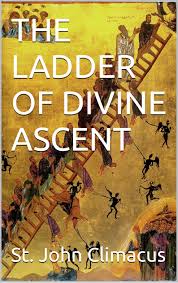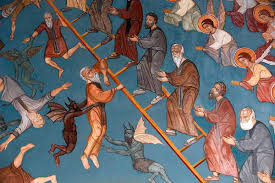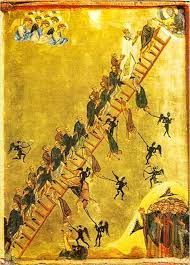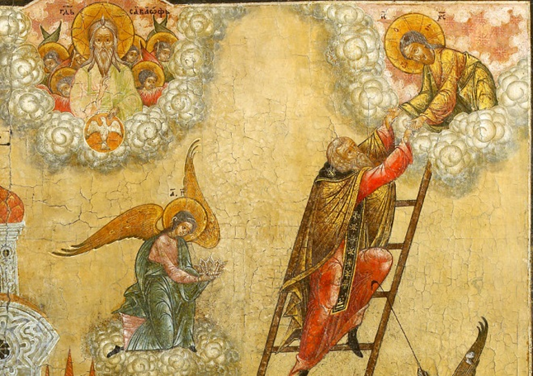
THE LADDER OF DIVINE ASCENT BY JOHN CLIMACUS: On Stillness (Step 27)

We are like purchased slaves, like slaves under contract to unholy passions” John writes in the beginning of the chapter.   The metaphor compares lives filled with passions to slavery.  John’s mastery of the human soul shows another, more insidious dimension of this slavery—the longer we stay in it the less we desire freedom because we can neither remember nor imagine what freedom looks, feels and tastes like.  Isn’t it why abused wives, addicts or abusers stay in destructive relationships, even though the right choice seems so logical and simple to those on the outside?  Abuse, violence and dysfunction become the norm after a while, and they can no longer remember or envision what health looks    like.

Not so long ago, I would have been dismissive of anything resembling silence.  How boring! Who would actually pursue it?  For most of us, living with noise and inner clutter is all we have known and defines normal. The Fathers, however, considered the practice of inner stillness an essential foundation of spiritual life.  Being silent is not the same as practicing inner silence. You can be quiet on the outside but tortured by the constant noise of racing thoughts and lingering resentments on the inside. 

Metropolitan Jonah defines inner stillness as “conscious communion’ with God.” He continues: “Inner stillness is not merely emptiness. It is a focus on the awareness of the presence of God in the depths of our heart. One of the essential things we have to constantly remember is that God is not out there someplace. He’s not just in the box on the altar. It may be the dwelling place of His glory. But God is everywhere. And God dwells in the depths of our hearts. When we can come to that awareness of God dwelling in the depths of our hearts, and keep our attention focused in that core, thoughts vanish.

How do we do this? In order to enter into deep stillness, we have to have a lot of our issues resolved. We have to have a lot of our anger and bitterness and resentments resolved. We have to forgive. If we don’t we’re not going to get into stillness, because the moment we try our inner turmoil is going to come vomiting out. This is good – painful, but good. Because when we try to enter into stillness and we begin to see the darkness that is lurking in our souls, we can then begin to deal with it. It distracts us from trying to be quiet, from trying to say the Jesus Prayer, but that’s just part of the process. And it takes time.”

John emphasizes the role of despondency in preventing us from union with God. To achieve stillness, we must be driven by love for God and the desire to experience the joy and sweetness of his presence. This spiritual state requires that any trace of despondency be shed from our soul. “For to link despondency to the loving of God,” John writes, “is rather like committing adultery.

John talks about the clarity we achieve through inner stillness and silence:  ‘Stillness of the soul is the accurate knowledge of one’s thoughts and is an unassailable mind.”  He writes:

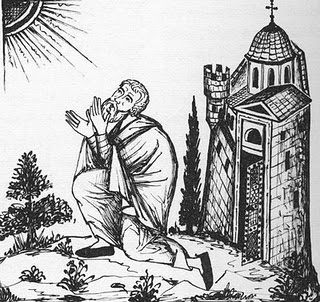
 “The start of stillness is the rejection of all noisiness as something that will trouble the depths of the soul….Close the door of your cell to your body, the door of your tongue to talk, and the gate within to evil spirits.” Yet being quiet or away from noise in nature does not necessarily imply stillness. Inner stillness is practiced “in the deep spaces of the heart.” 

When you have arrived at the” final point,” however, fear and rejection of noisiness are no longer concerns because you are immune to them and cannot even detect them.
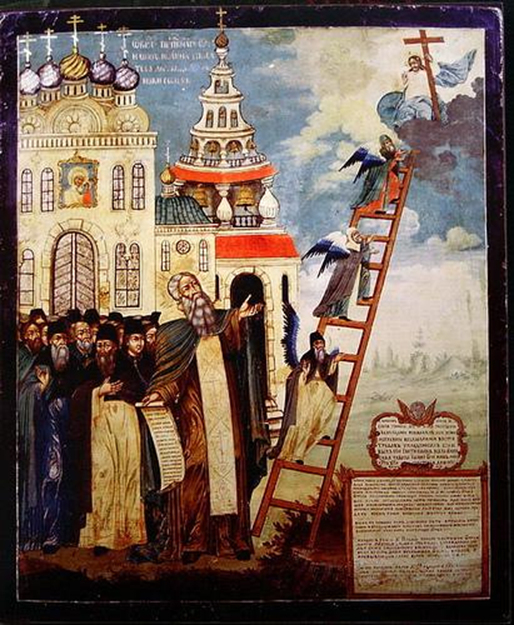
The Ladder of Divine Ascent by John Climacus: ON DISCERNMENT (Step 26)


Acquiring virtues, rung by rung in the Ladder, is not a simple, linear act. In this chapter, John explores the complexity of virtues; the thin and changeable boundaries that sometimes barely distinguish them from passions.  We have reached a higher level of spiritual growth at this stage that requires more than fighting passions—the understanding of the nuances of truth and the ability to clarify even the subtlest shades of ambiguity. This is why discernment, in addition to hard labor, is necessary at this rung of the Ladder. John highlights some of ambiguities and nuances of situations we should be aware of.

For one thing, the struggle for spiritual ascent is not uniform. John recognizes that virtues like silence, humility and temperance may come easily to some personalities while others have to struggle against their own natures to achieve them. Because the latter clearly have to work harder, John (somewhat reluctantly) considers their achievement to be a little higher than the others’.

Another complexity is that virtue is often mingled with malice and requires discernment and alertness to detect the dividing line between them. Love may conceal lust; hospitality, gluttony; discernment, cunning manipulation of a situation; hope, laziness; tranquility, despondency. To make this message clearer, John likens it to drawing water from a well and accidentally bringing up a frog with it. 

Over-achievement of virtues or pursuing them to earn praise is a grave danger that is no different from  the soul-destroying addictions of our own times–obsession with achievement and professional status; addictions to ambitions that turn us into workaholics; and lives spinning out of control by stretching our budgets, habits or expectations beyond what we can afford or deliver, plunging us into constant anxiety, fear and, eventually, despair.

John probes even more deeply into the risks of delusion and calls for extraordinary and finely hewn ability for discernment. “Monks should spare no effort in becoming a shining example in all things,” he states. Yet even when reaching for heaven we may be in danger of spreading ourselves too thinly, and “have our wretched souls be pulled in all directions, to take on, alone, a fight against a thousand upon thousands and ten thousands upon ten thousands of enemies, since the understanding of their evil workings, indeed even the listing of them, is beyond our capacities.”   I can’t imagine a more accurate description of men and women in our time–the modern professional, driven executive or ambitious soccer mom with a management agenda for her children’s lives.  The alternative is to discern God’s will for the right balance. “Instead, let us marshal the Holy Trinity to help us” John advises. Yet it takes humility to give us the discernment to acknowledge the reality of our limitation and need for God’s help.  And it takes patience to discern God’s will:

Discernment will also help us make a crucially important distinction—that between God’s will and timing and delusion and false timing, forced by our own will. “If God, who made dry land out of the sea for the Israelites to cross, dwells within us, then the Israel within us, the mind that looks to God, will surely make a safe crossing of this sea…”  And John adds:  if God “has not yet arrived in us, who will understand the roaring of the waves, that is, of our bodies?   Let’s pray for God to dwell in us and for humility to discern his will.

THE LADDER OF DIVINE ASCENT BY JOHN CLIMACUS: The Things that Deaden our Soul

The conventional understanding of “sin” is that of transgression of very concrete rules and laws.

This is how Wikipedia defines it:

Among some scholars, sin is understood mostly as legal infraction or contract violation of non-binding philosophical frameworks and perspectives of Christian ethics, and so salvation tends to be viewed in legal terms.

It continues with the relational definition of sin:

Other Christian scholars understand sin to be fundamentally relational—a loss of love for the Christian God and an elevation of self-love…

Hesychasts built on the relational definition of sin but delved to an unprecedented depth into the effects of the loss of love of God. In this sense, their profound understanding of the intricacies of the human soul, and the difference between healthy and unhealthy spiritual states, predates psychology and the steps to mental health that behavioral psychology espouses.

In step 18, St. Johns talks about insensibility “that is, deadening of the soul and the death of the mind before the death of the body.”

Have you had moments when the horrors shown on TV stir up indignation but do not touch your heart or bring tears to your eyes? Or when you are shocked to realize that at a particular moment, while you know you love your family, your heart is closed, and your feelings are frozen?  The Ladder recognizes these moments of spiritual paralysis and their consequences on our salvation:

 Insensibility both in the body and in the spirit is a deadened feeling, which from long sickness and negligence lapses into loss of feeling.

The word for insensitivity in the original Greek is anaesthisia—the same root as in “unaesthetic;” – loss of sensation, deadening of the senses.

Αναισθησία και στα σώματα και στις ψυχές είναι απονεκρωμένη αίσθησις, η οποία από χρονία ασθένεια και αμέλεια κατέληξε να αναισθητοποιηθή.

St. John forces us to face the consequences of insensitivity. Occasional insensitivity will become a habit causing “benumbed thought; the birth of presumption; a snare for zeal; the noose of courage; ignorance of compunction; a door to despair; the mother of forgetfulness, which gives birth to loss of the fear of God. And then she becomes the daughter of her own daughter.”

Insensitivity, constant sleepiness or dullness often hides a deeper attempt to escape into fantasy, apathy and sloth so we will have to face and engage with reality.  Alertness, on the other hand, gives us a fighting chance to resist evil and withstand misfortune.  It gives us clarity of mind and full presence in the moment to discern the glory of God all around us.

A state of alertness, John tells us, “is a quenching of lust, deliverance from fantasies in dreams, a tearful eye, a heart made soft and gentle, thoughts restrained  food digested , passions tamed spirits subdued, tongue controlled, idle imaginings banished.”

Without alertness, our life slips through our fingers like a dream, and we are unable to be in the presence of God.

How many times are we absent from our own lives in mental and emotional “sleepiness?”  Maybe we are too tired to engage with our family, opting to lay half- asleep in front of the TV with a bottle of beer. Or our minds are so cluttered with lists of chores to be done, worries about our next day’s presentation  at a meeting,  anger about perceived insults, that we barely take note of the beautiful spring day outside. Our senses and feelings have been so dulled that while we register others’ pains and sufferings and sympathize in our minds, our hearts cannot be engaged no matter how much we try to push our feelings. 

Indulging in sleep or, as John calls it, a state of somnolence is “stealing half our life time or more.”  

Alertness is focus; sharpness; full presence in the moment; a kind of spiritual transparency that allows God to enter unencumbered.

Fear (step 21) is another thief of souls. St. John, calls it “unmanly… a childish disposition in an old, vainglorious soul.”

Fear of course stems from focusing on what might happen in the future and prevents us from living life in the present. St. John goes further, however, to link fear with pride and vainglory.

If we didn’t think we deserved more than we had, we would not be afraid of loss. If we did not live to gain others’ acceptance and impress them with our wealth, position, looks and other material things, we would not spend our days in fear of rejection, disrespect or humiliation. If we think that we, alone, can battle to save ourselves, fear can grow into despair.

Cowardice is a falling away from faith that comes of expecting the unexpected. Fear is a rehearsing of danger beforehand; or again, fear is a trembling sensation of the heart, alarmed and troubled by unknown misfortunes. Fear is a loss of conviction. A proud soul is a slave of cowardice; it vainly trusts in itself and is afraid of any sound or shadow of creatures.

THE LADDER OF DIVINE ASCENT BY JOHN CLIMACUS: ON TALKATIVENESS & DESPODENCY (Steps 11 and 13)

Have you ever felt like you had to keep talking, not because you enjoyed it, but because you saw it as your responsibility to fill any awkward gaps of silence in the conversation? Or because you couldn’t stand the thought that someone may have been unaware of your accomplishments or your expertise on a topic?  Or because you were sure that if you persisted long enough, you would eventually be able to persuade the other person that you were right?  

In these situations, you usually know on some level that your motives are not just to communicate but to avoid becoming vulnerable or to make sure you are not ignored, disrespected or undervalued.  This is why  you feel listless or anxious and may leave a gathering with a sense of emptiness or exhaustion rather than the satisfaction of having connected with another human being.

Talkativeness, St. John tells us, is a grievous offense. Preoccupation with what we say and should say does not leave us with enough inner silence to be able to listen. It squanders our resources outward; strips us from inner peace and blocks spiritual nourishment leaving us vulnerable to despair.  Like gluttony, talkativeness is an addiction; and like all addictions, it drives and controls the “talker,” rather than be controlled by him. Once you abandon self- discipline and the dike bursts open through what John calls “a relaxed lifestyle,” it is very difficult to mend the hole and stem the flood.  As John says:

“It is hard to keep water in without a dike.”  

No wonder John calls talkativeness “the darkening of prayer” and gateway to despondency.

Why is it that talkativeness leads to despondency? Talkativeness, John tells us, encourages the talker to dwell on destructive trains of thought such as recollections of wrongs or bragging.  Compulsive talking can easily evolve into gossip or slander; tempt us to boast, lie or deceive in efforts to impress or manipulate others. 

Despondency or tedium of the spirit,” according to John, is “the paralysis of the soul.” We remain frozen and in limbo as we constantly procrastinate about what is important—reciting the psalms, praying, helping someone, connecting with others, loving and empathizing, doing our share of work. Instead of getting to our tasks, we distract ourselves with unimportant trivia.

I remember my compulsion to cook and clean the house when I was having a hard time starting the first chapter of my dissertation. This was my way of postponing a task that seemed to me insurmountable at the  time.

Despondency implies the loss of all hope, according to St. John. “It is a voice claiming that God has no mercy and no love for man.” 

Have you ever had the dream of being unable to finish your packing to get to the airport on time for your flight?  In my version of this dream, instead of focusing on how to reduce my load to expedite my trip, I feel compelled to bring the entire contents of a hotel room, filled to the brim with clothes and toys. Each time I think I am done with packing, I discover yet another enormous quantity of clothes and toys behind a closet door or in a drawer, that needs to be  packed.

I lose all hope of catching my flight, but I continue with the impossible task of stuffing a household worth of stuff into my suitcase without an end in sight.

The cure to my anguish would have been to exercise self-control and pack lightly, with only what was absolutely necessary .

For John the solution to spiritual tedium is the remembrance of death and past sins so that we can clearly perceive what is important and necessary and, thus, apply restraint.

The man who mourns for himself does not suffer from tedium

THE LADDER OF DIVINE ASCENT BY JOHN CLIMACUS: STEP 10, SLANDER

We are leaving Philokalia for a while to re-read the Ladder of Divine Ascent by St. John Climacus. With the exception of the Bible, writes Bishop Kallistos Ware in the introduction of this book, there is no other book as influential and foundational for Orthodox spirituality as the Ladder of Divine Ascent by St. John Climacus. While addressed to monastics, it embodies the transformational journey that all Christians are capable of, and have a right to, from the tumult of passions and fragmentation to wholeness, inner stillness and unity with God.

On Slander: Step 10

At first glance, it is easy to assume that we already know the topic of this chapter. “What’s there to say? Slander is bad. We get it!”  Yet, as always, we are humbled by the twists and brand-new insights that St. John brings to the topic, making it new.

Curiously, John doesn’t address the propriety of the act or its effect on others. He concentrates on its root causes of slander—hatred, self- love, hypocrisy, brooding over past injuries, contempt for others, and desire for self-promotion– and emphasizes their destructive effect on our souls.  

What is insidious about slander is the ease with which it can masquerade its intentions as innocent or even noble, hiding their dark underside: “I am only criticizing you out of love.”  “It doesn’t bother me at all that you are fat. I strongly believe that all sizes are beautiful. I am just so concerned for your health.”  John calls it:  “a leech in hiding and escaping notice.”    

Being tempted by slander should serve as a warning sign for us; an opportunity to examine our own soul rather than compile lists of others’ flaws. 

Think of the first thoughts that come to mind before you resort to slander —focusing on someone’s flaws, remembering offenses against you, reliving a moment of humiliation over and over again until you are livid with “justifiable” anger,” honing and practicing smart and revengeful responses against “offenders.” You can hardly contain yourself. You are bursting with the desire to share your anger with others and get their support for the condemnation of the offender.

While by slandering others we may achieve a few seconds of relief and a sense of superiority, we are left wallowing in self- justification, seething at perceived offenses and stuck in isolation from others.

John calls for restraint at the first impulse to focus on others’ flaws and offenses against us.  We should, instead, redirect our attention to ourselves.  What do these thoughts of slander say about our own state of mind and the passions simmering in our heart?  Are we lashing out at someone to avoid the pain of facing the reality of our sins?

“Those who pass speedy and harsh judgments on the sins of their neighbors,” John tells us, “fall into this passion because they, themselves, have failed to achieve a complete and unceasing memory of and concern for their sins. Anyone untrammeled by self- love and able to see his own faults for what they are would worry about no one else in this life.”

What are our lives like when we have rid ourself of the need to slander and removed the underlying causes?  We are told that our hearts would then be open to love, effortlessly and immediately by looking for the good in others rather than judging and probing to identify the bad. 

The temptation to slander stems from the temptation to look for, and focus on, flaws rather than virtues.  It implies a spiritual state of inner turmoil, discontent and ingratitude that makes it difficult to achieve the humility to repent.

You cannot “mix judgement of others with the desire to repent.”

If we are prone to slander, we have put ourselves in automatic judgment mode, maintaining a sense of control but keeping love at bay.

As St. John tells us, “a charitable and grateful mind  takes careful notes of the virtues it observes in another while the fool goes looking for faults and defects.”

He gives the example of the grape picker.

“A good grape picker chooses to eat ripe grapes and does not pluck what is unripe. A charitable and sensible mind takes careful note of the virtues it observes in another, while the fool goes looking for faults and defects…Do not condemn. Not even if your very eyes are seeing something, for they may be deceived.”

The tendency to slander implies a mind constantly holding itself above others and ensconced in anger and ingratitude.

Again, John focuses on the offender rather than the offended showing that the path of judgment and slander of others leads to spiritual death.

They searched out iniquity and died in the search ( ps. 63:7

THE LADDER OF DIVINE ASCENT BY JOHN CLIMACUS: STEP 8

We are leaving Philokalia for a while to re-read the Ladder of Divine Ascent by St. John Climacus. With the exception of the Bible, writes Bishop Kallistos Ware in the introduction of this book, there is no other book as influential and foundational for Orthodox spirituality as the Ladder of Divine Ascent by St. John Climacus. While addressed to monastics, it embodies the transformational journey that all Christians are capable of, and have a right to, from the tumult of passions and fragmentation to wholeness, inner stillness and unity with God.

 On Placidity and Meekness (step 8)

As the gradual pouring of water on a fire puts out the flame completely so the tears of genuine mourning can extinguish every flame of anger and irascibility.”  This is how step 8 begins as the natural continuation of the previous step on mourning.

Meekness for me used to imply failure! People who let others step on them! Starting with my early teens, I scorned anything that resembled meekness, moderation, timidity, quietness.  I defined myself through rebellion and excess. Unlike the faceless “meek” that stay in their little boxes, I was going to change the world and defy categories.  Little did I know then that the appearance of strength does not signify true, inner strength! Quite the contrary! Keeping up the trappings of strength and power and avoiding quietude through noise—outrage, anger, talkativeness—are often indications of fear and emptiness.

Meekness for St. John and other ascetics most certainly does not imply weakness. On the contrary, while anger is “an easily changed movement of one’s disposition” and the “disfigurement of the soul,” meekness is a “permanent condition;” unaffected by either praise or insult. It is, in fact, “a triumph of one’s nature.” This is the most profound and insightful differentiation I have seen.  Anger, however noble or justifiable we want to believe it is, is “movable;” something you can neither rely on nor control. It is a flash in time; a reaction rather than action, lacking permanence and substance. Meekness, on the other hand, is a hard-won spiritual state that deliberately, rather than reactively, cultivates virtues and resists temptations that threaten the inner stillness it has created. The difference between anger and meekness that John conjures up is one between a spoiled baby and a highly trained Olympic athlete.  Clearly he does not use the term to signify weakness.

There is a practical, “how to” dimension in John’s Ladder that is rooted in deep understanding of human psychology and the depths of the soul. He knows that, even as we desire the inner stillness of meekness, it will go against engrained habits and we will resist it. This is why he reminds us continuously that virtues are achieved in stages in a lifelong spiritual warfare and walks us through the steps.  First he advise us to learn how to keep “the lips silent when the heart is stirred” – go through the motions even if your heart is not yet open to it. Once you achieve this, the next step is to also “keep your thoughts silent when the soul is upset.”  Reaching the next and final step is when you are so unaffected by anger that your soul isn’t even stirred by insult or injustice against you.  

Vainglory, conceit, remembrance of past wrongs, self-justification, hate are among the passions that stir anger.  Yet, “just as darkness retreats before light, so all anger and bitterness disappear before the fragrance of humility,” John writes.   Meekness is the foundation on which we can anchor the virtue of humility. We will know that we have fully ascended the step of meekness when, instead of anger at someone who caused us harm, we feel compassion and love. Unless we root out anger and replace it with meekness and humility, there will simply be no space for the Holy Spirit to enter. 

THE LADDER OF DIVINE ASCENT BY JOHN CLIMACUS

STEP 4B

Since Lent has started, we are pausing our studies in Philokalia for a while to re-read the Ladder of Divine Ascent by St. John Climacus. With the exception of the Bible, writes Bishop Kallistos Ware in the introduction of this book, there is no other book as influential and foundational for Orthodox spirituality as the Ladder of Divine Ascent by St. John Climacus. It embodies the transformational journey that all Christians are capable of, and have a right to, from the tumult of passions and fragmentation to wholeness, inner stillness and unity with God. We use the edition, translated by Colm Luibheid and Norman Russell. Note, however, that my quotes are from a different, online translation. You can order the book from Amazon.

______________________________________________________________

In step #4, St. John brings up examples of obedience that are  jarring to the modern sensibility.

On a visit to a monastery, for example, St. John notices a monk, called Abbacyrus, who  is ill-treated and humiliated by all other monks. He has lived in the monastery for 17 years under this obedience. When asked about his apparent  sufferings, the monk responds joyfully that he  is thankful to God and the other monks for his humiliation and is  certain that the goal was to benefit his soul. He explains that during these 17 years, he has never had to battle the demons. The benefit of such state of peace is worth the  pain.

John mentions yet another example of extreme obedience. A monk named Macedonius, falsely confesses sins that he had not committed so he can gain humility through his subsequent punishment.  When John asks him why he is pursuing such a humiliating course of life, he responds:

Never’, he assured me, ‘have I felt in myself such relief from every conflict and such sweetness of divine light as now. It is the property of angels,’ he continued, ‘not to fall, and even, as some say, it is quite impossible for them to fall. It is the property of men to fall, and to rise again as often as this may happen. But it is the property of devils, and devils alone, not to rise once they have fallen.’

“Blessed is the monk who regards himself as hourly deserving every dishonour and disparagement,” St. John concludes… “He who will not accept a reproof, just or unjust, renounces his own salvation.”

Nothing could be more diametrically opposite to the secular point of view that equates “winning” with success in imposing our will. Our delusion stems from our belief  that we make the world (our children, home or workplace) right when we impose on them our sense of order. This belief burdens us with self-imposed responsibility. Instead of experiencing inner stillness we are constantly “on call” – judging, criticizing, maneuvering, controlling and, often conflicting with, others.

John asks us to compare the perceived extremity of total obedience with the extremity of anxiety in lives driven by our will and passions.

This anxiety has become such an intrinsic part of our daily lives that we are barely aware of it. Think about the latent unrest we experience at most moments of our lives, which we have come to perceive as “normal.”

In conversations we can hardly wait for someone of a different view to finish so we can insert our own opinion and set everyone straight. We can’t relax in the act of truly listening  because we are silently constructing brilliant responses. We are constantly scanning our environment to ascertain that we and our family are well perceived by others. We are quick to identify and respond to any possible sign of disapproval, disrespect, slander, or injustice against us. We are drowning in activities—kids’ sports, conferences, meetings, social events where we can meet people of influence, opportunities for being visible and influential. Not that any of these things are inherently bad of course. Yet driven by our will and desire to control, such impulses dominate. We can never experience inner peace.               

To achieve the goal of stillness of the soul, St. John advises meditation and restraint.

Control your wandering mind in your distracted body. Amidst the actions and movements of your limbs, practise mental quiet (hesychia). And, most paradoxical of all, in the midst of commotion be unmoved in soul. Curb your tongue which rages to leap into arguments. Seventy times seven in the day wrestle with this tyrant… Gag your mind, overbusy with its private concerns, and thoughtlessly prone to criticize and condemn your brother, by the practical means of showing your neighbour all love and sympathy.

Obedience means that you relinquish your role as the ruler of the word, the need to always manipulate, impress, control, come into conflict with others or talk over them to assert yourself or your universe will collapse.

Fix your mind to your soul as to the wood of a cross to be struck like an anvil with blow upon blow of the hammers, to be mocked, abused, ridiculed and wronged, without being in the least crushed or broken, but continuing to be quite calm and immovable. Shed your own will as a garment of shame, and thus stripped of it enter the practice ground. Array yourself in the rarely acquired breastplate of faith, not crushed or wounded by distrust towards your spiritual trainer.

THE LADDER OF DIVINE ASCENT BY JOHN CLIMACUS

STEP #3: EXILE

The concept of exile takes us even beyond renunciation and detachment.

Exile goes beyond just leaving material things behind. It is a state of mind and manner of living in which “we live “a hidden life, an invisible intention, unseen meditation, desire for humiliation, longing for hardship, constant determination to love God, abundance of charity, renunciation of vainglory, depth of silence.”

Exile is not the result of anger, bitterness, or despair.

 It is not from hatred that we separate ourselves from our own people or places (God forbid!), but to avoid the harm which might come to us from them.

“Exile” means having a hidden life that is so different than the lives of most others, that we feel like we are speaking a foreign language.

He is an exile who, having knowledge, sits like one of foreign speech amongst people of another tongue.

An exile is a fugitive from every attachment to his own people and to strangers.

This is a step that seems difficult to put into practice because it requires us to renounce relationships that are precious to us. However, let’s consider than St. John addressed monks. Let us also consider that such texts employ narrative conventions we would call rhetorical exaggerations to make the point of their critical importance.

How do we apply these principles?

We are asked not to “associate with people of the world or approach them.” He admonishes us that even our “attachment either to some particular relative or to strangers is dangerous. Little by little it can entice us back to the world, and completely quench the fire of our contrition.”

It seems extreme but isn’t this what AA and other addiction treatment programs advise? The first step is humility in recognizing that you are powerless over substances, things, feeling, behavior, or people you have an unhealthy attachment to. Having recognized that you are vulnerable to temptation, you deliberately avoid it. You stop going to bars, hanging out with those addicted to alcohol, drugs, or unhealthy behavior. You change your habits and way of thinking step by step.

A state of exile grows out of our admission of vulnerability. In other words, it requires humility.

We have no problem in understanding physical addiction, yet isn’t sin an addiction—a state when passions drive your life and you are no longer in control of your body and soul?

St. johns advies:

“Run from places of sin as from the plague, for when fruit is not present, we have no frequent desire to eat it.”

The hardest part for us to accept is the need to renounce your family.

Look, beware, lest you be exposed to the deluge of sentiment through your attachment to the things of your home, and all that you have be drowned in the waters of earthly affection. Do not be moved by the tears of parents or friends; otherwise you will be weeping eternally. When they surround you like bees, or rather wasps, and shed tears over you, do not for one moment hesitate, but sternly fix the eye of your soul on your past actions and your death, that you may ward off one sorrow by another.

Monastics, of course, must leave their family behind and renounce the world. Yet St. John is not asking us to literally hate and abandon our families but to prioritize our values. Christians are asked to love God above all else.

The last step in the Ladder of Divine Ascent is faith, hope and love. Once you have achieved this ultimate level of complete union of God, you are capable of true love, not sentimental or romantic love. You are in a state of inner stillness in which we can truly see, listen to and love others.

Putting God first does not mean abandoning the children but, for example, facilitating their salvation rather than pushing them to pick the most prestigious college or job or to succeed a level above their peers,

St. John advises us to note the temptations that come with a life of exile. Among us is the danger of feeling so superior that we consider it our job to teach and save others.

In trying to save the careless and indolent along with themselves, many perish with them, because in course of time the fire goes out. As soon as the flame is burning within you, run; for you do not know when it will go out and leave you in darkness. Not all of us are required to save others. The divine Apostle says: ‘Each one of us shall give account of himself to God.’4 And again he  says: ‘Thou therefore who teachest another, teachest thou not thyself?’1 This is like saying: I do not know whether we must all teach others; but teach yourselves at all costs.

In pursuing exile, John advises us to avoid extremes. He also wants us to understand that the state of inner freedom that exile brings about, can also elicit passions such as pride and contempt for others. He stresses the need for humility in acknowledging our own weaknesses and vulnerabilities. Such acknowledgment of our powerlessness justifies the sacrifices he is asking for.

THE LADDER OF DIVINE ASCENT BY JOHN CLIMACUS

With Lent coming, we are leaving Philokalia for a while to re-read the Ladder of Divine Ascent by St. John Climacus.

With the exception of the Bible, writes Bishop Kallistos Ware in the introduction of this book, there is no other book as influential and foundational for Orthodox spirituality as the Ladder of Divine Ascent by St. John Climacus.

While addressed to monastics, it embodies the transformational journey that all Christians are capable of, and have a right to, from the tumult of passions and fragmentation to wholeness, inner stillness and unity with God.

We use the edition, translated by Colm Luibheid and Norman Russell. Note, however, that my quotes are from a different, online translation.

You can order the book from Amazon.

STEP ONE

Like all journeys, the Ladder of Divine Ascent consists of many steps. St. John divides our journey into 30 small steps, which he describes and helps us climb one-by-one.

With his help we travel gradually from detachment and renunciation to the acquisition of fundamental virtues, the struggle against passions and finally the cultivation of dispassion and acquisition of inner stillness. When we reach at the top of the summit, we can directly experience the love of God and become God-like.

The first step, before our real climb even begins, is renunciation of the material world as we know it: our dependence on things, indulgences, addictions to passions, assumptions that close our hearts and minds.

Those who enter this contest must renounce all things, despise all things, deride all things, and shake off all things, that they may lay a firm foundation.

St. John’s audience, of course, is other monks who have chosen to leave the world and live a life of prayer. Yet renunciation is not negation but purification. Its three pillars according to St. John are “innocence, fasting and temperance.” They do not describe a simple deficit but the shedding of artifice and the return to a child-like nature:

Let all babes in Christ begin with these virtues, taking as their model the natural babes. For you never find in them anything sly or deceitful. They have no insatiate appetite, no insatiable stomach, not a body on fire…

Hence the return to a child-like state, free from passions and anxiety is possible for all of us.

Why would a citizen of the 21st century want to deprive himself/herself in an age when self-gratification and actualization are inalienable rights? In the hesychastic (and more broadly, Christian) worldview, material gratification and abandon in passions result in slavery of the soul. Renunciation, on the other hand, paradoxically leads to freedom.

The book’s preface quotes St. Augustine as he puts forth a vision of a life in which we are in union with God.

Imagine a man in whom the tumult of the flesh goes silent, in whom the images of earth, of water, of air and of the skies cease to resound. His soul turns quiet and, self-reflecting no longer, it transcends itself. Dreams and visions end. SO too does all speech and every gesture, everything in fact which comes to be only to pass away. All these things cry out: “We did not make ourselves. It is the Eternal One who made us.”

This is the vision that makes the journey worthwhile.

Unlike other meditative traditions, the journey up the ladder is enabled by faith and love. Why would you even want to undertake such a challenging journey without this motivation, John asks?

5. All who have willingly left the things of the world, have certainly done so either for the sake of the future Kingdom, or because of the multitude of their sins, or for love of God. If they were not moved by any of these reasons their withdrawal from the world was unreasonable. But God who sets our contests waits to see what the end of our course will be.

Our journey is not a willful adventure but a disciplined process that can only be undertaken under the guidance of a spiritual father. This journey, hence, should be driven by humility rather than certainty in our own knowledge and abilities.

In the patristic mindset, life is a constant spiritual warfare and the forces of evil and darkness are real and ever present.

We have very evil and dangerous, cunning, unscrupulous foes, who hold fire in their hands and try to burn the temple of God with the flame that is in it. These foes are strong; they never sleep; they are incorporeal and invisible.

The hope for Christians is that “God belongs to all free beings. He is the life of all, the salvation of all—faithful and unfaithful, just and unjust, pious and impious, passionate and dispassionate, monks and seculars, wise and simple, healthy and sick, young and old—just as the diffusion of light, the sight of the sun, and the changes of the weather are for all alike; ‘for there is no respect of persons with God’”. Being God-lie, then, is our heritage to reclaim.

In hesychasm there is a need for direct and personal experience with God. Only through renunciation can we hear God speak to us directly without intermediaries. Renunciation opens the door to the journey of direct communion with Him.

So that we can hear his word, not in the language of the flesh, not through the speech of an angel, not by way of a rattling cloud or a mysterious parable. But Himself. The One Whom we love in everything.

.

SPIRITUAL KNOWLEDGE: ST. PETER OF DAMASKOS

(Philokalia Vol. III, G.E.H Palmer, Philip Sherrard, Kallistos Ware)

We are born, St. Petter writes, with an innate spiritual knowledge which we later lose through passions.

What is the meaning of spiritual knowledge then?

It is the ability to see things as they really are in nature, to uncover the mystery that lies beyond appearance and physical attributes.

The intellect then sees things as they are by nature ….by others it is called spiritual insight, since he who possesses it knows something at least of the hidden mysteries- that is, of God’s purpose- in the Holy Scriptures and in every created thing.

Passions, however, “darken the intellect” and confine us to the surface of things.

Living on the surface is easily exhaustible. We burn through material things, praise, career milestones etc., rapidly. We are, thus, on a frantic course of constantly replenishing the supply and yet, for many of us, a sense of emptiness remains.

The Greeks had an extraordinary understanding of the physical and intellectual realm, we are told, yet they lacked spiritual knowledge, defined here as the discernment of purpose.

Without understanding purpose, one cannot penetrate the true meaning of all things.

…for the pagan Greeks perceived many things but, as St Basil the Great has said, they were unable to discern God’s purpose in created beings, or even God Himself, since they lacked the humility and the faith of Abraham.

Viewed through the lens of spiritual insight, then, nothing is insignificant and worthless. Nothing is dismissible.  Nothing is empty. Even a crumb of bread or a boring daily routine points to a larger meaning and purpose.

 (God’s purpose) is clearly revealed in the world to come, when everything hidden is disclosed.

A significant difference between Christian and other types of meditative traditions is that the true meaning of things cannot be deciphered through our own resources and will not be revealed without faith.

The gnostic ought not to rely in any way on his own thoughts, but should always seek to confirm them in the light of divine Scripture or of the nature of things themselves. Without such confirmation, there can be no true spiritual knowledge, but only wickedness and delusion.

God and his purpose are there to be discovered—ensconced in simple and lofty things alike, in humble daily discourse and scriptural writings. All we have to do is rid ourselves of passions, assumptions and obsession with our self-interest so we can be filled with spiritual knowledge and allow for the revelation to occur.

We have all seen little children’s wonder-filled eyes as they explore the world with hope, faith and awe. Everything is new, sacred, and filled with unending mysteries and delights. Even a speck of dust is a source of wonder and reveals to them something about a vast and unknown world. This is the state of innocence we must achieve in order to be filled with spiritual knowledge.

Peter expounds on the meaning of faith. It is, he says, going beyond the visible to extrapolate the invisible.

A person is said to have faith when, on the basis of what he can see, he believes in what he cannot see.

Yet, discerning hidden mysteries is not enough if you lack faith in their creator. “But to believe in what we can see of God’s works is not the same as to believe in Him who teaches and proclaims the truth to us.

Faith must proceed from the head to the heart. According to St. St. Peter, it is through suffering that one acquires faith, then fear, then awe, then gratitude and humility and, finally, true spiritual knowledge.  

In this way, the person who in faith endures these trials patiently will discover, once they have passed, that he has acquired spiritual knowledge, through which he knows things previously unknown to him, and that blessings have been bestowed on him. As a result, he gains humility together with love both towards God, as his benefactor, and towards his fellow-men for the healing wrought by God through them.