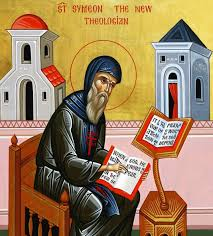
St. Symeon (949–1022), was a monk, thinker and poet, known as the “new theologian.” He spoke about his own mystical experience and believed that all humans had the capacity to ascend the ladder to God and experience his presence directly. In this essay in Philokalia IV, St. Symeon patiently demonstrates to monastics how to uderstand and apply mystical theology to the practicalities of everyday life.
While monks are his immediate audience, his astonishing insights into the human heart and the anxieties and struggles that plague us are highly relevant to us in the times we live.
So how does St. Symeon’s practical theology apply to our daily lives?
Five steps struck me as dominant in this chapter and could be adapted to our own daily lives.
RENUNCIATION
“Renunciation of the world,” St. Symeon says, includes “self-alienation from all material things, from the modes, attitudes and forms of this present life, as well as the denial of one’s own body and will.” It is a tough call, but he believes that it is far better than the alternative because “a person full of anxiety about worldly things is not free. He is dominated and enslaved by this anxiety, whether it is about himself or about others. “
We are not unlike the monks in St. Symeon’s world as we are similarly tormented by constant anxiety, festering resentment, self-pity, emotional or physical addictions, endless speculations about what if and how come that have our mind spinning in circles.
Twelve-step programs modify the concept of monastic renunciation to help addicts and their families achieve emotional detachment from turmoil and destructive urges. The concepts of dispassion and self-restraint are more easily applicable to us.
Detachment and renunciation are not equivalent to indifference or resignation. While the monk’s renunciation frees him from “worldly concerns, he will not be idle, or neglect even the most insignificant and trivial details; but all he does he will do for the glory of God, accomplishing everything in his life without anxiety. “
Those with a loved one who is an addict can empathize, grieve and take action, yet without being drawn into his downward spiral and losing themselves.
REPENTANCE AND TEARS
Symeon stresses the need for repentance as the foundation of a life in Christ and inner peace. It takes humility and detachment to truly see your flaws without justifying and minimizing them. This is why true repentance brings tears, as you become deeply aware of all that was lost through sin.
The tears of repentance are purifying.
For he who through many tears has purified his intellect and has received the illumination of the divine light – light that would grow no less even if everyone received it – will dwell spiritually in the age to come.
TRANSFORMATION
Repentance is much more than an admission of guilt and an apology. It heals only through transformative action– the ability to turn your life around.
For the kingdom of heaven,” St. Symeon says,“ is entered forcibly.
He does not mean forcing your will on others. He is referring, instead, to the force you need to exert on yourself to refrain from falling back into old habits, resist the lure of destructive passions and immediate pleasure, deny the temporary relief of anger, resentment and self-pity and taking on the role of spiritual warrior.
Laziness, then, is not just an annoying or unproductive habit but saps our energy, diminishes hope and gets us stuck on a downward spiral.
49· Bodily listlessness and torpor, which affect the soul as a result of our laziness and negligence, not only make us abandon our normal rule of prayer but also darken the mind and fill it with despondency.
Instead of allowing anxious, self-serving and negative thoughts to overwhelm and define us, we engage in nourishing contemplation and readings, St. Symeon advises.
Transformation affects a powerful reorientation from self to God
LOVE
The ultimate state of one’s ascendance to God is love. Love in Christ goes beyond the relatively easier type of love we may have for our family, friends and those who support and admire us. Christian love recognizes the humanity of all beings, no matter how destructive, and can perceive God’s presence in them under the most repulsive words or actions. .
If you truly love and pray for those who slander and maltreat you, who hate and defraud you, you will make rapid progress, for when your heart is fully aware that this is happening, your thoughts and, indeed, your whole soul with all its three powers are drawn down into the depths of humility and washed with tears.
Symeon asks us to go beyond curtailing our drive to judge and criticize others. He asks us, instead, to look at our peers and superiors as saints and ourselves as sinners.
You should look on all who are in the monastery as saints.
Love rises above even the strictest monastic rules and practices. Even when a monastic is consumed by devotional practices, he can pause his meditation to care for another human being.
If someone wants to contact you, do not spurn him on the grounds that he disturbs your devotions.
Even if someone is fasting, it is better to partake of a meal prepared for him than to hurt another person.
And if someone offers you a rich meal, not realizing that you are fasting, you should eat what is put in front of you, no matter what it is; and take wine with uncomplaining self-restraint.
Yet, this is not the sentimental notion of love as “being nice to all” or trying to please everybody. Instead, St. Symeon applies a type of “tough love.”
Part of our transformative change through repentance is a reorientation by which we abandon our habit of negative thoughts that, over time, become the norm, and replace them with hope, faith and love. We should therefore distance ourselves from those who may derail us from our course.
… you may find yourself hampered by someone who sows tares of despondency. He tries to prevent you from climbing to such heights of holiness by discouraging you with various thoughts…
In the same way, we should not allow a disruptor to derail the course of a well-functioning group.
62. A person false through hypocrisy, or culpable because of his actions, or easily shattered by some passion, or who lapses slightly through negligence, must not be left in the company of those who are working together in harmony. On the contrary, he must be excluded from their society as still corrupt and reprobate. Otherwise at some crucial moment he might break their chain of union, causing division where there should be none and distress both to those who are at the head of the chain – for they will be grieved for those who follow after them – and to those at the tail of the chain, who will suffer because they are cut off from those in front of them.
LIGHT
Without this inner transformation our vision is clouded, and we are unable to see the divine light.
They cannot see the marvels it contains; they regard as deluded those who dwell in that light and see and teach others about what is within it. On the contrary, it is they themselves that are deluded, not having tasted the ineffable blessings of God.
Through renunciation, repentance and love we ascend to a new and higher spiritual space. Our clouded and deluded vision is cleared, and we can now see the divine light.
…if he does this and with unhesitating faith allows himself to be led by those wise in divine matters, he will enter with them into the city of the living God. Guided and illumined by the divine Spirit, he will see and learn what others cannot ever see or learn. He will then be taught by God (cf. John 6 : 45}
 Readings in Philokalia