SURPRISED BY JOY: The Doctrine of Joy in the Works of Nikitas Stithatos

Philokalia, vol. 4, On the Inner Nature of Things and on the Purification of the Intellect

Dispersed through the austere examples of ascetic practice in Stithatos’ texts, there are abundant references to bright and even ecstatic joy.

Stithatos puts a special emphasis on joy, viewing it not as a fleeting emotion but as a profound, consistent spiritual state and one of the essential “fruits of the Holy Spirit.”

He describes several types of joy. For example:

The joy that stems from the practice of virtues: “When our intelligence is perfected through the practice of the virtues and is elevated through the knowledge and wisdom of the Spirit and by the divine fire, it is assimilated to these heavenly powers through the gifts of God, as by virtue of its purity it draws towards itself the particular characteristic of each of them.

      • The joy of dispassion and unity. Shedding our attachments to the material world and its passions is the most essential step in the achievement of theosis. Additionally, Nikitas Stithatos describes a mystical, spiritual reality where the “world above” (the heavenly or noetic realm) awaits its completion and perfection through the spiritual attainment of human beings in the “lower world” (the physical, material world). Instead of being at war with, or separated from, “the world above,” we  view it “as yet incomplete.” We understand that the world “awaits its fulfilment from the first-born of Israel…”  but we also understand our role in this fulfillment which comes “from those who see God,” and “it receives  its completion from those who attain the knowledge of God.”
      • Joy found in the liturgical experience and hierarchical, and liturgical account of the nine heavenly powers.

      The nine heavenly powers sing hymns of praise that have a threefold structure, as they stand in threefold rank before the Trinity, in awe celebrating their liturgy and glorifying God. Those who come first – immediately below Him who is the Source and Cause of all things and from whom they take their origin – are the initiators of the hymns and are named thrones, Cherubim and Seraphim.

      • Theosis: The ultimate joy of inner peace. Joy is an “ineffable” and “incomprehensive happiness” that comes from detachment from worldly passions and the ensuing union with God. This is a core part of the final stage of spiritual life (theosis or deification).

      The desire to experience the “joy and sweetness of His presence” is presented as a driving force for achieving inner stillness, emphasizing that despondency is incompatible with the love of God. This state represents the culmination of the spiritual journey. 

      For those who with the support of the Spirit have entered the fullness of contemplation, a chalice of wine is made ready, and bread from a royal banquet is set before them. A throne is prepared for their repose and silver for their wealth.

      • The joy of hope. Even if we do not experience a state of theosis in this life, we should be comforted by the knowledge that the Kingdom of Heaven will open for us after death. Stithatos enters details of the actual physical process of dying and advises us to learn we should ask that our departure from this life may take place without fear.

      In summary, for Stithatos, joy is a central, essential element of the mature spiritual life, signifying the soul’s harmonious dwelling in God’s presence.

      BECOMING A TREE OF LIFE: Nikitas Stithatos

      Philokalia, vol. 4, On the Inner Nature of Things and on the Purification of the Intellect:

      Nikitas Stithatos paints a lyrical image of the state of theosis, that is, union with God:

      When you have reached this state, you enter the peace of the Spirit that transcends every dauntless intellect (cf.Phil. 4 : 7) and through love you are united to God.”

      Getting there, however, is not a linear path.

      Pride for your spiritual achievements, for example, often creeps in, disrupting contemplation. The tranquility you achieved is shaken as you slip back into wanting to control, draw conclusions and make presumptions on your own. Such self-centered state of mind prevents you from seeing the inner nature of all things through God’s eyes.

      Stithatos makes clear that nothing remains static in this process of spiritual ascendance, including the role of the penitent.

      God does not want us always to be humiliated by the passions and to be hunted down by them like hares, making Him alone our rock and refuge (cf. Ps. 1 04 : 1 8);”

      God, then, wants us to be in a cooperative relationship with him.

      Accordingly, simply resisting the passions is not enough for salvation. Nikitas Stithatos’s emphasis is on the transformation of passions into virtuous energies (rather than their mere annihilation).

      To better illustrate this point, he brings up the metaphor of a deer eating snakes (don’t look for scientific evidence here).

      “But He wants us to run as deer on the high mountains of His commandments (cf. Ps. 1 04 : 1 8. LXX), thirsting for the life creating waters of the Spirit ( cf. Ps. 42 : 1 ). For, they say, it is the deer’s nature to eat snakes; but by virtue of the heat they generate through being always on the move, they strangely transform the snakes’ poison into musk and it does them no harm. In a similar manner, when passion-imbued thoughts invade our mind, we should bring them into subjection through our ardent pursuit of God’s commandments and the power of the Spirit, and so transform them into the fragrant and salutary practice of virtue. In this way we can take every thought captive and make it obey Christ ( cf. 2 Cor. 1 o : 5).”

      The spiritual application follows the deer analogy:

      The Process of Transformation given by Stithatos

      • Invasion of Thoughts: “Passion-imbued thoughts” will inevitably enter the mind [1]. The goal is not necessarily to avoid these thoughts entirely, but to actively confront them.
      • Active Subjection: Through “ardent pursuit of God’s commandments and the power of the Spirit,” the negative thoughts are engaged and brought “into subjection” [1].
      • Spiritual Alchemy: The “poison” of the passion is not just neutralized; it is “transformed them into the fragrant and salutary practice of virtue” [1]. The energy of the passion, when channeled correctly through spiritual discipline, becomes something positive and holy (musk).

      Free will, then, is not passive but has agency of its own to discern,  edit, re-direct and transform.

      This “dynamic path” is a key feature of the broader Eastern Orthodox concept of theosis, which involves a synergistic process of human effort and divine grace.

      The state of passivity or action, surface or depth depends on the level of engagement we have with God.

      Simply disciplining the body is not sufficient for achieving theosis. It is literal and one-dimensional. Yet, “we are meant for more than we can literally imagine,” writes Stithatos. Remaining on the surface–Christians in name only– means that we are simply treading water and we will experience no progress:

      A person who keeps turning round and round on the same spot and does not want to make any spiritual progress is like a mule that walks round and round a well-head operating a water-wheel.”

      Becoming one with God in every way is not achieved simply by adhering to technical details.

      In the book, Everywhere Present, by Stephen Freeman, the central metaphor is the contrast between a “two-storey” and a “one-storey” universe. The “two-storey” view, which Freeman argues is the prevailing mindset in secular society, relegates God and all spiritual matters to an unreachable “upstairs” realm. This effectively banishes God from everyday existence, making faith a distant, theoretical concept. The “one-storey universe,” in contrast, recognizes that God is “everywhere present and filling all things” in the here and now.

      This metaphor bears similarity to Stithatos’ contrast between passivity and total engagement, running in circles and ascending upwards.

      Freeman’s book advocates for a faith that changes how one perceives and interacts with the entire world and sees God’s presence in all things.  

      Stithatos’ path to theosis is similarly a transformative process by which a veil is lifted, and we can suddenly see the world around us with new eyes. We are able to discern God’s presence under the surface of even the most insignificant things and, hence, comprehend their true essence.

      But true devotion of soul attained through the spiritual knowledge of created things and of their immortal essences is as a tree of life within the spiritual activity of the intellect

      FROM DREAM TO REVELATION

      Nikitas Stithatos

      Philokalia, vol. 4, On the Inner Nature of Things and on the Purification of the Intellect:

      The understanding of dreams serves as an entry point for Stithatos’s broader mystical philosophy of theosis, the gradual process of becoming more like God. This transformation unfolds in three distinct stages: dreams, visions, and revelations.

      1. Dreams: The First Step of Purification
      • There is a direct correlation between who we are and what we dream. If we are attached to material things, for example, we will dream of possessions. If we are addicted to praise and success, we may dream of ourselves in powerful positions, dominating others and being admired.
      • A virtuous life produces peaceful dreams. We rise from bed filled with  peace, gratitude and the living presence of God
      • However, Stithatos notes that even these purified dreams are imperfect. They are produced by the “image-forming faculty of the intellect,” which is mutable and thus unreliable.

      2. Visions: Beyond the “Image-Forming Intellect”

      • Moving beyond dreams, the soul can experience visions. Unlike the fleeting images of dreams, visions are constant and unchanging, leaving an unforgettable imprint on the intellect.
      • These visions reveal future events, inspire the soul with awe and engender a sense of repentance.

      3. Revelations: Union with the Divine

      • The final, and most advanced, spiritual stage is that of revelations. With a purified and illuminated soul, an individual can transcend ordinary sense perception and understanding.
      • It is like a veil has been lifted and we can perceive the true, inner essence of things that lie beneath the surface. We are no longer separated from God,  so we are whole and free from struggle, conflict and contradiction. We have advanced beyond words and images to become God-like and perceive His hidden mysteries. Everything now makes sense, and  we understand the ultimate purpose of all things, and our own role in God’s creation.

      Stillness as the path to Theosis

      Those who achieve visions and revelations are no longer troubled by everyday anxieties and concerns. This allows them to achieve a state of inner stillness, which is a prerequisite for theosis.

      Reaching this state of stillness requires restraint, conquering our will and triumphing  over our own impulses. The path of the monk or nun—involving fasting, poverty, and other forms of ascetic discipline — is one example of a complete surrender of the passions. For modern readers, asceticism can seem unrealistic or off-putting, but its core principle is highly relevant: gaining control over our passions and “addictions” rather than being controlled by them, and achiving inner peace.

      Without restraint, our will to succeed, possess, indulge, gain status, receive praise and approval, control or defeat drives us.  

      We use external things to quell our inner fears and anxieties: we abuse substances, become workaholics, become dependent on others’ approval, and chase success at all costs. We sacrifice inner peace and contentment for perceived material success, becoming addicted to external gains and desires.

      In this state, Stithatos writes, our true, God-given soul is “disordered” and at war with itself, unable to receive divine grace.

      A passionate soul, like a leaf in the wind, is unstable. It is elated by praise and success but devastated by criticism and failure. Stillness is the antithesis of this instability. It is “an undisturbed state of the intellect, the calm of a free and joyful soul.”

       In stillness, however, since our contentment is no longer dependent on external factors, we experience an “unwavering stability of the heart in God.”

      The Result of Stillness
      Freed from the inner battle, our perception becomes clear. We can ascend from contemplating visible things to a profound apprehension of the divine, eventually transcending images, words, and thoughts to achieve complete union with God. The pure intellect, having internalized divine principles, then reflects God’s wisdom, uncovering the deeper mysteries of creation.

      Starting with dreams of things visible we ascend to the ever-increasing apprehension of things until we reach beyond images, words and thoughts to become united with God.

      When the intellect has interiorized these principles and revelations and made them part of its own nature, then it will elucidate the profundities of the Spirit to all who possess God’s Spirit within themselves, exposing the guile of the demons and expounding the mysteries of the kingdom of heaven.

      A RADICAL REDEFINITION OF SELF IN GOD

      Nikitas Stithatos

      Philokalia, vol. 4, On the Inner Nature of Things and on the
      Purification of the Intellect:
      One Hundred Texts

      What does Stithatos mean by knowledge of oneself? How is it achieved?

      For Socrates knowledge of oneself is a rational examination of strengths, weaknesses, values and limitations.

      Stithatos, however, peels away all the known assets of selfhood. You are NOT your innate strengths and weaknesses, profession or life choices, he tells us. External circumstances beyond your control—praise, wealth, misfortune, or social status—have no bearing on your true self.

      So, what remains of us then? How can there be “self” outside our values, actions, thoughts, successes and failures?

      I struggled with my understanding of self in this passage. I kept waiting for a clear definition of what constitutes the authentic core of myself and how to find it.   

      Instead, Stithatos offers a radical redefinition of self and our knowledge of it.  He shows that true self can only be experienced and not described.  Since we are made in the image of God, it is only through union with Him that we know ourselves.

      Without uniting ourselves to God, we are locked in our ego-centric perception of the world, and we are unable to fully give of ourselves to Him and our fellow human beings.

      Surely, we have all experienced the demon of distraction, even in things and situations we deeply value.  We catch ourselves missing entire chunks of conversation, important moments in our children’s lives, portions of liturgical services or even the beauty of the surrounding landscape because of our all-consuming thoughts and self-centered preoccupations —from reviewing the shopping list and feeling guilty for relaxing instead of pursuing a “productive”  task, to mentally preparing for a forthcoming interview or worrying about the future.

      For Stithatos, self-knowledge is not a solitary mental effort of introspection, but a spiritual pilgrimage away from the limited self and toward a true union with God.

      Shedding preoccupation with ourselves, we can now see the world anew through God’s perception and decipher the true essence of things all around us—their purpose, nature and role in creation. 

      Once the Bridegroom has led the soul into the sanctuary of His hidden mysteries, He will initiate it with wisdom into the contemplation of the inner essences of created things.

      By seeing the interconnectedness of all things and their divine purpose, we come to understand who we are in relation to God and His creation.

      To see the inner essence of all things around us and know ourselves requires humility.

      Nothing so inspires the soul with longing for God and love for one’s fellow beings as humility, compunction and pure prayer. …But until you come to know yourself through humility and spiritual knowledge your life is one of toil and sweat.

      Stithatos’ writing has detailed for us a spiritual path that moves beyond rational knowledge and physical perception toward a direct, personal experience of union with God. Instead of arriving at a definition or logical conclusions he gives us a glimpse into a life in union with God.

      1. Purification of the intellect which allows the soul’s “eye” to be unveiled. Free from passions and distractions, you can access a deeper, spiritual kind of knowledge and experience inner peace.

      With true knowledge of yourself, “…you cannot be constrained by sensory attachment to things. You are not distracted by any of the delectations of this life…”

      2. Transition from knowledge to mystical experience

      If you remain in a state of humility and keep your heart open

      …you will be filled with a strange, unspeakable intoxication – the intoxication of compunction – and will enter into the depths of humility. Rapt out of yourself, you take no account of food, drink or clothing beyond the minimum needed; for you are as one who has experienced the blessed change that comes from ‘the right hand of the Most High’

      3. Love. You can now experience and give pure love. We no longer see people as objects to impress or control and judge them on the basis of human-made categories. You see God’s presence and purpose in all people.

      You do no “regard some people as holy and others as unholy; but just as God makes the rain fall and the sun shine equally on the just and on the unjust, on the evil and on the good (cf. Matt. t; : 4t;), so you irradiate love and diffuse its rays to all men.”’’’

      In essence, Stithatos offers a profound redefinition of self. It argues that true identity is not a worldly achievement but a divine endowment that can only be uncovered through a spiritual journey toward union with God, leading to a profound and altered perception of yourself and reality.

      WHO AM I?

      Nikitas Stithatos

      Philokalia, vol. 4, On the Inner Nature of Things and on the
      Purification of the Intellect:
      One Hundred Texts

      Who am I when no one is watching? When I’m not striving for success, frantically checking items off to-do-lists,  or managing the impression I make on others? What remains of me if I lose my job, professional status, perfect performance of tasks or others’ admiration?

      Suppose you are successful at your work, have received promotions, met important people and were awarded several awards. Suppose also that you have failed to complete projects you started, and you were fired once. Consider finally where, in your perception of your successes, you place your daily virtues, such as loving and nurturing your children or your willingness to sacrifice yourself for others.

      Most of us, consciously or unconsciously, construct a “public self”  that highlights our successes, skips the failures and discounts the everyday virtues and domestic joys that we believe are not spectacular enough to impress.

      Our self-presentation often conceals perceived shortcomings or simple pleasures that we don’t believe would be recognized as accomplishments by others.

      Such presentation of ourselves leaves in the shadows supposed failures or ordinary virtues and joys we don’t believe others see as accomplishments, creating an internal friction between the self we present and the one we possess.

      Curating a version of ourselves based on what we believe others value is exhausting.  Yet most of the time we are hardly aware of the editing process we automatically undertake. This is because we are convinced that our story for ourselves is true. The constant work of hiding the discarded parts of our identity, however, breeds a profound, anxious disconnect.

      Nikitas Stithatos emphasizes the importance and, indeed, necessity of knowing ourselves.

      To know oneself is the goal of the practice of virtues.” Nikitas Stithatos tells us.

      True knowledge of ourselves will free us from our “addiction to success, ”(as Arthur C. Brooks calls it, in his book From Strength to Strength), and from the burden of constantly curating our persona so that it elicits the maximum praise and admiration.

      Knowledge of our true self can  only be achieved through humility. Conversely, humility can be only achieved and maintained by cutting through delusions and cravings for admiration and understanding who we really are.

      For if you do not yet know yourself you cannot know what humility is and have not yet embarked truly on the task of cultivating and guarding. To know oneself is the goal of the practice of virtues.

      The more we recognize our weakness, the stronger we will be in spiritual warfare and  the freer we will feel from our attachment to the stories we construct for ourselves.  

      We live authentically when we stop being driven by the quest for others’ approval and seek, instead, an understanding of who God, and not man, wants us to be.

      One way to judge our ability to live authentic lives in humility is by examining the “fruits” of our labor, not just our own rhetoric and conclusions. Our claim of satisfaction and success, for example, seems hollow when we feel discontent, spend sleepless nights agonizing, miss out on things we claim are important or look at the future with fear and dread.   

      Stithatos is clear about the true fruits of the Holy Spirit and those that uncover “vanity and pretentiousness of soul.”

      The fruits of the Holy Spirit are love, joy, peace, goodness, long-suffering, kindness, faith, gentleness, self-control ( cf. Gal.5″ : 2 2-23). The fruits of the spirit of evil are hatred, worldly despondency, restlessness of soul, a troubled heart, guile, inquisitiveness, negligence, anger, lack of faith, envy, gluttony, drunkenness, abusiveness, censoriousness, the lust of the eyes (cf. 1 John 2 : 1 6), vanity and pretentiousness of soul. By these fruits you may know the tree (cf. Matt. 1 2 : 3 3), and in this way you will certainly recognize what kind of spirit you have to deal with…

      God looks not at the outward form of what we say or do, but at the disposition of our soul and the purpose for which we perform a visible action or express a thought. In the same way those of greater understanding than others look rather to the inward meaning of words and the intention of actions, and unfalteringly assess them accordingly.

      Man looks at the outward form, but God looks on the heart,” Stithatos points out and quotes cf. I Sam.I 6 ; 7.

      We need to focus on cultivating the heart, building lives of inner contentment, love and faith rather than those of achievements and external admiration.

      The Relevance of Relentless Ambition

      On the Inner Nature of Things and on the
      Purification of the Intellect:
      One Hundred Texts

      Love for God begins with detachment from things human and visible. Purification of heart and intellect marks the intermediate stage, for through such purification the eye of the intellect is spiritually unveiled and we attain knowledge of the kingdom of heaven hidden within us (cf. Luke 1 7 : 2 1 ).

      Nikitas Stithatos

      If I read this paragraph to my non-believing family members and friends, they would laugh it off and consider terms such as “detachment” and “purification” as irrelevant to our age and fit only for medieval monks.

      Yet slavery of the soul, despair, emptiness and the secret longing for inner peace are especially relevant to us today, though the terms we use may sound different. Our attachment to praise, success, prestige, and material goods that drives us results in exhaustion, disappointment and a sense of emptiness. We can only achieve contentment and inner peace by detaching ourselves from this treadmill that keeps running in place.

      Arthur C. Brooks, in his book From Strength to Strength: Finding success, happiness and deep purpose in the second half of life, demonstrates just how relevant the need for detachment and purification is for our age. He believes that most of us are success addicts, relentlessly pursuing prestige, admiration, achievements, recognition, material goods and the like, at the expense of connections with family and friends and personal satisfaction.  

      On the basis of many interviews, he concludes that, despite our exhaustion and the high price we pay for success, we cannot give up its pursuit for fear of succumbing to a dull, boring, undistinguished life.

      “…People who choose being special rather than happy are addicts,”  he concludes. What workaholics truly crave is not work itself; it is success. They kill themselves working for money, power and prestige because they are forms of approval, power, applause and compliments. The success addict is never “successful enough.” The “high only lasts a day or two, and then it’s on to the next  success hit.”

      Nikitas Stithatos calls a life in pursuit of material things “carnal life:”

      The carnal mode of life is one wholly devoted to the pleasures and enjoyments of this present life and has nothing to do with the psychic and spiritual modes of life and does not even have any wish to acquire them.

      He describes those caught in vain, material pursuits as striving:

      …only for what is visible and corruptible, on this account fighting among themselves and even sacrificing their lives for such things, avid for wealth, glory and the pleasures of the flesh, and regarding the lack of any of these things as a disaster.

      Unless we detach ourselves from the carnal way of life, we will be unable to see the true essence of things in the light of God and unite with Him.

      Both Stithatos and Brooks point to pride as the culprit. Here Brooks quotes St. Augustine:

      Every other kind of sin has to do with the commission of evil deeds, whereas pride lurks even in good works in order to destroy them.

      Brooks concludes:

      So true-work, which is a source of meaning and purpose, becomes workaholism, which hurts our relationships. Success, the fruit of excellence, becomes an addiction. All because of pride.

      This addiction becomes especially painful as we age, Arthus C.Brooks  concludes.  This is the time when our abilities decline, our “wins” decrease and we are increasingly marginal to those we admire and emulate. Yet, unless we detach from the pursuit of “things human and visible,” and radically change our value compass, we will continue running in place on a treadmill.

      This is when many of us realize that we have created a trap for ourselves, he continues, which makes it difficult to reframe ourselves in the second half of our life and find contentment…The point is that the symbols of your specialness have encrusted you like a ton of barnacles.

      Many of us are fearful when trying to envision the future. 

      “A cousin of pride is fear,” Brooks observes– fear of normal life with its struggles, humiliations, boredom and obscurity.

      So who are we and who will we become when deprived of titles, workplace routines, affiliations, recognition, habits, or continuing praise?  Both Brooks and Stithatos point to detachment—chipping away of your attachments—as the most decisive step to finding your true self, as God intended it.

       Brooks advises:

      If you want to be happy, you have to state your honest aspiration to be happy, to be  willing to be a little less special in worldly terms. You must state your desire to lighten your load with pride’s opposite virtue: humility.

      Stithatos goes beyond contentment to show the incomprehensive happiness of the union with God that your detachment has enabled.

      Instead of longing for success and material goods, our souls are now  consumed by “an irrepressible longing for the supranatural gifts of God and in a natural desire for union with God and for finding one’s abode in Him…. Where there is intense longing for God, noetic labour, and participation in the unapproachable light, there too the soul’s powers will be at peace, the intellect will be purified, and the Holy Trinity will dwell within us; for it is written, ‘He who loves Me will fulfil My teaching, and My Father will love him, and We will come to him and take up Our abode in him’ (John 14 : 23).”

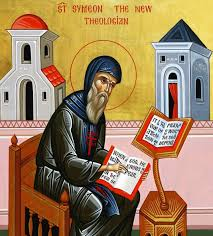
      Symeon the New Theologian: How to See the Divine Light in Daily Life 

      St. Symeon (949–1022), was a monk, thinker and poet, known as the “new theologian.” He spoke about his own mystical experience and believed that all humans had the capacity to ascend the ladder to God and experience his presence directly. In this essay in Philokalia IV, St. Symeon patiently demonstrates to monastics how to uderstand and apply mystical theology to the practicalities of everyday life.

      While monks are his immediate audience, his astonishing insights into the human heart and the anxieties and struggles that plague us are highly relevant to us in the times we live.    

      So how does St. Symeon’s practical theology apply to our daily lives?

      Five steps struck me as dominant in this chapter and could be adapted to our own daily lives.

      RENUNCIATION

      Renunciation of the world,” St. Symeon says, includes “self-alienation from all material things, from the modes, attitudes and forms of this present life, as well as the denial of one’s own body and will.” It is a tough call, but he believes that it is far better than the alternative because “a person full of anxiety about worldly things is not free. He is dominated and enslaved by this anxiety, whether it is about himself or about others. “  

      We are not unlike the monks in St. Symeon’s world as we are similarly tormented by constant anxiety, festering resentment, self-pity, emotional or physical addictions, endless speculations about what if and how come that have our mind spinning in circles.

      Twelve-step programs modify the concept of monastic renunciation to help addicts and their families achieve emotional detachment from turmoil and destructive urges.  The concepts of dispassion and self-restraint are more easily applicable to us.

      Detachment and renunciation are not equivalent to indifference or resignation. While the monk’s renunciation frees him from “worldly concerns, he will not be idle, or neglect even the most insignificant and trivial details; but all he does he will do for the glory of God, accomplishing everything in his life without anxiety. “

      Those with a loved one who is an addict can empathize, grieve and  take action, yet without being drawn into his downward spiral and losing themselves.    

      REPENTANCE AND TEARS

      Symeon stresses the need for repentance as the foundation of a life in Christ and inner peace.  It takes humility and detachment to truly see your flaws without justifying and minimizing them. This is why true repentance brings tears, as you become deeply aware of all that was lost through sin.

      The tears of repentance are purifying.

      For he who through many tears has purified his intellect and has received the illumination of the divine light – light that would grow no less even if everyone received it – will dwell spiritually in the age to come.

      TRANSFORMATION

      Repentance is much more than an admission of guilt and an apology. It heals only through transformative action– the ability to turn your life around.   

      For the kingdom of heaven,” St. Symeon says,“  is entered forcibly.

      He does not mean forcing your will on others. He is referring, instead, to the force  you need to exert on yourself to refrain from falling back into old habits, resist the lure of destructive passions and immediate pleasure, deny the temporary relief of anger, resentment and self-pity and taking on the role of spiritual warrior.  

      Laziness, then, is not just an annoying or unproductive habit but saps our energy, diminishes hope and gets us stuck on a downward spiral.  

      49· Bodily listlessness and torpor, which affect the soul as a result of our laziness and negligence, not only make us abandon our normal rule of prayer but also darken the mind and fill it with despondency.

      Instead of allowing anxious, self-serving and negative thoughts to overwhelm and define us, we engage in nourishing contemplation and readings, St. Symeon advises.

      Transformation affects a powerful  reorientation from self to God

      LOVE

      The ultimate state of one’s ascendance to God is love. Love in Christ goes beyond the relatively easier type of love  we may have for our family, friends and those who support and admire us. Christian love recognizes the humanity of all beings, no matter how destructive, and can perceive God’s presence in them under the most repulsive words or actions. .

      If you truly love and pray for those who slander and maltreat you, who hate and defraud you, you will make rapid progress, for when your heart is fully aware that this is happening, your thoughts and, indeed, your whole soul with all its three powers are drawn down into the depths of humility and washed with tears.

      Symeon asks us to go beyond curtailing our drive to judge and criticize others. He asks us, instead,  to look at our peers and superiors as saints and ourselves as sinners.

      You should look on all who are in the monastery as saints.

      Love rises above even the strictest monastic rules and practices. Even when a monastic is consumed by devotional practices, he can pause his meditation to care for another human being.

      If someone wants to contact you, do not spurn him on the grounds that he disturbs your devotions.

      Even if someone is fasting, it is better to partake of a meal prepared for him than to hurt another person.

      And if someone offers you a rich meal, not realizing that you are fasting, you should eat what is put in front of you, no matter what it is; and take wine with uncomplaining self-restraint.

      Yet, this is not the sentimental notion of love as “being nice to all” or trying to please everybody. Instead, St. Symeon applies a type of “tough love.”

      Part of our transformative change through repentance is a reorientation by which we abandon our habit of negative thoughts that, over time, become the norm,  and replace them with hope, faith and love. We should therefore distance ourselves from those who may derail us from our course.  

      … you may find yourself hampered by someone who sows tares of despondency. He tries to prevent you from climbing to such heights of holiness by discouraging you with various thoughts…

      In the same way, we should not allow a disruptor to derail the course of a well-functioning group.

      62. A person false through hypocrisy, or culpable because of his actions, or easily shattered by some passion, or who lapses slightly through negligence, must not be left in the company of those who are working together in harmony. On the contrary, he must be excluded from their society as still corrupt and reprobate. Otherwise at some crucial moment he might break their chain of union, causing division where there should be none and distress both to those who are at the head of the chain – for they will be grieved for those who follow after them – and to those at the tail of the chain, who will suffer because they are cut off from those in front of them.

      LIGHT

      Without this inner transformation our vision is clouded,  and we are unable to see the divine light.

      They cannot see the marvels it contains; they regard as deluded those who dwell in that light and see and teach others about what is within it. On the contrary, it is they themselves that are deluded, not having tasted the ineffable blessings of God.

      Through renunciation, repentance and love we ascend to a new and higher spiritual space.  Our clouded and deluded vision is cleared, and we can now see the divine light.

      …if he does this and with unhesitating faith allows himself to be led by those wise in divine matters, he will enter with them into the city of the living God. Guided and illumined by the divine Spirit, he will see and learn what others cannot ever see or learn. He will then be taught by God (cf. John 6 : 45}  
      St. Basil of Caesarea: Meditation on the Birth of Christ

      St. Basil was an early Christian cleric  who served as Bishop of Caesarea in Cappadocia for 8 years, until his death (370-378).

      He is one of the pillars of Orthodox theology, known for his support of the Nicene Creed and his battles against the heresies of the time. He was an influential theologian, renowned for his ideas, writings and preaching.  Of the homilies he delivered, only about 50 survive today, including his Homily on the Holy Birth of Christ.

      In addition to his work as a theologian, Basil was known for his care of the poor and powerless.  

      St. Basil begins this homily by yanking us out of our comfort zone—our iron-clad habits, beliefs, assumptions and patterns of thinking. Before he even mentions the birth of Christ, he warns us that we are incapable of understanding it solely based on our limited, human thinking.

      Our first step toward understanding is humility–accepting that the concept of the birth of Christ is “incomprehensible” to humans. It exists beyond the confines of our human experiences, logic and verbal expressions. Christ’s birth, he tells us, is a mystery and, hence, it cannot be captured through words. Terms such as  “eternal” or “ineffable birth” are woefully inadequate to capture the essence of that miracle.

      In a way, we must detach from all that we take for granted, and approach the holy birth naked and child-like.

      St. Basil asks us to forget all rules of cause-and-effect relationships, synthesis and antithesis.

      He uses the metaphor of iron and fire to explain how limited linear oppositions are. While iron is cold and fire is hot, he tells us, iron becomes hot when put in the fire, taking on the outwards characteristics of fire.

      The iron glows in the fire, yet the fire is not blackened. The iron is set ablaze, yet it does not cool the flame.”

      Are you puzzled,” he then asks, “how the easily corruptible nature can have incorruptibility through its communion with God? Realize that it’s a mystery. God is in flesh so that he may kill the death that lurks therein.”

      St. Basil continues with a catalogue of concepts that are accepted as truth by the church, even though they appear to be impossible within the laws of nature. He lists, and argues for, foundational beliefs about Christ’s birth that, at the time, were challenged by various heresies.  For example, the virgin birth, Mary’s eternal virginity that continues after the birth, and the nature of the pregnancy, that is that Christ was placed in the womb fully formed—“perfect”—without undergoing  the stages of development from fertilized egg to a fully formed child.

      The basis of his arguments was the impossibility to understand a mystery with tools that pertain to the physical world.

      St. Basil displays enormous mastery of science, theology and history. He rejects the notion that astrology explains the rising of the star as this implies that “each person’s life is caused by a particular configuration of the stars.”

      St. Basil sees the birth of Christ as causing a cosmic shift in the world by freeing from the grips of pagan rules and worldview which dominated thought and culture.

      Having warned us of the inadequacy of human thought and expression to grasp the mystery of the birth of Christ, St. Basil shows that spiritual understanding is not merely intellectual but experiential. One arrives at it through participation in, rather than descriptions of, the mystery. An outstanding writer, St. Basil ends the chapter with lyrical accounts of his immersion in the mystery itself:

      Let us celebrate the salvation of the world, the birthday of humanity.

      My heart is alive and well, and my mind is overflowing, but the tongue is  deficient  and words insufficient to proclaim such great glory.

      For the divine power has been manifested through the human body as light through vitreous membranes, and shines upon those who have the eyes of their hearts purified. May we also be found among them , with “unveiled face beholding the glory of the Lord” so that we too can be transformed “from glory to glory” by the glory of our Lord Jesus Christ and his love of humanity.

      On Faith, Hope and Love, The Ladder of Divine Ascent, step #30

      All that remains,” the last chapter begins, “is the triad of faith, hope and love to be fully united to God.” 

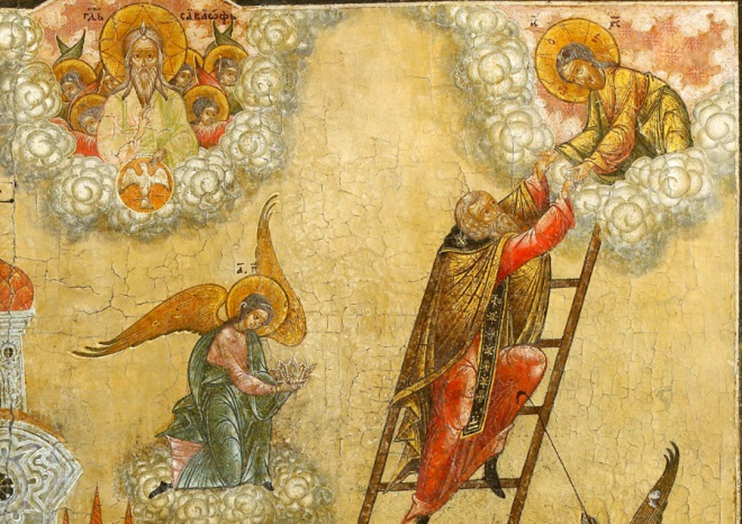
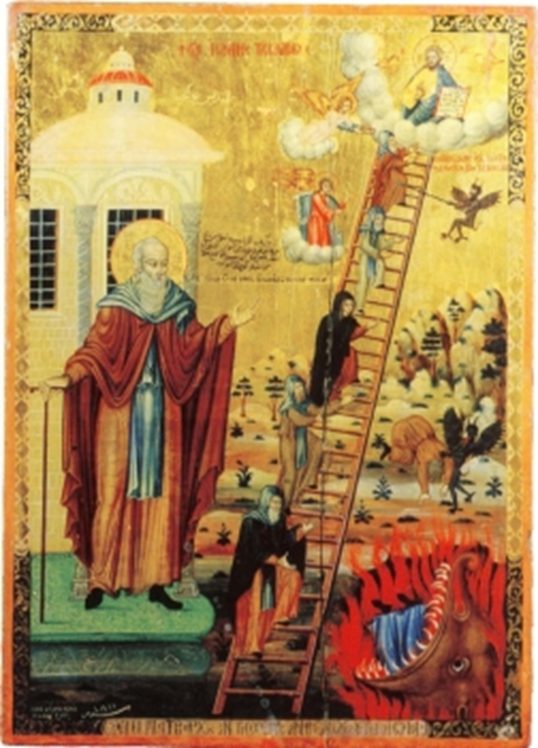
      At the 30th and last step of the ladder, we have  finally arrived at the summit: theosis or union with God.

      When I was younger, I would have expected something rare and powerful at the very top of the Ladder. Infinite wisdom, perhaps; eternal life on earth, immediate sainthood, power over others, miracle-granting authority! Extraordinarily, at the very top of the Ladder is a triad of virtues, with the highest among them being love. Instead of magic powers, we achieve a spiritual state that, though hard, is possible to be achieved by all.

      The purpose of all the battles against passions and the cultivation of virtues along  our long ascent on the ladder was to finally experience love in its fullness. Since God is love, we become one with Him. 

      To understand the concept of love in the writings of the desert fathers, we must banish our associations with romantic love or obsessive passion. Christian love is not  selective or conditional. It does not ebb and flow with circumstances or mood. Having shed our passions through our ascendance on the ladder, we are free from the blindness of personal agendas, resentments, jealousies, recrimination, desire to control and all the other passions that separate us from God. We are now able to see the image of God in others, regardless of their behavior, flaws, circumstances or mood.

      Having achieved the ability to love fully we have not simply acquired a virtue, but become transformed in God’s image:

      Love is by its nature resemblance of God, insofar as this is humanly possible.

      Achieving theosis is a state beyond words or actions, a true “inebriation of the soul.” When your heart is filled with love, it transforms the way you see and experience the world.

      Love grants prophecy, miracles. It is an abyss of illumination, a fountain of fire, bubbling up to inflame the thirsty soul. It is the condition of angels and the progress of eternity. You cannot love God and hate your neighbor because you now see God in him.

      You experience love’s “distinctive character,” and thus become “a fountain of faith, an abyss of patience, a sea of humility.” Fear disappears when love consumes you.

      Fear shows up when love departs.  Lack of fear means that you are either filled with love or dead in spirit, John observes.

      A metaphor often used to communicate the intensity of our love for God is that of a person deeply in love. Just as someone besought with erotic love can think of nothing but the object of that love, those who ascend to the top of the ladder are so consumed by divine love that they may forget to eat and are unaware of physical needs.

      Yet unlike bodily passions love of God is not uncontrollable, suffocating and destructive. It does not obliterate our identity and sense of self. Christ gave up his life out of love but retained his personhood.  Instead of consuming and destroying, love of God transforms.

      Hope is the power behind love. When hope goes, so does love. “Hope comes from the experience of the Lord’s gifts, and someone with no such experience must be ever in doubt.”  Hope is destroyed by anger.

      John’s last admonition is also a glorification: 

      We are here at the summit,” he reminds us. “Let the ladder teach us the spiritual unity of these virtues so the “grossness of the flesh” will not hold us back.  And the chapter ends with an unequivocal declaration.

      Remaining now are faith, hope and love, these three. But love is the greatest of them all.” (1 Cor. 13:13)

      THE LADDER OF DIVINE ASCENT BY JOHN CLIMACUS: On Prayer (step 28)

      “Prayer,” John tells us in the beginning of this chapter, “is future gladness, action without end, wellspring of virtues, source of grace, hidden progress, food of the soul, enlightenment of the mind, an axe against despair, hope demonstrated, sorrow done away with.”  This stream of lyrical metaphors establishes an important theme: prayer is not a discrete act, strictly confined to a specific place and time.  It is nourishment to our souls; the personal experience of God’s presence which can dwell ceaselessly within us.

      John leads us to gradually deeper stages of prayer from simply keeping physical prayer routines to transforming your entire life into ceaseless prayer.

      The first step is to prepare for prayer through purification:   

      The beginning of prayer is the expulsion of distractions from the very start by a single thought.

      Prayer is tarnished when we stand before God, our minds seething with irrelevancies. It disappears when we are led off into useless cares. (p.277)

      Distractions from mundane cares and seething passions are likened to imprisonment, keeping us from the shining freedom achieved through prayer.

      If you are clothed in gentleness and in freedom from anger, you will find it no trouble to free your mind from captivity (p. 276)

      Simplicity and submission are the antidotes to distraction: “Pray in all simplicity,” John tells us. ”Avoid talkativeness lest your search for just the right words distracts you.” In fact, “when a man has found the Lord, he no longer has to use words when he is praying …”

      You truly pray when you ask for understanding of His and submerge your  ego to it.   “While we are still in prison, let us listen to him who told Peter to put on the garment of obedience, to shed his own wishes and, having been stripped of them, to come close to the Lord in prayer, seeking only His will.

      The Fire that Resurrects Prayer

      It is easy to forget that prayer is a gate to the presence of God and begin to see our daily prayer rituals as chores or even disruptions to our busy lives. John reminds us that prayer is not an opportunity to make requests but a reward unto itself as a vehicle for uniting with God. 

      “What have I longed on earth besides you? Nothing except to cling always to you in undistracted prayer!”

      The stage of unity of God is not one of passive submission but of spiritual transformation. John uses the metaphor of fire to describe it: “When fire comes to dwell in the heart,” he says, “it resurrects prayer.”

      Such an ecstatic state is not achieved on demand. We live in a time when service or information on demand, anytime, anywhere, is considered our birthright and the natural course of events. Yet, reaching this mystical, prayerful state cannot be achieved through our own efforts and at our chosen time, but only through God’s Grace. This is why when, by God’s Grace, our souls are suddenly gifted with a moment of true prayer, we must not let anything interfere with it. “Do not stop praying as long as, by God’s grace, the fire and the water have not been exhausted (as long as fervor and tears remain), for it may happen that never again in your whole life will you have such a chance to ask for the forgiveness of your sins.

      One of the greatest dangers in our time is to look for shortcuts to ecstatic communion with God, replacing the fire of God’s presence in prayer with the superficial “high” of excess or addiction—whether it is drugs, extreme sports, workaholism or other compulsion.  The danger for us, practicing Christians, is to transfer this attitude to our prayer life, seeking “highs” in our prayer and worship experiences and judging their quality of the basis of the emotions we believe we should be feeling.  Forcing the emotions  we think we should be feeling in worship and judging rather than submitting to prayer and worship—leads some to constantly “shop” around for churches or for rapturous worship experiences which, ironically, does not give them the inner stillness needed to truly pray.  

      We shouldn’t confuse the fire that is stoked by the labor of ascending the Ladder and emptying ourselves from passions, with artificially induced emotions.  The fire that comes to dwell in the heart and engenders true prayer is achieved through the Grace of God rather than our will and through spiritual warfare. Above all it transforms rather than to simply excite  or entertain us.  

      Prayer as Transformation

      John places a great deal of weight on the transformative role of prayer. He considers those who emerge from prayer without having experienced [illumination, joy or peace] to have prayed bodily rather than spiritually. “A body changes in its activity as a result of contact with another body. How therefore could there be no change in someone who with innocent hands has touched the Body of God?” 

      John, however, is a pragmatist and wants us to at least adhere to the discipline of prayer routines, even when our hearts are closed and are not participating in the prayer. Committing to these routines eventually allows our hearts to follow our bodies.

      For those who have achieved the higher level of true prayer, prayer is no longer a distinct activity but a continuous spiritual state.

      John tells us that we should aspire to this state of continuous prayers. In is living life as prayer than our lives are transformed. We experience life—even its most insignificant moments or mundane elements —as “as sacrament” (as Schmemann puts it).  Life is lived as whole; there is separation between sacred and secular; worldly and prayer life. We may have a set time for prayer, but we are already prepared for it by “unceasing prayer in [the] soul.”