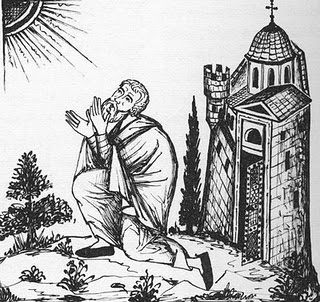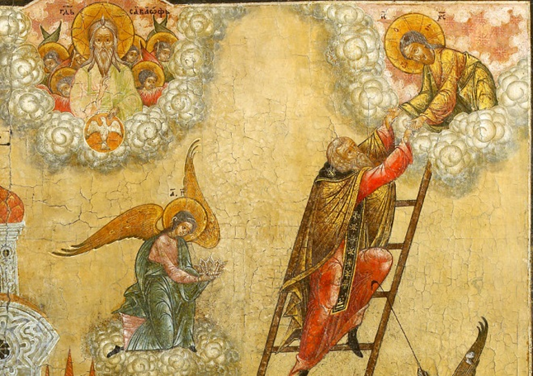
THE LADDER OF DIVINE ASCENT BY JOHN CLIMACUS: On Stillness (Step 27)

We are like purchased slaves, like slaves under contract to unholy passions” John writes in the beginning of the chapter.   The metaphor compares lives filled with passions to slavery.  John’s mastery of the human soul shows another, more insidious dimension of this slavery—the longer we stay in it the less we desire freedom because we can neither remember nor imagine what freedom looks, feels and tastes like.  Isn’t it why abused wives, addicts or abusers stay in destructive relationships, even though the right choice seems so logical and simple to those on the outside?  Abuse, violence and dysfunction become the norm after a while, and they can no longer remember or envision what health looks    like.

Not so long ago, I would have been dismissive of anything resembling silence.  How boring! Who would actually pursue it?  For most of us, living with noise and inner clutter is all we have known and defines normal. The Fathers, however, considered the practice of inner stillness an essential foundation of spiritual life.  Being silent is not the same as practicing inner silence. You can be quiet on the outside but tortured by the constant noise of racing thoughts and lingering resentments on the inside. 

Metropolitan Jonah defines inner stillness as “conscious communion’ with God.” He continues: “Inner stillness is not merely emptiness. It is a focus on the awareness of the presence of God in the depths of our heart. One of the essential things we have to constantly remember is that God is not out there someplace. He’s not just in the box on the altar. It may be the dwelling place of His glory. But God is everywhere. And God dwells in the depths of our hearts. When we can come to that awareness of God dwelling in the depths of our hearts, and keep our attention focused in that core, thoughts vanish.

How do we do this? In order to enter into deep stillness, we have to have a lot of our issues resolved. We have to have a lot of our anger and bitterness and resentments resolved. We have to forgive. If we don’t we’re not going to get into stillness, because the moment we try our inner turmoil is going to come vomiting out. This is good – painful, but good. Because when we try to enter into stillness and we begin to see the darkness that is lurking in our souls, we can then begin to deal with it. It distracts us from trying to be quiet, from trying to say the Jesus Prayer, but that’s just part of the process. And it takes time.”

John emphasizes the role of despondency in preventing us from union with God. To achieve stillness, we must be driven by love for God and the desire to experience the joy and sweetness of his presence. This spiritual state requires that any trace of despondency be shed from our soul. “For to link despondency to the loving of God,” John writes, “is rather like committing adultery.

John talks about the clarity we achieve through inner stillness and silence:  ‘Stillness of the soul is the accurate knowledge of one’s thoughts and is an unassailable mind.”  He writes:

 “The start of stillness is the rejection of all noisiness as something that will trouble the depths of the soul….Close the door of your cell to your body, the door of your tongue to talk, and the gate within to evil spirits.” Yet being quiet or away from noise in nature does not necessarily imply stillness. Inner stillness is practiced “in the deep spaces of the heart.” 

When you have arrived at the” final point,” however, fear and rejection of noisiness are no longer concerns because you are immune to them and cannot even detect them.
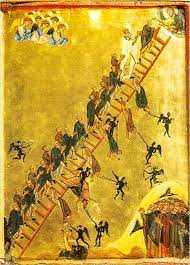
THE LADDER OF DIVINE ASCENT BY JOHN CLIMACUS: The Things that Deaden our Soul

The conventional understanding of “sin” is that of transgression of very concrete rules and laws.

This is how Wikipedia defines it:

Among some scholars, sin is understood mostly as legal infraction or contract violation of non-binding philosophical frameworks and perspectives of Christian ethics, and so salvation tends to be viewed in legal terms.

It continues with the relational definition of sin:

Other Christian scholars understand sin to be fundamentally relational—a loss of love for the Christian God and an elevation of self-love…

Hesychasts built on the relational definition of sin but delved to an unprecedented depth into the effects of the loss of love of God. In this sense, their profound understanding of the intricacies of the human soul, and the difference between healthy and unhealthy spiritual states, predates psychology and the steps to mental health that behavioral psychology espouses.

In step 18, St. Johns talks about insensibility “that is, deadening of the soul and the death of the mind before the death of the body.”

Have you had moments when the horrors shown on TV stir up indignation but do not touch your heart or bring tears to your eyes? Or when you are shocked to realize that at a particular moment, while you know you love your family, your heart is closed, and your feelings are frozen?  The Ladder recognizes these moments of spiritual paralysis and their consequences on our salvation:

 Insensibility both in the body and in the spirit is a deadened feeling, which from long sickness and negligence lapses into loss of feeling.

The word for insensitivity in the original Greek is anaesthisia—the same root as in “unaesthetic;” – loss of sensation, deadening of the senses.

Αναισθησία και στα σώματα και στις ψυχές είναι απονεκρωμένη αίσθησις, η οποία από χρονία ασθένεια και αμέλεια κατέληξε να αναισθητοποιηθή.

St. John forces us to face the consequences of insensitivity. Occasional insensitivity will become a habit causing “benumbed thought; the birth of presumption; a snare for zeal; the noose of courage; ignorance of compunction; a door to despair; the mother of forgetfulness, which gives birth to loss of the fear of God. And then she becomes the daughter of her own daughter.”

Insensitivity, constant sleepiness or dullness often hides a deeper attempt to escape into fantasy, apathy and sloth so we will have to face and engage with reality.  Alertness, on the other hand, gives us a fighting chance to resist evil and withstand misfortune.  It gives us clarity of mind and full presence in the moment to discern the glory of God all around us.

A state of alertness, John tells us, “is a quenching of lust, deliverance from fantasies in dreams, a tearful eye, a heart made soft and gentle, thoughts restrained  food digested , passions tamed spirits subdued, tongue controlled, idle imaginings banished.”

Without alertness, our life slips through our fingers like a dream, and we are unable to be in the presence of God.

How many times are we absent from our own lives in mental and emotional “sleepiness?”  Maybe we are too tired to engage with our family, opting to lay half- asleep in front of the TV with a bottle of beer. Or our minds are so cluttered with lists of chores to be done, worries about our next day’s presentation  at a meeting,  anger about perceived insults, that we barely take note of the beautiful spring day outside. Our senses and feelings have been so dulled that while we register others’ pains and sufferings and sympathize in our minds, our hearts cannot be engaged no matter how much we try to push our feelings. 

Indulging in sleep or, as John calls it, a state of somnolence is “stealing half our life time or more.”  

Alertness is focus; sharpness; full presence in the moment; a kind of spiritual transparency that allows God to enter unencumbered.

Fear (step 21) is another thief of souls. St. John, calls it “unmanly… a childish disposition in an old, vainglorious soul.”

Fear of course stems from focusing on what might happen in the future and prevents us from living life in the present. St. John goes further, however, to link fear with pride and vainglory.

If we didn’t think we deserved more than we had, we would not be afraid of loss. If we did not live to gain others’ acceptance and impress them with our wealth, position, looks and other material things, we would not spend our days in fear of rejection, disrespect or humiliation. If we think that we, alone, can battle to save ourselves, fear can grow into despair.

Cowardice is a falling away from faith that comes of expecting the unexpected. Fear is a rehearsing of danger beforehand; or again, fear is a trembling sensation of the heart, alarmed and troubled by unknown misfortunes. Fear is a loss of conviction. A proud soul is a slave of cowardice; it vainly trusts in itself and is afraid of any sound or shadow of creatures.

THE LADDER OF DIVINE ASCENT BY JOHN CLIMACUS. STEP 7

We are leaving Philokalia for a while to re-read the Ladder of Divine Ascent by St. John Climacus. With the exception of the Bible, writes Bishop Kallistos Ware in the introduction of this book, there is no other book as influential and foundational for Orthodox spirituality as the Ladder of Divine Ascent by St. John Climacus. While addressed to monastics, it embodies the transformational journey that all Christians are capable of, and have a right to, from the tumult of passions and fragmentation to wholeness, inner stillness and unity with God.

Mourning as Gateway to Life

We live our lives trying to minimize discomfort and avoid sorrow. We consider our happiness, safety, achievements, comfort and others’ respect as our indisputable rights. This shared worldview makes sense to us.

The world seen through the eyes of God, however,  applies a different kind of logic that turns the logic of the world upside down.  If you think that modern schools of thought, like nihilism or deconstructionism, are revolutionary, think again.

Mourning, John tells us in the beginning of this chapter, could be a melancholy of the soul, an anguished heart; futile longing for something that will never be obtained.  This sounds logical to us. But then John suggests a different possibility for viewing it. “Alternatively,” he tells us: “mourning is a golden spur within a soul that has been stripped of all bonds and ties, set by holy sorrow to keep watch over the heart.” (p. 136, Penguin edition)

What does this mean? Instead of spelling it out, John relies on a series of paradoxes to gradually reveal its significance and implications. True mourning is the gateway to love and freedom, while the single-minded pursuit of bodily pleasures leads to emptiness and despair. Mourning, paradoxically,

We live our lives trying to minimize discomfort and avoid sorrow. We consider our happiness, safety, achievements, comfort and others’ respect as our indisputable rights. This shared worldview makes sense to us.

The world seen through the eyes of God, however,  applies a different kind of logic that turns the logic of the world upside down.  If you think that modern schools of thought, like nihilism or deconstructionism, are revolutionary, think again.

Mourning, John tells us in the beginning of this chapter, could be a melancholy of the soul, an anguished heart; futile longing for something that will never be obtained.  This sounds logical to us. But then John suggests a different possibility for viewing it. “Alternatively,” he tells us: “mourning is a golden spur within a soul that has been stripped of all bonds and ties, set by holy sorrow to keep watch over the heart.” (p. 136, Penguin edition)

What does this mean? Instead of spelling it out, John relies on a series of paradoxes to gradually reveal its significance and implications. True mourning is the gateway to love and freedom, while the single-minded pursuit of bodily pleasures leads to emptiness and despair. Mourning, paradoxically, cleanses us and opens our hearts so that delight and a spirit of celebration arrive unexpectedly to fill our daily lives. Conversely those who pursue shallow pleasures through indulgence, glory or material goods can never satisfy their thirst and are led to despair. Achievement and status can only bring about shallow, inauthentic and passing moments of pleasure if we have not acknowledged, and repented for, the destructive passions that still weigh on our souls. Contrition paves the way to real, deep and unforced joy.

Groans and sadness cry out to the Lord, trembling tears intercede for us and the tears shed out of all holy love show that our prayer has been accepted.” P. 137

Mourning is not antithetical to joy. Surprisingly, those unable to mourn cannot experience true, inner joy.

The man who mourns constantly in a way that pleases God does not seize to celebrate daily, but tears without end are in store for him who him who does not abandon bodily celebration. P. 140

Mourning requires humility; surrender of the heart to God rather than intellectual understanding of Him.  Theology and mourning do not go together, according to John. One sits on a professorial chair and the other “passes his days in rags on a dung heap.”   Christ did not teach us from the heights and safety of heaven. He became one of us and willingly experienced the full extent of suffering as a man to save us.  Through mourning we go from talking the talk to walking the walk, and from the head to the heart.

Mourning is, in fact, a gateway to life.

“If you find yourself unable to mourn, then lament that very fact,” John tells us. 

This is a powerful image and a stunning possibility to contemplate. Can you imagine living without the capacity for empathy that would allow you to be touched by others’ struggles and experience love and sorrow for them? Or being unable to experience regret and, hence, to find redemption and experience transformation?  This is why the ability to mourn is a gift:

True mourning penetrates the depths of our soul, freeing us from the need to show off, control or yearn for wealth and prestige that block us from openness to love and union with God:

 He who has the gift of spiritual tears will be able to mourn anywhere. But if it is all outward show, there will be no end to his discussion of places and means.

Tears alone do not constitute mourning, however. There are, in fact, good tears and  bad tears. We may cry because of a sense of entitlement and self-pity for lacking the rewards we feel entitled to.  Or good tears may turn into bad tears when we become proud of them and feel superior to others.

Silly men take pride in their tears, and this is why some are not granted the gift of mourning…”  When mourning is deep-rooted, it leaves no room for efforts to garner raise or reap rewards from God. Paradoxically, this is exactly when Christ comes uninvited to a heart that is open and cleansed through mourning.

Mourning, John tells us, is freedom from passions and anguish, a state of humility and inner stillness, an experience of love and union with God and man.   

 When the heart is filled with sorrow and weeps, it is full of tenderness and all this without having striven for it. …”the Lord has arrived uninvited and is holding out to us the sponge of loving sorrow, the cool waters of blessed sadness with which to wipe away the sadness of our sings.

THE LADDER OF DIVINE ASCENT BY JOHN CLIMACUS

Step 4 On blessed and ever-memorable obedience

Having renounced the world, St. John asks us to renounce ourselves in order to ascend the next rung in the Ladder.

Obedience is absolute renunciation of our own life, clearly expressed in our bodily actions.

How can we, as modern men and women, view the concept of obedience which is such a fundamental requirement to your ability to ascend the Ladder? After all, questioning authority, challenging boundaries and deconstructing received truths are part of the definition of the modern hero. Are we called to dutifully obey all those with authority over us? Is our ideal self, someone like Dilbert, mindlessly performing menial tasks and unable to form a single thought independently? Are there limits to obedience? Should you obey an abusive husband or boss for example? Or comply with the requests of someone whose judgment is impaired?

To grasp the meaning of “obedience” in ascetic life, we must first drop all familiar associations.

Let’s first consider the context. “Obedience” in ascetic spirituality refers to the relationship of a monastic to his spiritual director. Hence, obedience is exercised within an agreed upon relationship and assumes a consensual framework. Without mutual agreement and consent you have tyranny rather than obedience. For example, spiritual directors use their authority on those who have willingly entered the monastery and, hence, have already accepted a life of obedience. Conversely, the directors have accepted responsibility for guiding the souls of those in obedience to them, to lead them to salvation.

Christianity is practiced in community. No man is an island.

The concept of obedience is not alien to the modern world. The journey of healing in all 12-step and similar programs that fight addiction begins with humility and obedience. You must admit that you are powerless over a habit or addiction and seek a guide for your recovery journey. The concept of mentorship exists in multiple realms of   life—from sports to business, artistic and trade apprenticeships.

Mother Raphaela, of the Holy Myrrhbearers monastery points out that the roots of the word “obedience” are in the Latin obaudire which means to listen. In that sense, relationships between husband and wife, parents and children are built on a construct of obedience in that they all involve mutual “listening” — mutual obligations and responsibilities for the salvation of the relationship rather than the fulfillment of one’s own will.

Ironically, as in the case of detachment, obedience becomes a gateway to freedom by releasing us from the tyranny of our own will. Self-will, which we often mistake for freedom, tethers our lives to the unceasing need to control and impose on others our script for how the world should run. It usually results in conflict, disappointment and bitterness as the world constantly falls short of our expectations. St. John shows us that faith and trust are gateways to obedience:

Obedience is the tomb of the will and the resurrection of humility…You who are therefore trying to lay your own burden on Another’s shoulders, you who are hastening to sign a pledge that you are voluntarily surrendering yourself to slavery, and in return want freedom written to your account, you who are being supported by the hands of others as you swim across this great sea—

Levels of Obedience and Surrender

To show us how obedience becomes the bridge to salvation, St. John tells a story as an example.

A repentant robber seeks to enter a monastery John was visiting. As a prerequisite to being admitted, the Abbott asks him to confess his sins before the brothers as an indication of his penitence. The robber complies, but the Abbot is still not convinced of the sincerity of his repentance. The robber next dons a hair shirt and ashes, has his hands tied behind him and appears humbled before 230 brothers at the monastery. The Abbot knows that, while he said the right things, he has not yet experienced true mourning. Eager to be admitted, the robber raises the bar and offers to confess his sins in the middle of the city square as an indication of his humility. Yet the Abbott still does not deem him worthy of admission. Suddenly, struck by a new awareness of his sins and filled with remorse, the robber drops to the ground, sheds real tears and confesses all his sins (pp. 94-95}. At that moment, he is probably not even worrying about the impression he  makes on the Abbot or what he has to do to convince him. I picture him so crushed by a fresh awareness of the magnitude of his sins and the state of his soul that he has no interest in impressing others. The Abbott recognizes the sincerity of his repentance and admits him.

He later explains to St. John his reasons for making the robber wait for that long: had he admitted him before the robber fully faced his past and repented with his whole heart, he would have doomed him to a life of torment with his past sins still dwelling in him unresolved, and gnawing at his soul. Another consideration, the Abbot continued, was the opportunity to give an example to the brothers.

This pastor understood that public confession or displays of humility did not go far enough to render the robber completely transparent to God and the brothers. True repentance has to engage the heart completely without a shred of deception or attempts to hold back.

How often do we think we have forgiven or accepted something, mistaking what is only intellectual understanding for deep commitment of the heart? During moments when we are suddenly able to peel the last layer of the onion of our consciousness and our hearts are touched by love or grief, we just know it. There are no doubts or ambiguities; and the world looks different, even for a moment, as we experience it authentically.

The Abbot recognized that the robber’s repentance had not yet reached the heart and pushed him to the fullness of being through surrender to true mourning. Yet it was obedience–the robber’s willingness to put his complete trust in the pastor and dig deeper into his soul than he thought necessary-that enabled salvation and forgiveness.

This is the ideal of obedience. We do not achieve salvation alone and on our terms, but through communion with others and, especially, relationships bound by obedience to a spiritual director.

SPIRITUAL KNOWLEDGE: ST. PETER OF DAMASKOS

(Philokalia Vol. III, G.E.H Palmer, Philip Sherrard, Kallistos Ware)

We are born, St. Petter writes, with an innate spiritual knowledge which we later lose through passions.

What is the meaning of spiritual knowledge then?

It is the ability to see things as they really are in nature, to uncover the mystery that lies beyond appearance and physical attributes.

The intellect then sees things as they are by nature ….by others it is called spiritual insight, since he who possesses it knows something at least of the hidden mysteries- that is, of God’s purpose- in the Holy Scriptures and in every created thing.

Passions, however, “darken the intellect” and confine us to the surface of things.

Living on the surface is easily exhaustible. We burn through material things, praise, career milestones etc., rapidly. We are, thus, on a frantic course of constantly replenishing the supply and yet, for many of us, a sense of emptiness remains.

The Greeks had an extraordinary understanding of the physical and intellectual realm, we are told, yet they lacked spiritual knowledge, defined here as the discernment of purpose.

Without understanding purpose, one cannot penetrate the true meaning of all things.

…for the pagan Greeks perceived many things but, as St Basil the Great has said, they were unable to discern God’s purpose in created beings, or even God Himself, since they lacked the humility and the faith of Abraham.

Viewed through the lens of spiritual insight, then, nothing is insignificant and worthless. Nothing is dismissible.  Nothing is empty. Even a crumb of bread or a boring daily routine points to a larger meaning and purpose.

 (God’s purpose) is clearly revealed in the world to come, when everything hidden is disclosed.

A significant difference between Christian and other types of meditative traditions is that the true meaning of things cannot be deciphered through our own resources and will not be revealed without faith.

The gnostic ought not to rely in any way on his own thoughts, but should always seek to confirm them in the light of divine Scripture or of the nature of things themselves. Without such confirmation, there can be no true spiritual knowledge, but only wickedness and delusion.

God and his purpose are there to be discovered—ensconced in simple and lofty things alike, in humble daily discourse and scriptural writings. All we have to do is rid ourselves of passions, assumptions and obsession with our self-interest so we can be filled with spiritual knowledge and allow for the revelation to occur.

We have all seen little children’s wonder-filled eyes as they explore the world with hope, faith and awe. Everything is new, sacred, and filled with unending mysteries and delights. Even a speck of dust is a source of wonder and reveals to them something about a vast and unknown world. This is the state of innocence we must achieve in order to be filled with spiritual knowledge.

Peter expounds on the meaning of faith. It is, he says, going beyond the visible to extrapolate the invisible.

A person is said to have faith when, on the basis of what he can see, he believes in what he cannot see.

Yet, discerning hidden mysteries is not enough if you lack faith in their creator. “But to believe in what we can see of God’s works is not the same as to believe in Him who teaches and proclaims the truth to us.

Faith must proceed from the head to the heart. According to St. St. Peter, it is through suffering that one acquires faith, then fear, then awe, then gratitude and humility and, finally, true spiritual knowledge.  

In this way, the person who in faith endures these trials patiently will discover, once they have passed, that he has acquired spiritual knowledge, through which he knows things previously unknown to him, and that blessings have been bestowed on him. As a result, he gains humility together with love both towards God, as his benefactor, and towards his fellow-men for the healing wrought by God through them.

PATIENCE AND ENDURANCE: St. Peter of Damaskos

(Philokalia Vol. III, G.E.H Palmer, Philip Sherrard, Kallistos Ware)

When I look for an urgent answer or solution, my double “A” personality often kicks in. There have been times when, in my impatience for an immediate answer, I stayed up until dawn, doing Google research, drawing diagrams, or making lists. Even if I become exhausted and unproductive, I am sure that if I just persist a little more, I can get results within my timeline.  

How much of our inner peace do we sacrifice, in our efforts to force our agenda and sense of timing on the universe?

St. Peter advises that we apply “conscious awareness of our own hearts” to discern God’s perspective and free ourselves from the frantic pressure to bring about the results we want, when we want them.

Harmonizing our will with God’s brings about patience and endurance. Patience and endurance are not simply two of many virtues. They are, instead, the preconditions for possessing our soul. If fact, St. Peter believes that “you come into yourself when you endure with patience.”

Without patient endurance, we live in turmoil, burdened by the idea that unless we force results, nothing worthwhile will happen in our lives. We are riddled with anxiety, uncertainty, and lack of clarity as our passions obscure the true nature of things.

How many tears would I like to shed whenever I gain even a partial glimpse of myself! If I do not sin, I become elated with pride; while if I sin and am able to realize it, in my dismay I lose heart and begin to despair. If I take refuge in hope, again I become arrogant. If I weep, it feeds my presumption; if I do not weep, the passions visit me again… In my ignorance all things seem contradictory, and I cannot reconcile them.

Patience is living in God’s infinite time. It is abandoning the futile struggle of forcing our temporal time frame on a God-created universe. It is acquiring humility to put aside our own assumptions; and discernment to understand the connecting links among things that appear contradictory.

Patient endurance is not a solitary virtue but the result of a transformative process that begins with faith and fear of God. As we no longer see ourselves as the center of the world, we experience awe, humility, clarity of vision, gratitude, and inner stillness.

For if such endurance is not born in the soul out of faith, the soul cannot possess any virtue at all.

The working assumptions for most of us are that we acquire and increase knowledge through our own efforts, feel justifiable pride in it, receive recognition for it and continue to ascend levels of accomplishment until we become “experts” or wise. It thus becomes easy to judge others, become anxious about winning arguments and impose our opinions which we “know” to be wiser than others.’  

St. Peter, and other desert fathers, turn this value system on its head. Spiritual knowledge begins with acknowledgment of ignorance and the recognition of the need of God’s grace.  

For this reason it is good to say ‘I do not know’, so that we neither disbelieve what is said by an angel nor place credence in what occurs through the deceitfulness of the enemy.

Giving up the pressure of forcing results and timelines, judging, impressing, and dominating others frees us from impatience. We now live in God’s time, realizing that experience and insight may take years, rather than hours or days, and that we cannot achieve anything on our own without God’s grace.

We may wait for many years until the answer is given us, unsolicited and unperceived, in the form of some concrete action- as someone has put it with reference to the contemplation of created beings. In this way we reach the haven of active spiritual knowledge. When we see this knowledge persisting in us over many years, then we will understand that truly we have been heard and have invisibly received the answer.