From his homily “On the Martyr Julitta (and on Giving Thanks) in the book On Fasting and Feasts
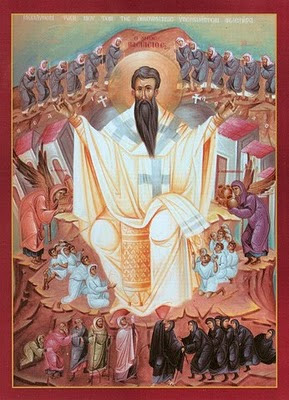
Is it possible to be always grateful, and “give thanks in all circumstances’’ even in the face of pain, loss and even death?
St. Basil’s answer is a resounding yes. A constant state of gratitude is in fact our path to salvation and union with God. He begins this homily with a tribute to St. Julitta.
St. Julitta, we are told, had a lawsuit against a powerful and greedy man who had robbed her of her considerable property. Because of a corrupt court that sided with her opponent, St. Julitta lost the lawsuit. Yet St. Basil declares her the real winner of this case as the spiritual battle she waged was far more important than the loss of physical property.
On the material level, St. Julitta stood her ground during the trial and refused to be intimidated by her opponent and the biased judge. She eloquently presented her case and brought tangible and undeniable evidence of the violence and injustice done to her. Yet the court ordered that the young woman would not only lose her property but also her very life because she boldly refuted the false claims and refused to renounce Christ.
Instead of despairing, however, St. Julitta embraced her legal defeat as a spiritual victory and an opportunity for salvation. Instead of cowering in fear, she eagerly and joyfully jumped into the flames of the fire that was to burn her alive.
This is why St. Basil concludes that, while she has a woman’s body, she has the courage and spirit of a man. He means that her moral strength and courage had defied any biological or cultural category and rendered hollow the decisions of legal authorities.
Why is Basil using Julitta’s story as the jumping point to a homily of gratitude?
In a life of continuous prayer, he says, you “do everything for the glory of God.” This means that everything—pleasant or unpleasant, satisfactory or painful, expected or unexpected—can be a window to the glory of God and a vehicle for experiencing it. St. Julitta discerned God’s glory in the pain of her martyrdom.
Everything contains a pointer to God’s glory and, hence, can become a source of gratitude, he tells us.
“But the Apostle says: ‘Give thanks in all circumstances.’ ”
Yet St. Basil asks the question most of us would ask: How is it possible to maintain gratitude in the face of soul-crushing circumstances, untold acts of violence, loss and deprivation?
It is a difficult task to convince a widow or mother of a dead child that even when finding themselves in such circumstances, they can dig deeper, beyond the pain, and still perceive the glory of God and believe in His purpose.
He proceeds gently but steadily.
First, there is an implicit distinction in his homily between grief and despair. In Orthodox Christianity one faces grief head-on, without sugar-coating it or suppressing it, yet without being subsumed by it. One example is the lamentations of the Virgin in the Holy Friday hymnology which, following the secular oral poetic traditions, freely express pain, disbelief and even anger toward the departed.
The Church doesn’t hurry past the passion of Christ to the Resurrection. It celebrates each day or even hour of his passion, it lingers on every wound and humiliation suffered by Christ, and allows us to experience the physicality of pain. In the same vein, the hymnology of funeral services also faces openly and directly the physical toll of death on the departed and the deep pain of the mourners.
Grief, however, does not relinquish hope, as despair does. Unlike despair, it does not explode into anger, bitterness and hatred, all of which would prevent comfort, reconciliation and even gratitude.
Secondly, the key to gratitude is acceptance of God’s will and freedom from your own set expectations. This means renunciation of control over your and others’ lives.
In today’s business terms, willingness to abandon set plans and expectations and openness to embracing a radically new direction, is called “pivoting.” The leadership of an organization, for example, recognizes that their original plan is not bringing desired results. Instead of clinging to their initial expectations and plans, they “pivot”—reframe their position and value proposition and dramatically change strategy and direction.
Acceptance is clearly not passivity. St. Julitta fought a hard fight against the injustice done to her. Yet, accepting that the result was not within her control, she transformed defeat into victory.
“Why not let ourselves yield entirely to the action of such a wise master rather than complaining when we are robbed as if it is our property, and pitying the dead as if they have suffered some great disaster” rather then being “returned” to God, St. Basil asks.
Acceptance and freedom from your own script for life bring about inner peace and the defeat of fear.
“Proceed with this principle as a guide for your soul , a guard over every thought , so that you cannot be shaken by what happens in life; instead, your mind will be like a rock in the sea, one that endures the wind and waves without moving.”
This is what St. Julitta did and why her example prefaces a homily on living a life of perpetual gratitude.
But let us not grieve for what we do not have. Let us learn to give thanks for the present…
 Readings in Philokalia