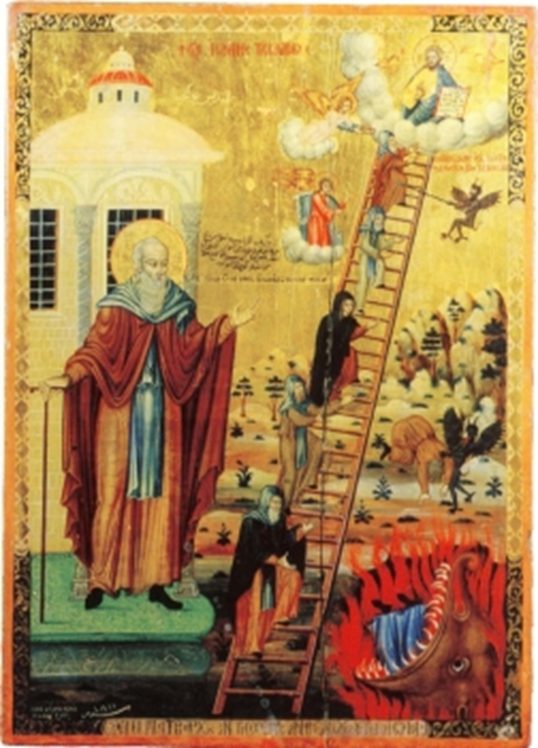
THE LADDER OF DIVINE ASCENT BY JOHN CLIMACUS: On Prayer (step 28)

“Prayer,” John tells us in the beginning of this chapter, “is future gladness, action without end, wellspring of virtues, source of grace, hidden progress, food of the soul, enlightenment of the mind, an axe against despair, hope demonstrated, sorrow done away with.”  This stream of lyrical metaphors establishes an important theme: prayer is not a discrete act, strictly confined to a specific place and time.  It is nourishment to our souls; the personal experience of God’s presence which can dwell ceaselessly within us.

John leads us to gradually deeper stages of prayer from simply keeping physical prayer routines to transforming your entire life into ceaseless prayer.

The first step is to prepare for prayer through purification:   

The beginning of prayer is the expulsion of distractions from the very start by a single thought.

Prayer is tarnished when we stand before God, our minds seething with irrelevancies. It disappears when we are led off into useless cares. (p.277)

Distractions from mundane cares and seething passions are likened to imprisonment, keeping us from the shining freedom achieved through prayer.

If you are clothed in gentleness and in freedom from anger, you will find it no trouble to free your mind from captivity (p. 276)

Simplicity and submission are the antidotes to distraction: “Pray in all simplicity,” John tells us. ”Avoid talkativeness lest your search for just the right words distracts you.” In fact, “when a man has found the Lord, he no longer has to use words when he is praying …”

You truly pray when you ask for understanding of His and submerge your  ego to it.   “While we are still in prison, let us listen to him who told Peter to put on the garment of obedience, to shed his own wishes and, having been stripped of them, to come close to the Lord in prayer, seeking only His will.

The Fire that Resurrects Prayer

It is easy to forget that prayer is a gate to the presence of God and begin to see our daily prayer rituals as chores or even disruptions to our busy lives. John reminds us that prayer is not an opportunity to make requests but a reward unto itself as a vehicle for uniting with God. 

“What have I longed on earth besides you? Nothing except to cling always to you in undistracted prayer!”

The stage of unity of God is not one of passive submission but of spiritual transformation. John uses the metaphor of fire to describe it: “When fire comes to dwell in the heart,” he says, “it resurrects prayer.”

Such an ecstatic state is not achieved on demand. We live in a time when service or information on demand, anytime, anywhere, is considered our birthright and the natural course of events. Yet, reaching this mystical, prayerful state cannot be achieved through our own efforts and at our chosen time, but only through God’s Grace. This is why when, by God’s Grace, our souls are suddenly gifted with a moment of true prayer, we must not let anything interfere with it. “Do not stop praying as long as, by God’s grace, the fire and the water have not been exhausted (as long as fervor and tears remain), for it may happen that never again in your whole life will you have such a chance to ask for the forgiveness of your sins.

One of the greatest dangers in our time is to look for shortcuts to ecstatic communion with God, replacing the fire of God’s presence in prayer with the superficial “high” of excess or addiction—whether it is drugs, extreme sports, workaholism or other compulsion.  The danger for us, practicing Christians, is to transfer this attitude to our prayer life, seeking “highs” in our prayer and worship experiences and judging their quality of the basis of the emotions we believe we should be feeling.  Forcing the emotions  we think we should be feeling in worship and judging rather than submitting to prayer and worship—leads some to constantly “shop” around for churches or for rapturous worship experiences which, ironically, does not give them the inner stillness needed to truly pray.  

We shouldn’t confuse the fire that is stoked by the labor of ascending the Ladder and emptying ourselves from passions, with artificially induced emotions.  The fire that comes to dwell in the heart and engenders true prayer is achieved through the Grace of God rather than our will and through spiritual warfare. Above all it transforms rather than to simply excite  or entertain us.  

Prayer as Transformation

John places a great deal of weight on the transformative role of prayer. He considers those who emerge from prayer without having experienced [illumination, joy or peace] to have prayed bodily rather than spiritually. “A body changes in its activity as a result of contact with another body. How therefore could there be no change in someone who with innocent hands has touched the Body of God?” 

John, however, is a pragmatist and wants us to at least adhere to the discipline of prayer routines, even when our hearts are closed and are not participating in the prayer. Committing to these routines eventually allows our hearts to follow our bodies.

For those who have achieved the higher level of true prayer, prayer is no longer a distinct activity but a continuous spiritual state.

John tells us that we should aspire to this state of continuous prayers. In is living life as prayer than our lives are transformed. We experience life—even its most insignificant moments or mundane elements —as “as sacrament” (as Schmemann puts it).  Life is lived as whole; there is separation between sacred and secular; worldly and prayer life. We may have a set time for prayer, but we are already prepared for it by “unceasing prayer in [the] soul.”
THE LADDER OF DIVINE ASCENT BY JOHN CLIMACUS: On Stillness (Step 27)

We are like purchased slaves, like slaves under contract to unholy passions” John writes in the beginning of the chapter.   The metaphor compares lives filled with passions to slavery.  John’s mastery of the human soul shows another, more insidious dimension of this slavery—the longer we stay in it the less we desire freedom because we can neither remember nor imagine what freedom looks, feels and tastes like.  Isn’t it why abused wives, addicts or abusers stay in destructive relationships, even though the right choice seems so logical and simple to those on the outside?  Abuse, violence and dysfunction become the norm after a while, and they can no longer remember or envision what health looks    like.

Not so long ago, I would have been dismissive of anything resembling silence.  How boring! Who would actually pursue it?  For most of us, living with noise and inner clutter is all we have known and defines normal. The Fathers, however, considered the practice of inner stillness an essential foundation of spiritual life.  Being silent is not the same as practicing inner silence. You can be quiet on the outside but tortured by the constant noise of racing thoughts and lingering resentments on the inside. 

Metropolitan Jonah defines inner stillness as “conscious communion’ with God.” He continues: “Inner stillness is not merely emptiness. It is a focus on the awareness of the presence of God in the depths of our heart. One of the essential things we have to constantly remember is that God is not out there someplace. He’s not just in the box on the altar. It may be the dwelling place of His glory. But God is everywhere. And God dwells in the depths of our hearts. When we can come to that awareness of God dwelling in the depths of our hearts, and keep our attention focused in that core, thoughts vanish.

How do we do this? In order to enter into deep stillness, we have to have a lot of our issues resolved. We have to have a lot of our anger and bitterness and resentments resolved. We have to forgive. If we don’t we’re not going to get into stillness, because the moment we try our inner turmoil is going to come vomiting out. This is good – painful, but good. Because when we try to enter into stillness and we begin to see the darkness that is lurking in our souls, we can then begin to deal with it. It distracts us from trying to be quiet, from trying to say the Jesus Prayer, but that’s just part of the process. And it takes time.”

John emphasizes the role of despondency in preventing us from union with God. To achieve stillness, we must be driven by love for God and the desire to experience the joy and sweetness of his presence. This spiritual state requires that any trace of despondency be shed from our soul. “For to link despondency to the loving of God,” John writes, “is rather like committing adultery.

John talks about the clarity we achieve through inner stillness and silence:  ‘Stillness of the soul is the accurate knowledge of one’s thoughts and is an unassailable mind.”  He writes:

 “The start of stillness is the rejection of all noisiness as something that will trouble the depths of the soul….Close the door of your cell to your body, the door of your tongue to talk, and the gate within to evil spirits.” Yet being quiet or away from noise in nature does not necessarily imply stillness. Inner stillness is practiced “in the deep spaces of the heart.” 

When you have arrived at the” final point,” however, fear and rejection of noisiness are no longer concerns because you are immune to them and cannot even detect them.

The Ladder of Divine Ascent by John Climacus:ON HUMILITY (Step 25)

Do you imagine that plain words can precisely or truly or appropriately or clearly or sincerely describe the Love of the Lord, humility, blessed purity, divine enlightenment, fear of God and assurance of the Heart?” John asks at the beginning of this chapter. “If you think so,” he continues, “then you will be like a man who, with words and examples, tries to convey the sweetness of honey to those who never tasted it.” And this is how John introduces us to a virtue that is the foundation of all others and the antidote to all passions.  

In this chapter we are ascending the top rungs of the ladder. We have battled destructive passions and are now concentrating on acquiring virtues. We are entering a deeper level of communion with God that cannot be easily captured in words or images. True humility can only be experienced.  It is a treasure that “eludes adequate description,” we are told. “Humility is a grace of the soul and with a name known only to those who have had experience of it.” It cannot be acquired through persuasion.  Neither, as John tells us, can it be learned from books, men or angels but only from Christ who dwells inside of us.  

The path to humility is long and achieved through the same stages all spiritual travelers pass through on their journey: Purification, Illumination and Theosis.  While it different for each of us, the destination is the same. “The appearance of this sacred vine is one thing in the winter of passions, another in the springtime of flowering and still another in the harvest time of all the virtues.” Yet all stages have one thing in common: joy and signs of the harvest to come.

A Parent of young children among us asked whether the path to humility posed a dilemma to parents today. Do we guide our children toward humility and detachment or toward aggressiveness and competitiveness, she wanted to know. Aren’t these two necessary for career success?  We decided that there was no contradiction there.  Ascending the Ladder is not a path to weakness but to inner strength.

The struggle, perseverance and discipline it takes to go against our very nature and seize control from destructive passions nurtures true inner strength.  Conversely being controlled by passions and disguising pride, envy or fear under superficial aggressiveness sap our strength and soul. Living in Christ and guided by virtues rather than torn by passions is the strong foundation on which everything else, including academic or professional achievements, can be built and sustained.