Step 4 On blessed and ever-memorable obedience
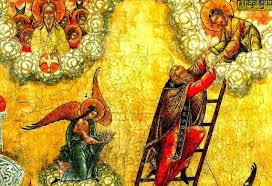
Having renounced the world, St. John asks us to renounce ourselves in order to ascend the next rung in the Ladder.
Obedience is absolute renunciation of our own life, clearly expressed in our bodily actions.
How can we, as modern men and women, view the concept of obedience which is such a fundamental requirement to your ability to ascend the Ladder? After all, questioning authority, challenging boundaries and deconstructing received truths are part of the definition of the modern hero. Are we called to dutifully obey all those with authority over us? Is our ideal self, someone like Dilbert, mindlessly performing menial tasks and unable to form a single thought independently? Are there limits to obedience? Should you obey an abusive husband or boss for example? Or comply with the requests of someone whose judgment is impaired?
To grasp the meaning of “obedience” in ascetic life, we must first drop all familiar associations.
Let’s first consider the context. “Obedience” in ascetic spirituality refers to the relationship of a monastic to his spiritual director. Hence, obedience is exercised within an agreed upon relationship and assumes a consensual framework. Without mutual agreement and consent you have tyranny rather than obedience. For example, spiritual directors use their authority on those who have willingly entered the monastery and, hence, have already accepted a life of obedience. Conversely, the directors have accepted responsibility for guiding the souls of those in obedience to them, to lead them to salvation.
Christianity is practiced in community. No man is an island.
The concept of obedience is not alien to the modern world. The journey of healing in all 12-step and similar programs that fight addiction begins with humility and obedience. You must admit that you are powerless over a habit or addiction and seek a guide for your recovery journey. The concept of mentorship exists in multiple realms of life—from sports to business, artistic and trade apprenticeships.
Mother Raphaela, of the Holy Myrrhbearers monastery points out that the roots of the word “obedience” are in the Latin obaudire which means to listen. In that sense, relationships between husband and wife, parents and children are built on a construct of obedience in that they all involve mutual “listening” — mutual obligations and responsibilities for the salvation of the relationship rather than the fulfillment of one’s own will.
Ironically, as in the case of detachment, obedience becomes a gateway to freedom by releasing us from the tyranny of our own will. Self-will, which we often mistake for freedom, tethers our lives to the unceasing need to control and impose on others our script for how the world should run. It usually results in conflict, disappointment and bitterness as the world constantly falls short of our expectations. St. John shows us that faith and trust are gateways to obedience:
Obedience is the tomb of the will and the resurrection of humility…You who are therefore trying to lay your own burden on Another’s shoulders, you who are hastening to sign a pledge that you are voluntarily surrendering yourself to slavery, and in return want freedom written to your account, you who are being supported by the hands of others as you swim across this great sea—
Levels of Obedience and Surrender
To show us how obedience becomes the bridge to salvation, St. John tells a story as an example.
A repentant robber seeks to enter a monastery John was visiting. As a prerequisite to being admitted, the Abbott asks him to confess his sins before the brothers as an indication of his penitence. The robber complies, but the Abbot is still not convinced of the sincerity of his repentance. The robber next dons a hair shirt and ashes, has his hands tied behind him and appears humbled before 230 brothers at the monastery. The Abbot knows that, while he said the right things, he has not yet experienced true mourning. Eager to be admitted, the robber raises the bar and offers to confess his sins in the middle of the city square as an indication of his humility. Yet the Abbott still does not deem him worthy of admission. Suddenly, struck by a new awareness of his sins and filled with remorse, the robber drops to the ground, sheds real tears and confesses all his sins (pp. 94-95}. At that moment, he is probably not even worrying about the impression he makes on the Abbot or what he has to do to convince him. I picture him so crushed by a fresh awareness of the magnitude of his sins and the state of his soul that he has no interest in impressing others. The Abbott recognizes the sincerity of his repentance and admits him.
He later explains to St. John his reasons for making the robber wait for that long: had he admitted him before the robber fully faced his past and repented with his whole heart, he would have doomed him to a life of torment with his past sins still dwelling in him unresolved, and gnawing at his soul. Another consideration, the Abbot continued, was the opportunity to give an example to the brothers.
This pastor understood that public confession or displays of humility did not go far enough to render the robber completely transparent to God and the brothers. True repentance has to engage the heart completely without a shred of deception or attempts to hold back.
How often do we think we have forgiven or accepted something, mistaking what is only intellectual understanding for deep commitment of the heart? During moments when we are suddenly able to peel the last layer of the onion of our consciousness and our hearts are touched by love or grief, we just know it. There are no doubts or ambiguities; and the world looks different, even for a moment, as we experience it authentically.
The Abbot recognized that the robber’s repentance had not yet reached the heart and pushed him to the fullness of being through surrender to true mourning. Yet it was obedience–the robber’s willingness to put his complete trust in the pastor and dig deeper into his soul than he thought necessary-that enabled salvation and forgiveness.
This is the ideal of obedience. We do not achieve salvation alone and on our terms, but through communion with others and, especially, relationships bound by obedience to a spiritual director.
 Readings in Philokalia