FROM DREAM TO REVELATION

Nikitas Stithatos

Philokalia, vol. 4, On the Inner Nature of Things and on the Purification of the Intellect:
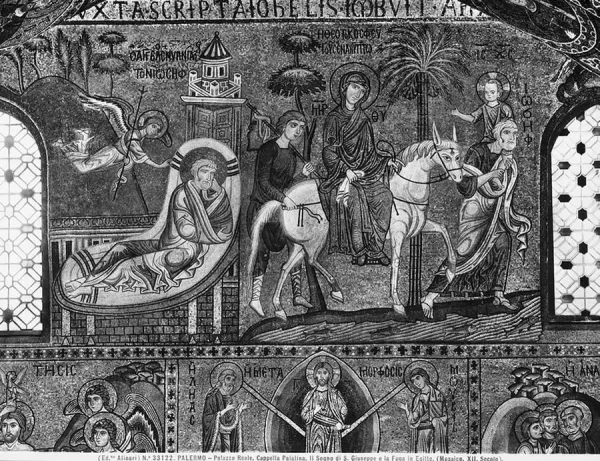
The understanding of dreams serves as an entry point for Stithatos’s broader mystical philosophy of theosis, the gradual process of becoming more like God. This transformation unfolds in three distinct stages: dreams, visions, and revelations.

  1. Dreams: The First Step of Purification
  • There is a direct correlation between who we are and what we dream. If we are attached to material things, for example, we will dream of possessions. If we are addicted to praise and success, we may dream of ourselves in powerful positions, dominating others and being admired.
  • A virtuous life produces peaceful dreams. We rise from bed filled with  peace, gratitude and the living presence of God
  • However, Stithatos notes that even these purified dreams are imperfect. They are produced by the “image-forming faculty of the intellect,” which is mutable and thus unreliable.

2. Visions: Beyond the “Image-Forming Intellect”

  • Moving beyond dreams, the soul can experience visions. Unlike the fleeting images of dreams, visions are constant and unchanging, leaving an unforgettable imprint on the intellect.
  • These visions reveal future events, inspire the soul with awe and engender a sense of repentance.

3. Revelations: Union with the Divine

  • The final, and most advanced, spiritual stage is that of revelations. With a purified and illuminated soul, an individual can transcend ordinary sense perception and understanding.
  • It is like a veil has been lifted and we can perceive the true, inner essence of things that lie beneath the surface. We are no longer separated from God,  so we are whole and free from struggle, conflict and contradiction. We have advanced beyond words and images to become God-like and perceive His hidden mysteries. Everything now makes sense, and  we understand the ultimate purpose of all things, and our own role in God’s creation.

Stillness as the path to Theosis

Those who achieve visions and revelations are no longer troubled by everyday anxieties and concerns. This allows them to achieve a state of inner stillness, which is a prerequisite for theosis.

Reaching this state of stillness requires restraint, conquering our will and triumphing  over our own impulses. The path of the monk or nun—involving fasting, poverty, and other forms of ascetic discipline — is one example of a complete surrender of the passions. For modern readers, asceticism can seem unrealistic or off-putting, but its core principle is highly relevant: gaining control over our passions and “addictions” rather than being controlled by them, and achiving inner peace.

Without restraint, our will to succeed, possess, indulge, gain status, receive praise and approval, control or defeat drives us.  

We use external things to quell our inner fears and anxieties: we abuse substances, become workaholics, become dependent on others’ approval, and chase success at all costs. We sacrifice inner peace and contentment for perceived material success, becoming addicted to external gains and desires.

In this state, Stithatos writes, our true, God-given soul is “disordered” and at war with itself, unable to receive divine grace.

A passionate soul, like a leaf in the wind, is unstable. It is elated by praise and success but devastated by criticism and failure. Stillness is the antithesis of this instability. It is “an undisturbed state of the intellect, the calm of a free and joyful soul.”

 In stillness, however, since our contentment is no longer dependent on external factors, we experience an “unwavering stability of the heart in God.”

The Result of Stillness
Freed from the inner battle, our perception becomes clear. We can ascend from contemplating visible things to a profound apprehension of the divine, eventually transcending images, words, and thoughts to achieve complete union with God. The pure intellect, having internalized divine principles, then reflects God’s wisdom, uncovering the deeper mysteries of creation.

Starting with dreams of things visible we ascend to the ever-increasing apprehension of things until we reach beyond images, words and thoughts to become united with God.

When the intellect has interiorized these principles and revelations and made them part of its own nature, then it will elucidate the profundities of the Spirit to all who possess God’s Spirit within themselves, exposing the guile of the demons and expounding the mysteries of the kingdom of heaven.
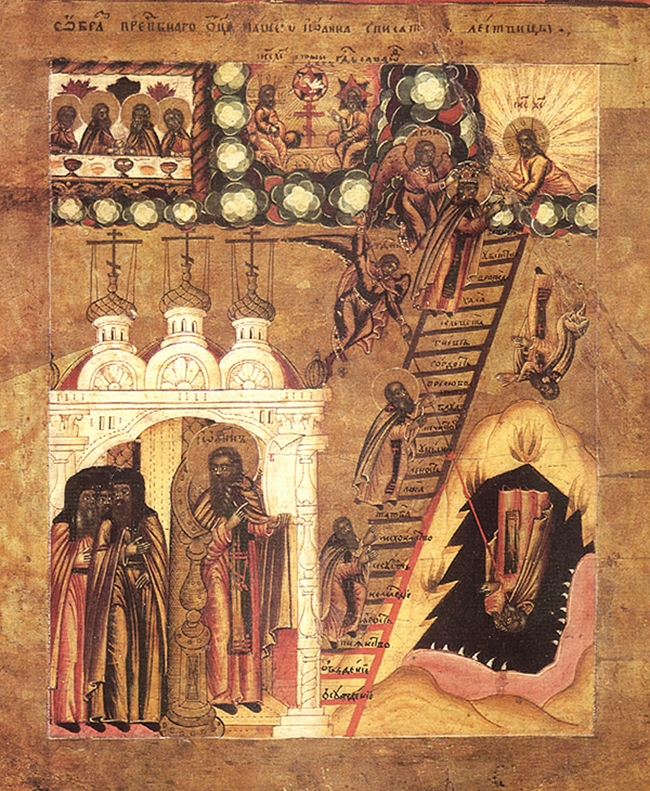
THE LADDER OF DIVINE ASCENT BY JOHN CLIMACUS: ON DISPASSION (step 29)

“By dispassion, I mean a heaven of the mind within the heart which regards the artifice of demons a contemptible joke” says John in the beginning of step #29, as he brings us to the last rung of the ladder before reaching the summit.

Very early in our journey, on step 3, we were introduced to the principle of detachment-turning away from earthly passions.  Dispassion, however, goes beyond struggling to detach from destructive passions, to inner transformation!  We have already broken free from the dominance of passions and temptations and we now experience our lives as transformed.  

“Its effect,” John reports from accounts of those who have reached a state of dispassion, “is to sanctify the mind and detach it from material things, and it does so in such a way that, after entering this heavenly harbor, a man, for most of his earthly life is enraptured, like someone already in heaven, and he is lifted up to the contemplation of God.”  Through dispassion, we are afforded a foretaste of a sanctified life in which “the artifice of demons,” instead of tempting us, appear so contemptible we are reduced to laughter.  

Dispassion is calmness in the face of turbulence.  Dispassion, John reminds us, is also the strength to “keep thoughts under control in the face of praise.”  The latter is much harder than the former.  The highest “state of dispassion is when one is in such close union with God that he is oblivious to any evil around him and there is longer a necessity to control evil thoughts.  At this point he cannot separate himself from God…The will of God becomes for him as sort of inner voice through illumination.”

“Think of dispassion,” John asks, “as a celestial palace with numerous mansions. Think of the forgiveness of sins as being the fortifying wall of Jerusalem.”  If we falter or fail, we can still recapture the palace as long as we make sure that we at least remain within these walls. Forgiveness, therefore, is a basic pre-requisite—even if we have lost everything else.  As long as anger, bitterness, hatred and countless of petty grudges cloud our soul, nothing else can enter.  To be whole, John urges us to break that wall of separation.  He ends with a ray of hope as he reminds that reaching dispassion and sampling the joy of the Resurrection are achievable and within our nature as children of God and that God Himself is dispassion.  

Be still and know that I am God and am Dispassion (Ps 45:11)

THE LADDER OF DIVINE ASCENT BY JOHN CLIMACUS

With Lent coming, we are leaving Philokalia for a while to re-read the Ladder of Divine Ascent by St. John Climacus.

With the exception of the Bible, writes Bishop Kallistos Ware in the introduction of this book, there is no other book as influential and foundational for Orthodox spirituality as the Ladder of Divine Ascent by St. John Climacus.

While addressed to monastics, it embodies the transformational journey that all Christians are capable of, and have a right to, from the tumult of passions and fragmentation to wholeness, inner stillness and unity with God.

We use the edition, translated by Colm Luibheid and Norman Russell. Note, however, that my quotes are from a different, online translation.

You can order the book from Amazon.

STEP ONE

Like all journeys, the Ladder of Divine Ascent consists of many steps. St. John divides our journey into 30 small steps, which he describes and helps us climb one-by-one.

With his help we travel gradually from detachment and renunciation to the acquisition of fundamental virtues, the struggle against passions and finally the cultivation of dispassion and acquisition of inner stillness. When we reach at the top of the summit, we can directly experience the love of God and become God-like.

The first step, before our real climb even begins, is renunciation of the material world as we know it: our dependence on things, indulgences, addictions to passions, assumptions that close our hearts and minds.

Those who enter this contest must renounce all things, despise all things, deride all things, and shake off all things, that they may lay a firm foundation.

St. John’s audience, of course, is other monks who have chosen to leave the world and live a life of prayer. Yet renunciation is not negation but purification. Its three pillars according to St. John are “innocence, fasting and temperance.” They do not describe a simple deficit but the shedding of artifice and the return to a child-like nature:

Let all babes in Christ begin with these virtues, taking as their model the natural babes. For you never find in them anything sly or deceitful. They have no insatiate appetite, no insatiable stomach, not a body on fire…

Hence the return to a child-like state, free from passions and anxiety is possible for all of us.

Why would a citizen of the 21st century want to deprive himself/herself in an age when self-gratification and actualization are inalienable rights? In the hesychastic (and more broadly, Christian) worldview, material gratification and abandon in passions result in slavery of the soul. Renunciation, on the other hand, paradoxically leads to freedom.

The book’s preface quotes St. Augustine as he puts forth a vision of a life in which we are in union with God.

Imagine a man in whom the tumult of the flesh goes silent, in whom the images of earth, of water, of air and of the skies cease to resound. His soul turns quiet and, self-reflecting no longer, it transcends itself. Dreams and visions end. SO too does all speech and every gesture, everything in fact which comes to be only to pass away. All these things cry out: “We did not make ourselves. It is the Eternal One who made us.”

This is the vision that makes the journey worthwhile.

Unlike other meditative traditions, the journey up the ladder is enabled by faith and love. Why would you even want to undertake such a challenging journey without this motivation, John asks?

5. All who have willingly left the things of the world, have certainly done so either for the sake of the future Kingdom, or because of the multitude of their sins, or for love of God. If they were not moved by any of these reasons their withdrawal from the world was unreasonable. But God who sets our contests waits to see what the end of our course will be.

Our journey is not a willful adventure but a disciplined process that can only be undertaken under the guidance of a spiritual father. This journey, hence, should be driven by humility rather than certainty in our own knowledge and abilities.

In the patristic mindset, life is a constant spiritual warfare and the forces of evil and darkness are real and ever present.

We have very evil and dangerous, cunning, unscrupulous foes, who hold fire in their hands and try to burn the temple of God with the flame that is in it. These foes are strong; they never sleep; they are incorporeal and invisible.

The hope for Christians is that “God belongs to all free beings. He is the life of all, the salvation of all—faithful and unfaithful, just and unjust, pious and impious, passionate and dispassionate, monks and seculars, wise and simple, healthy and sick, young and old—just as the diffusion of light, the sight of the sun, and the changes of the weather are for all alike; ‘for there is no respect of persons with God’”. Being God-lie, then, is our heritage to reclaim.

In hesychasm there is a need for direct and personal experience with God. Only through renunciation can we hear God speak to us directly without intermediaries. Renunciation opens the door to the journey of direct communion with Him.

So that we can hear his word, not in the language of the flesh, not through the speech of an angel, not by way of a rattling cloud or a mysterious parable. But Himself. The One Whom we love in everything.

.

SPIRITUAL KNOWLEDGE: ST. PETER OF DAMASKOS

(Philokalia Vol. III, G.E.H Palmer, Philip Sherrard, Kallistos Ware)

We are born, St. Petter writes, with an innate spiritual knowledge which we later lose through passions.

What is the meaning of spiritual knowledge then?

It is the ability to see things as they really are in nature, to uncover the mystery that lies beyond appearance and physical attributes.

The intellect then sees things as they are by nature ….by others it is called spiritual insight, since he who possesses it knows something at least of the hidden mysteries- that is, of God’s purpose- in the Holy Scriptures and in every created thing.

Passions, however, “darken the intellect” and confine us to the surface of things.

Living on the surface is easily exhaustible. We burn through material things, praise, career milestones etc., rapidly. We are, thus, on a frantic course of constantly replenishing the supply and yet, for many of us, a sense of emptiness remains.

The Greeks had an extraordinary understanding of the physical and intellectual realm, we are told, yet they lacked spiritual knowledge, defined here as the discernment of purpose.

Without understanding purpose, one cannot penetrate the true meaning of all things.

…for the pagan Greeks perceived many things but, as St Basil the Great has said, they were unable to discern God’s purpose in created beings, or even God Himself, since they lacked the humility and the faith of Abraham.

Viewed through the lens of spiritual insight, then, nothing is insignificant and worthless. Nothing is dismissible.  Nothing is empty. Even a crumb of bread or a boring daily routine points to a larger meaning and purpose.

 (God’s purpose) is clearly revealed in the world to come, when everything hidden is disclosed.

A significant difference between Christian and other types of meditative traditions is that the true meaning of things cannot be deciphered through our own resources and will not be revealed without faith.

The gnostic ought not to rely in any way on his own thoughts, but should always seek to confirm them in the light of divine Scripture or of the nature of things themselves. Without such confirmation, there can be no true spiritual knowledge, but only wickedness and delusion.

God and his purpose are there to be discovered—ensconced in simple and lofty things alike, in humble daily discourse and scriptural writings. All we have to do is rid ourselves of passions, assumptions and obsession with our self-interest so we can be filled with spiritual knowledge and allow for the revelation to occur.

We have all seen little children’s wonder-filled eyes as they explore the world with hope, faith and awe. Everything is new, sacred, and filled with unending mysteries and delights. Even a speck of dust is a source of wonder and reveals to them something about a vast and unknown world. This is the state of innocence we must achieve in order to be filled with spiritual knowledge.

Peter expounds on the meaning of faith. It is, he says, going beyond the visible to extrapolate the invisible.

A person is said to have faith when, on the basis of what he can see, he believes in what he cannot see.

Yet, discerning hidden mysteries is not enough if you lack faith in their creator. “But to believe in what we can see of God’s works is not the same as to believe in Him who teaches and proclaims the truth to us.

Faith must proceed from the head to the heart. According to St. St. Peter, it is through suffering that one acquires faith, then fear, then awe, then gratitude and humility and, finally, true spiritual knowledge.  

In this way, the person who in faith endures these trials patiently will discover, once they have passed, that he has acquired spiritual knowledge, through which he knows things previously unknown to him, and that blessings have been bestowed on him. As a result, he gains humility together with love both towards God, as his benefactor, and towards his fellow-men for the healing wrought by God through them.