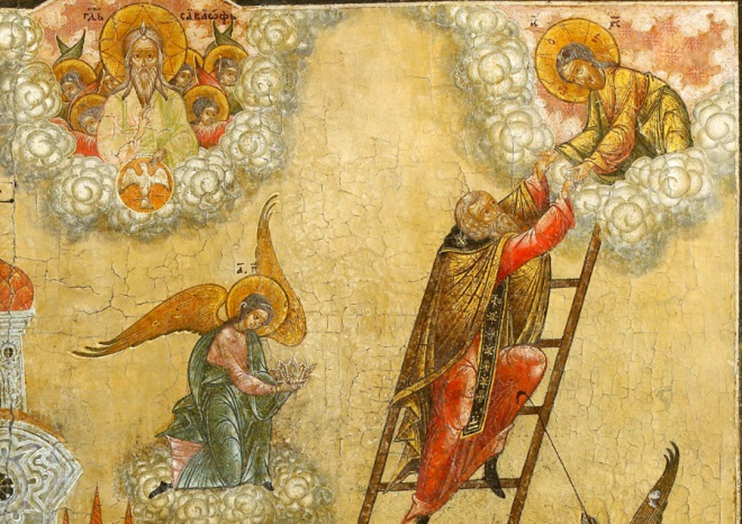
On Faith, Hope and Love, The Ladder of Divine Ascent, step #30

All that remains,” the last chapter begins, “is the triad of faith, hope and love to be fully united to God.” 

At the 30th and last step of the ladder, we have  finally arrived at the summit: theosis or union with God.

When I was younger, I would have expected something rare and powerful at the very top of the Ladder. Infinite wisdom, perhaps; eternal life on earth, immediate sainthood, power over others, miracle-granting authority! Extraordinarily, at the very top of the Ladder is a triad of virtues, with the highest among them being love. Instead of magic powers, we achieve a spiritual state that, though hard, is possible to be achieved by all.

The purpose of all the battles against passions and the cultivation of virtues along  our long ascent on the ladder was to finally experience love in its fullness. Since God is love, we become one with Him. 

To understand the concept of love in the writings of the desert fathers, we must banish our associations with romantic love or obsessive passion. Christian love is not  selective or conditional. It does not ebb and flow with circumstances or mood. Having shed our passions through our ascendance on the ladder, we are free from the blindness of personal agendas, resentments, jealousies, recrimination, desire to control and all the other passions that separate us from God. We are now able to see the image of God in others, regardless of their behavior, flaws, circumstances or mood.

Having achieved the ability to love fully we have not simply acquired a virtue, but become transformed in God’s image:

Love is by its nature resemblance of God, insofar as this is humanly possible.

Achieving theosis is a state beyond words or actions, a true “inebriation of the soul.” When your heart is filled with love, it transforms the way you see and experience the world.

Love grants prophecy, miracles. It is an abyss of illumination, a fountain of fire, bubbling up to inflame the thirsty soul. It is the condition of angels and the progress of eternity. You cannot love God and hate your neighbor because you now see God in him.

You experience love’s “distinctive character,” and thus become “a fountain of faith, an abyss of patience, a sea of humility.” Fear disappears when love consumes you.

Fear shows up when love departs.  Lack of fear means that you are either filled with love or dead in spirit, John observes.

A metaphor often used to communicate the intensity of our love for God is that of a person deeply in love. Just as someone besought with erotic love can think of nothing but the object of that love, those who ascend to the top of the ladder are so consumed by divine love that they may forget to eat and are unaware of physical needs.

Yet unlike bodily passions love of God is not uncontrollable, suffocating and destructive. It does not obliterate our identity and sense of self. Christ gave up his life out of love but retained his personhood.  Instead of consuming and destroying, love of God transforms.

Hope is the power behind love. When hope goes, so does love. “Hope comes from the experience of the Lord’s gifts, and someone with no such experience must be ever in doubt.”  Hope is destroyed by anger.

John’s last admonition is also a glorification: 

We are here at the summit,” he reminds us. “Let the ladder teach us the spiritual unity of these virtues so the “grossness of the flesh” will not hold us back.  And the chapter ends with an unequivocal declaration.

Remaining now are faith, hope and love, these three. But love is the greatest of them all.” (1 Cor. 13:13)
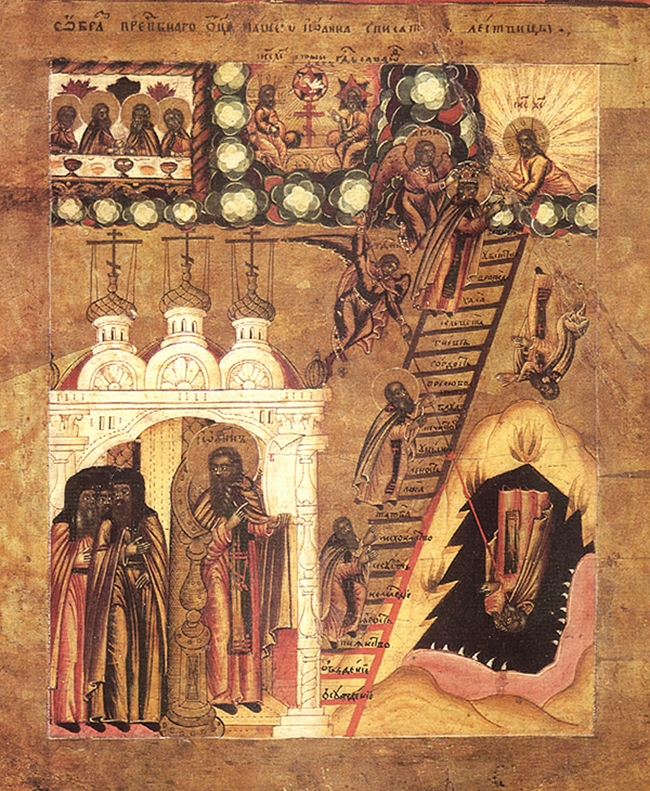
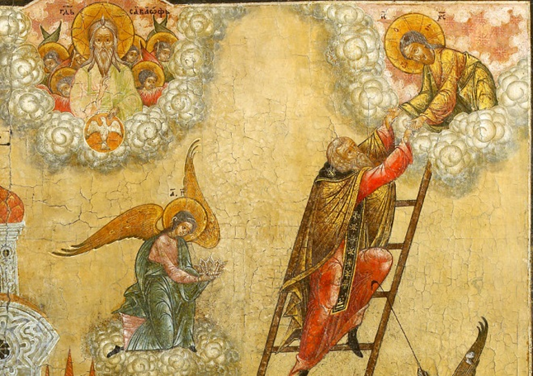
THE LADDER OF DIVINE ASCENT BY JOHN CLIMACUS: ON DISPASSION (step 29)

“By dispassion, I mean a heaven of the mind within the heart which regards the artifice of demons a contemptible joke” says John in the beginning of step #29, as he brings us to the last rung of the ladder before reaching the summit.

Very early in our journey, on step 3, we were introduced to the principle of detachment-turning away from earthly passions.  Dispassion, however, goes beyond struggling to detach from destructive passions, to inner transformation!  We have already broken free from the dominance of passions and temptations and we now experience our lives as transformed.  

“Its effect,” John reports from accounts of those who have reached a state of dispassion, “is to sanctify the mind and detach it from material things, and it does so in such a way that, after entering this heavenly harbor, a man, for most of his earthly life is enraptured, like someone already in heaven, and he is lifted up to the contemplation of God.”  Through dispassion, we are afforded a foretaste of a sanctified life in which “the artifice of demons,” instead of tempting us, appear so contemptible we are reduced to laughter.  

Dispassion is calmness in the face of turbulence.  Dispassion, John reminds us, is also the strength to “keep thoughts under control in the face of praise.”  The latter is much harder than the former.  The highest “state of dispassion is when one is in such close union with God that he is oblivious to any evil around him and there is longer a necessity to control evil thoughts.  At this point he cannot separate himself from God…The will of God becomes for him as sort of inner voice through illumination.”

“Think of dispassion,” John asks, “as a celestial palace with numerous mansions. Think of the forgiveness of sins as being the fortifying wall of Jerusalem.”  If we falter or fail, we can still recapture the palace as long as we make sure that we at least remain within these walls. Forgiveness, therefore, is a basic pre-requisite—even if we have lost everything else.  As long as anger, bitterness, hatred and countless of petty grudges cloud our soul, nothing else can enter.  To be whole, John urges us to break that wall of separation.  He ends with a ray of hope as he reminds that reaching dispassion and sampling the joy of the Resurrection are achievable and within our nature as children of God and that God Himself is dispassion.  

Be still and know that I am God and am Dispassion (Ps 45:11)

THE LADDER OF DIVINE ASCENT BY JOHN CLIMACUS: On Stillness (Step 27)

We are like purchased slaves, like slaves under contract to unholy passions” John writes in the beginning of the chapter.   The metaphor compares lives filled with passions to slavery.  John’s mastery of the human soul shows another, more insidious dimension of this slavery—the longer we stay in it the less we desire freedom because we can neither remember nor imagine what freedom looks, feels and tastes like.  Isn’t it why abused wives, addicts or abusers stay in destructive relationships, even though the right choice seems so logical and simple to those on the outside?  Abuse, violence and dysfunction become the norm after a while, and they can no longer remember or envision what health looks    like.

Not so long ago, I would have been dismissive of anything resembling silence.  How boring! Who would actually pursue it?  For most of us, living with noise and inner clutter is all we have known and defines normal. The Fathers, however, considered the practice of inner stillness an essential foundation of spiritual life.  Being silent is not the same as practicing inner silence. You can be quiet on the outside but tortured by the constant noise of racing thoughts and lingering resentments on the inside. 

Metropolitan Jonah defines inner stillness as “conscious communion’ with God.” He continues: “Inner stillness is not merely emptiness. It is a focus on the awareness of the presence of God in the depths of our heart. One of the essential things we have to constantly remember is that God is not out there someplace. He’s not just in the box on the altar. It may be the dwelling place of His glory. But God is everywhere. And God dwells in the depths of our hearts. When we can come to that awareness of God dwelling in the depths of our hearts, and keep our attention focused in that core, thoughts vanish.

How do we do this? In order to enter into deep stillness, we have to have a lot of our issues resolved. We have to have a lot of our anger and bitterness and resentments resolved. We have to forgive. If we don’t we’re not going to get into stillness, because the moment we try our inner turmoil is going to come vomiting out. This is good – painful, but good. Because when we try to enter into stillness and we begin to see the darkness that is lurking in our souls, we can then begin to deal with it. It distracts us from trying to be quiet, from trying to say the Jesus Prayer, but that’s just part of the process. And it takes time.”

John emphasizes the role of despondency in preventing us from union with God. To achieve stillness, we must be driven by love for God and the desire to experience the joy and sweetness of his presence. This spiritual state requires that any trace of despondency be shed from our soul. “For to link despondency to the loving of God,” John writes, “is rather like committing adultery.

John talks about the clarity we achieve through inner stillness and silence:  ‘Stillness of the soul is the accurate knowledge of one’s thoughts and is an unassailable mind.”  He writes:

 “The start of stillness is the rejection of all noisiness as something that will trouble the depths of the soul….Close the door of your cell to your body, the door of your tongue to talk, and the gate within to evil spirits.” Yet being quiet or away from noise in nature does not necessarily imply stillness. Inner stillness is practiced “in the deep spaces of the heart.” 

When you have arrived at the” final point,” however, fear and rejection of noisiness are no longer concerns because you are immune to them and cannot even detect them.

The Ladder of Divine Ascent by John Climacus:ON HUMILITY (Step 25)

Do you imagine that plain words can precisely or truly or appropriately or clearly or sincerely describe the Love of the Lord, humility, blessed purity, divine enlightenment, fear of God and assurance of the Heart?” John asks at the beginning of this chapter. “If you think so,” he continues, “then you will be like a man who, with words and examples, tries to convey the sweetness of honey to those who never tasted it.” And this is how John introduces us to a virtue that is the foundation of all others and the antidote to all passions.  

In this chapter we are ascending the top rungs of the ladder. We have battled destructive passions and are now concentrating on acquiring virtues. We are entering a deeper level of communion with God that cannot be easily captured in words or images. True humility can only be experienced.  It is a treasure that “eludes adequate description,” we are told. “Humility is a grace of the soul and with a name known only to those who have had experience of it.” It cannot be acquired through persuasion.  Neither, as John tells us, can it be learned from books, men or angels but only from Christ who dwells inside of us.  

The path to humility is long and achieved through the same stages all spiritual travelers pass through on their journey: Purification, Illumination and Theosis.  While it different for each of us, the destination is the same. “The appearance of this sacred vine is one thing in the winter of passions, another in the springtime of flowering and still another in the harvest time of all the virtues.” Yet all stages have one thing in common: joy and signs of the harvest to come.

A Parent of young children among us asked whether the path to humility posed a dilemma to parents today. Do we guide our children toward humility and detachment or toward aggressiveness and competitiveness, she wanted to know. Aren’t these two necessary for career success?  We decided that there was no contradiction there.  Ascending the Ladder is not a path to weakness but to inner strength.

The struggle, perseverance and discipline it takes to go against our very nature and seize control from destructive passions nurtures true inner strength.  Conversely being controlled by passions and disguising pride, envy or fear under superficial aggressiveness sap our strength and soul. Living in Christ and guided by virtues rather than torn by passions is the strong foundation on which everything else, including academic or professional achievements, can be built and sustained.