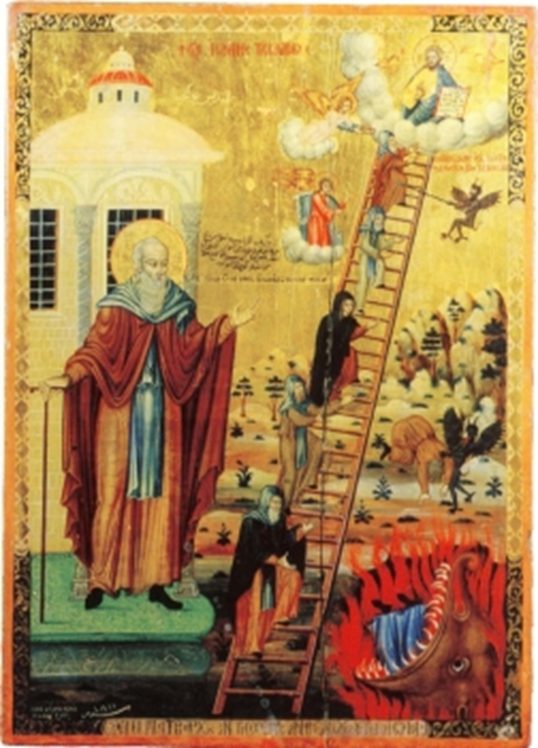
THE LADDER OF DIVINE ASCENT BY JOHN CLIMACUS: On Prayer (step 28)

“Prayer,” John tells us in the beginning of this chapter, “is future gladness, action without end, wellspring of virtues, source of grace, hidden progress, food of the soul, enlightenment of the mind, an axe against despair, hope demonstrated, sorrow done away with.”  This stream of lyrical metaphors establishes an important theme: prayer is not a discrete act, strictly confined to a specific place and time.  It is nourishment to our souls; the personal experience of God’s presence which can dwell ceaselessly within us.

John leads us to gradually deeper stages of prayer from simply keeping physical prayer routines to transforming your entire life into ceaseless prayer.

The first step is to prepare for prayer through purification:   

The beginning of prayer is the expulsion of distractions from the very start by a single thought.

Prayer is tarnished when we stand before God, our minds seething with irrelevancies. It disappears when we are led off into useless cares. (p.277)

Distractions from mundane cares and seething passions are likened to imprisonment, keeping us from the shining freedom achieved through prayer.

If you are clothed in gentleness and in freedom from anger, you will find it no trouble to free your mind from captivity (p. 276)

Simplicity and submission are the antidotes to distraction: “Pray in all simplicity,” John tells us. ”Avoid talkativeness lest your search for just the right words distracts you.” In fact, “when a man has found the Lord, he no longer has to use words when he is praying …”

You truly pray when you ask for understanding of His and submerge your  ego to it.   “While we are still in prison, let us listen to him who told Peter to put on the garment of obedience, to shed his own wishes and, having been stripped of them, to come close to the Lord in prayer, seeking only His will.

The Fire that Resurrects Prayer

It is easy to forget that prayer is a gate to the presence of God and begin to see our daily prayer rituals as chores or even disruptions to our busy lives. John reminds us that prayer is not an opportunity to make requests but a reward unto itself as a vehicle for uniting with God. 

“What have I longed on earth besides you? Nothing except to cling always to you in undistracted prayer!”

The stage of unity of God is not one of passive submission but of spiritual transformation. John uses the metaphor of fire to describe it: “When fire comes to dwell in the heart,” he says, “it resurrects prayer.”

Such an ecstatic state is not achieved on demand. We live in a time when service or information on demand, anytime, anywhere, is considered our birthright and the natural course of events. Yet, reaching this mystical, prayerful state cannot be achieved through our own efforts and at our chosen time, but only through God’s Grace. This is why when, by God’s Grace, our souls are suddenly gifted with a moment of true prayer, we must not let anything interfere with it. “Do not stop praying as long as, by God’s grace, the fire and the water have not been exhausted (as long as fervor and tears remain), for it may happen that never again in your whole life will you have such a chance to ask for the forgiveness of your sins.

One of the greatest dangers in our time is to look for shortcuts to ecstatic communion with God, replacing the fire of God’s presence in prayer with the superficial “high” of excess or addiction—whether it is drugs, extreme sports, workaholism or other compulsion.  The danger for us, practicing Christians, is to transfer this attitude to our prayer life, seeking “highs” in our prayer and worship experiences and judging their quality of the basis of the emotions we believe we should be feeling.  Forcing the emotions  we think we should be feeling in worship and judging rather than submitting to prayer and worship—leads some to constantly “shop” around for churches or for rapturous worship experiences which, ironically, does not give them the inner stillness needed to truly pray.  

We shouldn’t confuse the fire that is stoked by the labor of ascending the Ladder and emptying ourselves from passions, with artificially induced emotions.  The fire that comes to dwell in the heart and engenders true prayer is achieved through the Grace of God rather than our will and through spiritual warfare. Above all it transforms rather than to simply excite  or entertain us.  

Prayer as Transformation

John places a great deal of weight on the transformative role of prayer. He considers those who emerge from prayer without having experienced [illumination, joy or peace] to have prayed bodily rather than spiritually. “A body changes in its activity as a result of contact with another body. How therefore could there be no change in someone who with innocent hands has touched the Body of God?” 

John, however, is a pragmatist and wants us to at least adhere to the discipline of prayer routines, even when our hearts are closed and are not participating in the prayer. Committing to these routines eventually allows our hearts to follow our bodies.

For those who have achieved the higher level of true prayer, prayer is no longer a distinct activity but a continuous spiritual state.

John tells us that we should aspire to this state of continuous prayers. In is living life as prayer than our lives are transformed. We experience life—even its most insignificant moments or mundane elements —as “as sacrament” (as Schmemann puts it).  Life is lived as whole; there is separation between sacred and secular; worldly and prayer life. We may have a set time for prayer, but we are already prepared for it by “unceasing prayer in [the] soul.”
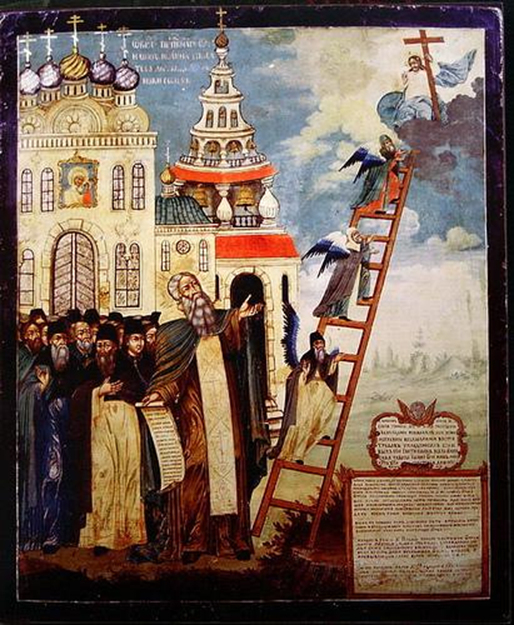
The Ladder of Divine Ascent by John Climacus: ON DISCERNMENT (Step 26)


Acquiring virtues, rung by rung in the Ladder, is not a simple, linear act. In this chapter, John explores the complexity of virtues; the thin and changeable boundaries that sometimes barely distinguish them from passions.  We have reached a higher level of spiritual growth at this stage that requires more than fighting passions—the understanding of the nuances of truth and the ability to clarify even the subtlest shades of ambiguity. This is why discernment, in addition to hard labor, is necessary at this rung of the Ladder. John highlights some of ambiguities and nuances of situations we should be aware of.

For one thing, the struggle for spiritual ascent is not uniform. John recognizes that virtues like silence, humility and temperance may come easily to some personalities while others have to struggle against their own natures to achieve them. Because the latter clearly have to work harder, John (somewhat reluctantly) considers their achievement to be a little higher than the others’.

Another complexity is that virtue is often mingled with malice and requires discernment and alertness to detect the dividing line between them. Love may conceal lust; hospitality, gluttony; discernment, cunning manipulation of a situation; hope, laziness; tranquility, despondency. To make this message clearer, John likens it to drawing water from a well and accidentally bringing up a frog with it. 

Over-achievement of virtues or pursuing them to earn praise is a grave danger that is no different from  the soul-destroying addictions of our own times–obsession with achievement and professional status; addictions to ambitions that turn us into workaholics; and lives spinning out of control by stretching our budgets, habits or expectations beyond what we can afford or deliver, plunging us into constant anxiety, fear and, eventually, despair.

John probes even more deeply into the risks of delusion and calls for extraordinary and finely hewn ability for discernment. “Monks should spare no effort in becoming a shining example in all things,” he states. Yet even when reaching for heaven we may be in danger of spreading ourselves too thinly, and “have our wretched souls be pulled in all directions, to take on, alone, a fight against a thousand upon thousands and ten thousands upon ten thousands of enemies, since the understanding of their evil workings, indeed even the listing of them, is beyond our capacities.”   I can’t imagine a more accurate description of men and women in our time–the modern professional, driven executive or ambitious soccer mom with a management agenda for her children’s lives.  The alternative is to discern God’s will for the right balance. “Instead, let us marshal the Holy Trinity to help us” John advises. Yet it takes humility to give us the discernment to acknowledge the reality of our limitation and need for God’s help.  And it takes patience to discern God’s will:

Discernment will also help us make a crucially important distinction—that between God’s will and timing and delusion and false timing, forced by our own will. “If God, who made dry land out of the sea for the Israelites to cross, dwells within us, then the Israel within us, the mind that looks to God, will surely make a safe crossing of this sea…”  And John adds:  if God “has not yet arrived in us, who will understand the roaring of the waves, that is, of our bodies?   Let’s pray for God to dwell in us and for humility to discern his will.

THE LADDER OF DIVINE ASCENT BY JOHN CLIMACUS

Step 4 On blessed and ever-memorable obedience

Having renounced the world, St. John asks us to renounce ourselves in order to ascend the next rung in the Ladder.

Obedience is absolute renunciation of our own life, clearly expressed in our bodily actions.

How can we, as modern men and women, view the concept of obedience which is such a fundamental requirement to your ability to ascend the Ladder? After all, questioning authority, challenging boundaries and deconstructing received truths are part of the definition of the modern hero. Are we called to dutifully obey all those with authority over us? Is our ideal self, someone like Dilbert, mindlessly performing menial tasks and unable to form a single thought independently? Are there limits to obedience? Should you obey an abusive husband or boss for example? Or comply with the requests of someone whose judgment is impaired?

To grasp the meaning of “obedience” in ascetic life, we must first drop all familiar associations.

Let’s first consider the context. “Obedience” in ascetic spirituality refers to the relationship of a monastic to his spiritual director. Hence, obedience is exercised within an agreed upon relationship and assumes a consensual framework. Without mutual agreement and consent you have tyranny rather than obedience. For example, spiritual directors use their authority on those who have willingly entered the monastery and, hence, have already accepted a life of obedience. Conversely, the directors have accepted responsibility for guiding the souls of those in obedience to them, to lead them to salvation.

Christianity is practiced in community. No man is an island.

The concept of obedience is not alien to the modern world. The journey of healing in all 12-step and similar programs that fight addiction begins with humility and obedience. You must admit that you are powerless over a habit or addiction and seek a guide for your recovery journey. The concept of mentorship exists in multiple realms of   life—from sports to business, artistic and trade apprenticeships.

Mother Raphaela, of the Holy Myrrhbearers monastery points out that the roots of the word “obedience” are in the Latin obaudire which means to listen. In that sense, relationships between husband and wife, parents and children are built on a construct of obedience in that they all involve mutual “listening” — mutual obligations and responsibilities for the salvation of the relationship rather than the fulfillment of one’s own will.

Ironically, as in the case of detachment, obedience becomes a gateway to freedom by releasing us from the tyranny of our own will. Self-will, which we often mistake for freedom, tethers our lives to the unceasing need to control and impose on others our script for how the world should run. It usually results in conflict, disappointment and bitterness as the world constantly falls short of our expectations. St. John shows us that faith and trust are gateways to obedience:

Obedience is the tomb of the will and the resurrection of humility…You who are therefore trying to lay your own burden on Another’s shoulders, you who are hastening to sign a pledge that you are voluntarily surrendering yourself to slavery, and in return want freedom written to your account, you who are being supported by the hands of others as you swim across this great sea—

Levels of Obedience and Surrender

To show us how obedience becomes the bridge to salvation, St. John tells a story as an example.

A repentant robber seeks to enter a monastery John was visiting. As a prerequisite to being admitted, the Abbott asks him to confess his sins before the brothers as an indication of his penitence. The robber complies, but the Abbot is still not convinced of the sincerity of his repentance. The robber next dons a hair shirt and ashes, has his hands tied behind him and appears humbled before 230 brothers at the monastery. The Abbot knows that, while he said the right things, he has not yet experienced true mourning. Eager to be admitted, the robber raises the bar and offers to confess his sins in the middle of the city square as an indication of his humility. Yet the Abbott still does not deem him worthy of admission. Suddenly, struck by a new awareness of his sins and filled with remorse, the robber drops to the ground, sheds real tears and confesses all his sins (pp. 94-95}. At that moment, he is probably not even worrying about the impression he  makes on the Abbot or what he has to do to convince him. I picture him so crushed by a fresh awareness of the magnitude of his sins and the state of his soul that he has no interest in impressing others. The Abbott recognizes the sincerity of his repentance and admits him.

He later explains to St. John his reasons for making the robber wait for that long: had he admitted him before the robber fully faced his past and repented with his whole heart, he would have doomed him to a life of torment with his past sins still dwelling in him unresolved, and gnawing at his soul. Another consideration, the Abbot continued, was the opportunity to give an example to the brothers.

This pastor understood that public confession or displays of humility did not go far enough to render the robber completely transparent to God and the brothers. True repentance has to engage the heart completely without a shred of deception or attempts to hold back.

How often do we think we have forgiven or accepted something, mistaking what is only intellectual understanding for deep commitment of the heart? During moments when we are suddenly able to peel the last layer of the onion of our consciousness and our hearts are touched by love or grief, we just know it. There are no doubts or ambiguities; and the world looks different, even for a moment, as we experience it authentically.

The Abbot recognized that the robber’s repentance had not yet reached the heart and pushed him to the fullness of being through surrender to true mourning. Yet it was obedience–the robber’s willingness to put his complete trust in the pastor and dig deeper into his soul than he thought necessary-that enabled salvation and forgiveness.

This is the ideal of obedience. We do not achieve salvation alone and on our terms, but through communion with others and, especially, relationships bound by obedience to a spiritual director.