(Philokalia Vol. III, G.E.H Palmer, Philip Sherrard, Kallistos Ware)
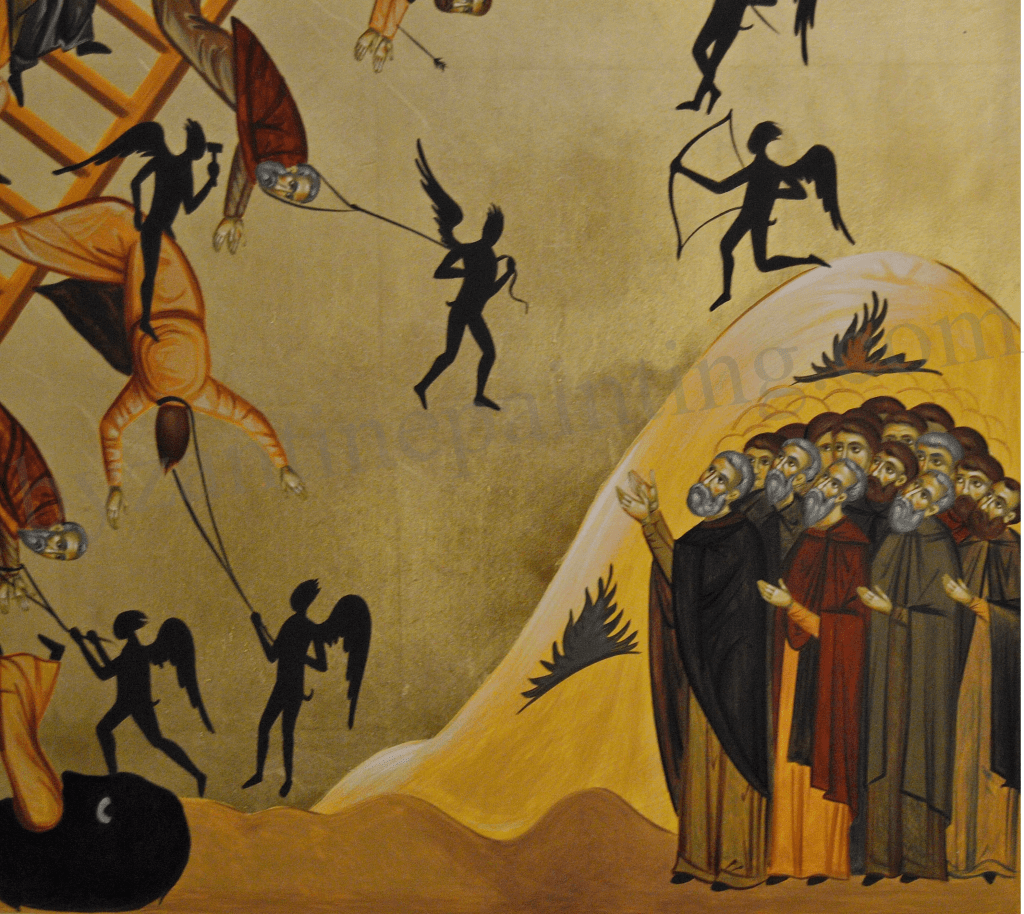
“Without knowledge no one does anything good,” says Peter of Damaskos in his chapter, “The Remembrance of Christ’s Sufferings.”
We are told the story of a virgin who came up to an Abba while he was sitting with St. Anthony. She proudly listed all the hardships she had endured for the sake of Christ — fasting, scriptural readings, poverty and abandonment of all earthy things. Yet, when questioned by the elder, it turned out that her strict, ascetic practice had not resulted in dispassion, compassion, love, and discernment.
‘Go, get to work,” admonished the elder, “you have accomplished nothing.‘
St. Peter concludes:
So, with this virgin: because she did not know what was really needed, she laboured in vain.
What is it that the virgin should know?
Let’s first keep in mind that the “spiritual knowledge” we read about in patristic writings differs a great deal from all other forms of knowledge–theoretical and empirical.
The goal of spiritual knowledge is not merely to preserve in memory facts or ideas but to acquire discernment– the ability to distinguish between good and evil, truth and falsehood. It is mystical knowledge, acquired through direct participation in God’s essence. It results in transformation rather than mere enrichment. Archim. Dr. Teofan Mada, considers spiritual knowledge, “knowledge in and by love.”
The Eastern Church Fathers underlined the specificity of the christocentrical knowledge as knowledge in and by love that is a knowledge of love which binds the one who knows and the one who is known. In love and by love, one can discover the way of Truth and of the real knowledge.
Teofan Mada, Love and Knowledge in the Patristic Tradition https://www.orthodox-theology.com/media/PDF/IJOT1.2014/Mada.pdf
Paradoxically, achieving discernment requires that we empty, rather than add to, our intellect.
we withdraw our intellect from all that it has known or heard, and concentrate it on the remembrance of God…
Thoughts, images and even colors cloud our mind. Our own will and personal interpretation of things prevent us from discerning God’s revelations and uniting with Him.
To be ‘in peace’ means to have no thoughts, whether bad or good, because, as Evagrios says, if the intellect perceives something, it is not in God alone, but also in itself. This is true; for since God is undetermined and indeterminable, without form or colour, the intellect that is with God alone should itself be without form or colour, free from all figuration and undistracted. Otherwise, it will be subject to demonic illusion.
Most of us take for granted that our basic perception of objects and ideas, and the distinctions between good and evil, true and false, are self-evident to us and we are firmly in control of our reality. We are confident that the way we perceive and understand the world is correct and do not see illusion as an imminent threat.
Imagine the level of humility and spiritual openness it must take to silence all conclusions and assumptions inside us. Yet this is the magnitude of humility required to truly empty ourselves and learn.
For St. Peter and the other Dessert Fathers true humility and transparency mean the willingness to admit that no true knowledge can be achieved without God’s help and, hence, that we are in danger of self-delusion at every moment in our lives.
There is nothing astonishing in the fact that the devil assumes the form of ‘an angel of light’ (2 Cor. I I : I4), for the thoughts that he sows in us also appear to be righteous when we lack experience. Humility is the gateway to dispassion, said St John Klimakos;
We are constantly on a precipice, requiring constant vigilance and spiritual knowledge to keep from falling. St. Peter makes mention of two disciplines for preventing delusion:
- Meditation on the suffering of Christ as it humbles us and joins us to Him in love.
- The need for a spiritual counselor, mentioned multiple times in these chapters.
…unless we have taken advice from someone of experience, we should not entertain any thought, whether good or bad, for we do not know which it is. For the demons take whatever shape they want and appear in this way to us, just as the human intellect is shaped by what it wants and is coloured by the forms of the things that it perceives.
Just as the first step in Alcoholic Anonymous is to admit our powerlessness over our addiction, we must admit our powerlessness over illusion and ask for help.
Just as someone who lacks horticultural knowledge, on seeing the flower and thinking that it is the fruit, rushes forward to pick it, not realizing that by picking the flower he destroys the fruit, so it is here: for, as St Maximos puts it, ‘To think that one knows prevents one from advancing in knowledge. ‘2 Hence we ought to cleave to God and to do all things with discrimination. Discrimination comes from seeking advice with humility and from criticizing oneself and what one thinks and does.
 Readings in Philokalia
May God continue to bless your ministry
LikeLike
Thank you so much.
LikeLike