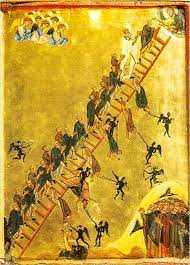
The conventional understanding of “sin” is that of transgression of very concrete rules and laws.
This is how Wikipedia defines it:
Among some scholars, sin is understood mostly as legal infraction or contract violation of non-binding philosophical frameworks and perspectives of Christian ethics, and so salvation tends to be viewed in legal terms.
It continues with the relational definition of sin:
Other Christian scholars understand sin to be fundamentally relational—a loss of love for the Christian God and an elevation of self-love…
Hesychasts built on the relational definition of sin but delved to an unprecedented depth into the effects of the loss of love of God. In this sense, their profound understanding of the intricacies of the human soul, and the difference between healthy and unhealthy spiritual states, predates psychology and the steps to mental health that behavioral psychology espouses.
In step 18, St. Johns talks about insensibility “that is, deadening of the soul and the death of the mind before the death of the body.”
Have you had moments when the horrors shown on TV stir up indignation but do not touch your heart or bring tears to your eyes? Or when you are shocked to realize that at a particular moment, while you know you love your family, your heart is closed, and your feelings are frozen? The Ladder recognizes these moments of spiritual paralysis and their consequences on our salvation:
Insensibility both in the body and in the spirit is a deadened feeling, which from long sickness and negligence lapses into loss of feeling.
The word for insensitivity in the original Greek is anaesthisia—the same root as in “unaesthetic;” – loss of sensation, deadening of the senses.
Αναισθησία και στα σώματα και στις ψυχές είναι απονεκρωμένη αίσθησις, η οποία από χρονία ασθένεια και αμέλεια κατέληξε να αναισθητοποιηθή.
St. John forces us to face the consequences of insensitivity. Occasional insensitivity will become a habit causing “benumbed thought; the birth of presumption; a snare for zeal; the noose of courage; ignorance of compunction; a door to despair; the mother of forgetfulness, which gives birth to loss of the fear of God. And then she becomes the daughter of her own daughter.”
Insensitivity, constant sleepiness or dullness often hides a deeper attempt to escape into fantasy, apathy and sloth so we will have to face and engage with reality. Alertness, on the other hand, gives us a fighting chance to resist evil and withstand misfortune. It gives us clarity of mind and full presence in the moment to discern the glory of God all around us.
A state of alertness, John tells us, “is a quenching of lust, deliverance from fantasies in dreams, a tearful eye, a heart made soft and gentle, thoughts restrained food digested , passions tamed spirits subdued, tongue controlled, idle imaginings banished.”
Without alertness, our life slips through our fingers like a dream, and we are unable to be in the presence of God.
How many times are we absent from our own lives in mental and emotional “sleepiness?” Maybe we are too tired to engage with our family, opting to lay half- asleep in front of the TV with a bottle of beer. Or our minds are so cluttered with lists of chores to be done, worries about our next day’s presentation at a meeting, anger about perceived insults, that we barely take note of the beautiful spring day outside. Our senses and feelings have been so dulled that while we register others’ pains and sufferings and sympathize in our minds, our hearts cannot be engaged no matter how much we try to push our feelings.
Indulging in sleep or, as John calls it, a state of somnolence is “stealing half our life time or more.”
Alertness is focus; sharpness; full presence in the moment; a kind of spiritual transparency that allows God to enter unencumbered.
Fear (step 21) is another thief of souls. St. John, calls it “unmanly… a childish disposition in an old, vainglorious soul.”
Fear of course stems from focusing on what might happen in the future and prevents us from living life in the present. St. John goes further, however, to link fear with pride and vainglory.
If we didn’t think we deserved more than we had, we would not be afraid of loss. If we did not live to gain others’ acceptance and impress them with our wealth, position, looks and other material things, we would not spend our days in fear of rejection, disrespect or humiliation. If we think that we, alone, can battle to save ourselves, fear can grow into despair.
Cowardice is a falling away from faith that comes of expecting the unexpected. Fear is a rehearsing of danger beforehand; or again, fear is a trembling sensation of the heart, alarmed and troubled by unknown misfortunes. Fear is a loss of conviction. A proud soul is a slave of cowardice; it vainly trusts in itself and is afraid of any sound or shadow of creatures.
 Readings in Philokalia
Thank you. As someone who does not identify with any religion, I can still recognise this in my process, and though a lonely traveller I can find a connection albeit historically. I find I stay stuck with these drivers if I confront them. I have to find and accept what is cowardly or diverting me into slothfulness and bring them home like lost sheep into the fold, to function as part of the whole. They mean well, but they need loving acceptance and the faith to hand over our protection to divinity. Best Wishes.
LikeLike