Intermingling Our Soul with God Himself, St Maximos the Confessor

Various Texts on Theology, the Divine Economy, and Virtue and Vice, Third Century, #22-30
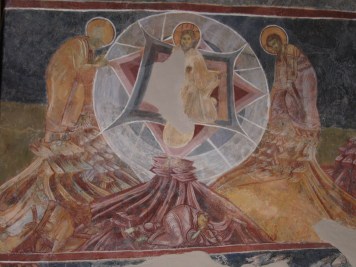
Building on the theme of gratitude that he introduced in the last few pages, St. Maximos makes us look at our relationship to God, and the path to complete union with him, through a number of different lenses.

STILLNESS

First, he depicts the state of true inner stillness of both thoughts and senses that the death of passions, the practice of virtues and gratitude enable.

Truly blessed is the intellect that dies to all created beings: to sensible beings by quelling the activity of the senses, and to intelligible beings by ceasing from noetic activity.

While purifying ourselves from dependency on worldly things is a first step, restraining our thoughts is another, even more difficult task. It involves resisting the temptation of dwelling on the “what if’s,” the “why not’s” and the “why me’s” that St. Maximos calls “outlandish speculations” that “disturb [our] contemplative activity.” They clutter our intellect and enmesh us into the ever-deepening pools of discontent, self-pity, resentment, depression, anger and desire to control.

Only through such “death of the intellect” –freeing ourselves from the tyranny of circular thinking– can our intellect become “able to receive the life of divine grace and to apprehend, in a manner that transcends its noetic power, not simply created beings, but their Creator.” This is when we will be able to understand and experience God’s goodness and truth.

GOODNESS AND TRUTH

Goodness, St. Maximos tells us, is more than practicing virtuous deeds. We experience it when the goodness of our actions is mirrored by the goodness dwelling in our hearts. Goodness represents “the lull expression of divine activity within us” not just on the outside.

The complement of   goodness is truth, “the simple, undivided knowledge of all the qualities that appertain to God.”

Goodness and truth, then, are not extrinsic qualities, foreign to our nature, but part of nature. They are not intellectual abstractions but dwell in our hearts and link action with the intellect, “nous.”

With our intellect purified and renewed, we can experience goodness and truth and partake of God’s holistic, integrated universe in which practice is united with action, and contemplative life with natural truth.  By rejecting created things, we have paradoxically reunited with them on a deeper level by looking past appearance to discern their inner essence and intrinsic goodness.  And by attaining spiritual knowledge, we transcend intellect itself.

When goodness and truth are attained,’ we move more easily toward true union with God because “nothing can afflict the soul’s capacity for practicing the virtues, or disturb its contemplative activity with outlandish speculations; for the soul will now transcend every created and intelligible reality, and will enter into God Himself, who alone is goodness and truth and who is beyond all being and all intellection.”

TRANSFORMED RELATIONSHIP TO GOD ON THE PATH TO THEOSIS

Yet nothing can be attained without the grace of God, St. Maximos reminds us. To “enter into God Himself,” we must have experienced gratitude for his grace and, hence, restored our relationship with Him to the proper balance and proportions.

“Blessed is he who knows in truth that we are but tools in God’s hands,” St. Maximos says. “…that it is God who effects within us all ascetic practice and contemplation, virtue and spiritual knowledge, victory and wisdom, goodness and truthAll the achievements of the saints were clearly gifts of grace from God.

While we are but “tools of God,” we are engaged in a dynamic relationship with him in which we are far from passive. Though “we contribute nothing at all” to our achievements, there is one exception: our willingness and desire; “a disposition that desires what is good.”  And while our contribution is small, in relationship to God’s, it requires an arduous, lifelong journey of continuous ascendance and transformation.

Even though a saint does not achieve anything by himself, St. Maximos says,  but only through “the goodness granted to him by the Lord God according to the measure of his gratitude and love… what he acquired he acquired only in so far as he surrendered himself to the Lord who bestowed it…”  

Our journey then is not solitary but relational, transformational and synergistic.

OUR JOURNEY TO LOVE AND UNION WITH GOD.

As we ascend toward theosis, our vision is transformed, revealing more of God’s true nature and giving us a glimpse of his unspeakable beauty.

“In goodness the beauty that is according to God’s likeness is made manifest.

Our purified intellect, now free of obsessive thoughts, achieves spiritual knowledge which “makes manifest the dignity of the divine image in a wholly unsullied state.”  

In other words, a different world is gradually revealed to us because we no longer rely on our limited, human intellect. Through “the life of divine grace,” our intellect has transcended itself and its own “noetic power.” We are now able to comprehend “not simply created beings, but their Creator.”

This is not the same world we experienced when were torn apart by anguish, anger, disappointment, discontent and despair. In this transformed reality, we become one with God as goodness and truth “give rise to the love that unites men with God and with one another. This love wrests the soul away from all that is subject to generation and decay and from all intelligible beings that are beyond generation and decay, and – in so far as this can happen to human nature – it intermingles the soul with God Himself in a kind of erotic union, mystically establishing a single shared life, undefiled and divine.
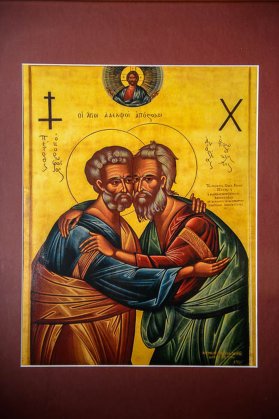


Life Lived in Gratitude, St. Maximos the Confessor

Various Texts on Theology, the Divine Economy, and Virtue and Vice, Third Century, # 11-22

In existentialism, freedom is the ability of individuals to define their own meaning of life despite the absurdity of a meaningless universe. St. Maximos tells us that salvation is a process of reunification with God and that confining the world to the limitations and loneliness of one’s own self, is enslavement and death.
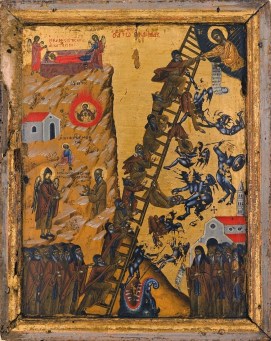
Far from being random and meaningless, the travails of the human condition are opportunities for cultivating humility, growing spiritually and coming closer to God.

For St. Maximos and other desert fathers, achieving victory over passions and adversities is not transformative unto itself. To affect transformation, events or actions must contribute to a fundamental reorientation of self, such as when we convert victory into gratitude. Instead of enabling fragmentation between ourselves and an absurd and capricious universe surrounding us, we experience unity with God and full participation in divine intelligence, when we acknowledge God’s help in achieving this victory.

Providence has implanted a divine standard or law in created beings, and in accordance with this law when we are ungrateful for spiritual blessings we are schooled in gratitude by adversity and brought to recognize through this experience that all such blessings are produced through the workings of divine power. This is to prevent us from becoming irrepressibly conceited, and from thinking in our arrogance that we possess virtue and spiritual knowledge by nature and not by grace.

When victory over passions or adversity increases our delusion of power and hardens us with arrogance, gratitude is replaced by a sense of entitlement and growing distance from God.

…For when conceit about one’s virtue is left undisciplined it naturally generates arrogance, and this induces a sense of hostility to God.

In Tolstoy’s War and Peace, charismatic Prince Andrei Nikolayevich Bolkonsky leads a life of reason and success yet one devoid of gratitude and joy. He rids himself of his habitual cynicism when once, on the battlefield, he gazes on the vastness of the night sky and is lost in contemplation. He senses the transformative nature of his encounter with a universe so much more enormous than himself and vows to change his life. But without accepting Christ and humbling himself to him, he misinterprets the signs, believing that he must now live for himself alone and not for others. As a result, he isolates himself further, hardens his heart and narrows his vision, losing his interest in war and politics and refusing to forgive his then fiancée, Nastasha Rostova, for her unfaithfulness.  It is only on his deathbed that his cynicism leaves him. He is suddenly filled with gratitude over Natasha’s tender nursing of him and forgives her. He sees his life as a gift and experiences love. After a dream in which death is revealed to him as an awakening to a new life, he dies peacefully.

St. Maximos sees ingratitude as fragmentation and gratitude as wholeness and union. Acknowledging the self as the ultimate authority and desired destination is tantamount to willingly locking oneself in a dark and narrow jail cell. Conversely, instead of being confining, true gratitude and submission to God opens the gateways to freedom.

Think about it. People, like organizations, become stale when self-satisfied and confident. In my experience as consultant, organizations that lacked curiosity about their customers and the outside world; were devoid of “hunger” and were indifferent to continuous learning and improvement, were those that stagnated and died. St. Maximos made similar observations about the state of our souls:

He who thinks that he has achieved perfection in virtue will never go on to seek the original source of blessing, for he has limited the scope of his aspiration to himself and so of his own accord has deprived himself of the condition of salvation, namely God. The person aware of his natural poverty where goodness is concerned never relaxes his impetus towards Him who can fully supply what he lacks.

He who has perceived how limitless virtue is, never ceases from pursuing it, so as not to be deprived of the origin and consummation of virtue, namely God, by confining his aspiration to himself. For by wrongly supposing that he had achieved perfection he would forfeit true being, towards which every diligent person strives.

In Eastern Orthodoxy we believe that man was originally created in communion with God and that the path to salvation is a continued journey toward theosis—union with God. Anything that disrupts this unending journey is an obstacle to salvation. St. Maximos tells us that ingratitude, and the belief that you are the sole author of your achievement, impedes the journey upward and returns us from the pursuit of life in God’s likeness to the isolation of a jail cell, inhabited only by us. Salvation is not achieved by our own will but though the grace of God. Gratitude for his grace fuels and re-energizes our journey, opens the gates to continuous spiritual growth and increases our desire for theosis.

Stages of Descent and Ascent: St Maximos the Confessor

(Various Texts on Theology, the Divine Economy, and Virtue and Vice, Second Century #89-100)

theosis1St. Maximos recounts for us the stages of sin and pits them against the stages of spiritual contemplation that lead to salvation.
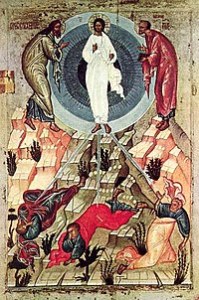
He starts by clarifying that “appetites and pleasures” are not sins unto themselves. They are “in accordance with nature” and “not reprehensible, since they are a necessary consequence of natural appetency.”

It is the devil’s perversion of nature, not nature itself, that creates confusion and enslaves us to sin. St. Maximos compares the devil to the kingdom of the Assyrians (cf. 2 Kgs.18:11) that “has organized a war against virtue and spiritual knowledge, plotting to pervert the soul through the soul’s innate powers.”

His focus is not on static stages but the often-imperceptible processes of evolution as experienced by the senses and intellect. First, the demonic force “stimulates the soul’s desire to develop an appetite for what is contrary to nature and persuades it to prefer sensible to intelligible things. Then it rouses the soul’s incensive power to struggle with all its might in order to attain the sensible object which it desires. Finally, it teaches the soul’s intelligence how to contrive opportunities for sensual pleasure.”

This is why, though the created world is not evil, itself, he who has not yet achieved spiritual knowledge “is trying to escape from the confusion of sin” by renouncing passions since he is vulnerable to being overcome by them.

What a great tragedy that, lost in confusion, we are unable to see “the true nature of visible things” and discern in them “the divine and incorporeal essences of noetic realities;” the “images of His unutterable glory…”

Our only hope is to replace the perversion of the intellect that the devil brings upon us with the restoration of the true, God-given nature of creation through spiritual contemplation. St. Maximos presents to us the stages of such contemplation. Unlike the process of perversion and fragmentation that leads to our subjugation to sin, the ascent to theosis is one of integration, oneness and transformation. Renunciation of sin must be accompanied by the practice of virtue; word must be backed by deed:

If the words of God are uttered merely as verbal expressions, and their message is not rooted in the virtuous way of life of those who utter them, they will not be heard. But if they are uttered through the practice of the commandments, their sound has such power that they dissolve the demons and dispose men eagerly to build their hearts into temples of God through making progress in works of righteousness.

No matter how far along the path of spiritual contemplation we are, we can never fully hope to comprehend God’s essence. Instead of forcing understanding of the eternal God through the limited lens of temporal reasoning we participate in God through his energy. By leading virtuous lives, cleansing our souls of passions and engaging in spiritual contemplation we reach a state of dispassion in which they way we perceive and experience the world around us is radically transformed.

Instead of the kingdom of the Assyrians and subjugation to passions, we dwell in, and rule over, the “Jerusalem” of dispassion:

“every intellect crowned with virtue and spiritual knowledge is appointed like the great Hezekiah to rule over Jerusalem (cf. 2 Kgs. 18:1-2) – that is to say, over the state in which one beholds only peace and which is free from all passions. For Jerusalem means ‘vision of peace.’ “

Instead of allowing material things to dominate and lead us to sin, we see in them God’s image and a bridge to Him.

“…through natural contemplation an understanding of the nature of visible things – a nature which offers through you as gifts to the Lord the divine essences dwelling within it, and presents to you, as if presenting gifts to a king, the laws that lie within it – then you are ‘magnified in sight of all nations’ (2 Chr. 32:23).”

Instead of being trapped into a downward spiral, we rise “above natural bodies” to unite with God:

“For you are now above all things: through the practice of the virtues you have risen above natural bodies and the passions of the flesh, and through contemplation you have passed beyond the indwelling spiritual essences and qualities of all sensible forms.”


The River Running Through the City of Our Souls: St Maximos the Confessor

(Various Texts on Theology, the Divine Economy, and Virtue and Vice, Second Century) #77-89

The Trap of Natural Contemplation

Have you ever experienced situations when, remembering a perceived injustice against you or angered at life not conforming to your expectations, you rehash the situation in your mind over and over? Did you find that each recollection fans the flames of resentment or self-pity until they dominate your soul?

This is an example of what St. Maximos calls “natural contemplation”—keeping your mind on the natural, created world around you. He warns us against natural contemplation before achieving spiritual knowledge.

When our intelligence becomes “stupefied” (Όταν άνους ο λόγος γέννηται) ιt is incapable of looking past temporary passions to eternal truths and exercising discernment and self-control. Without spiritual knowledge, we are stuck in our passions, as in a tar pit. We cannot get past anger, resentment, self-pity or lust We allow them to dominate our souls and define our lives. We become, as St. Maximos calls it, “entangled.”

As always, St. Maximos does not leave us with statements and aphorisms but delves into the psychological progression of sin in our souls. Over time, without the resistance and self-control that spiritual knowledge enables, our submission to unexamined passions becomes a habit.  We become so used to, and invested in, a state of passion that we mistake it for normalcy and truth–who we really are; the inevitable outcomes of a situation or the way anybody else would react, after all.

Eventually, we come to justify our behavior and decisions so we can indulge in these passions, thus confusing falsehood with truth, evil with good.

For it was the devil who insinuated this habit into you and, relying on it, he boastfully approached your soul, vilifying truth with proud thoughts

[You] may deceive the intellect with what seems to be good and secretly turn its desire away from God, drawing its understanding, which seeks what is good, towards what is bad, because it has mistaken the bad for the good.

This is when our souls are most vulnerable, and our lives can spin out of control into misery and despair.

Guarding the Walls of the City

St. Maximos compares our soul to a city and admonishes us to guard its walls from the senses.

The mature intellect must with spiritual knowledge escape from invisible entanglements. While it is being provoked by evil powers it must not engage in natural contemplation or do anything but pray, tame the body with hardship, diligently bring the earthly will into subjection, and guard the walls of the city, that is, the virtues which protect the soul or the qualities which guard the virtues, namely, self-control and patience

The person who courageously closes his senses by means of the deliberate and all-embracing practice of self-control and patience, and prevents sensory forms from entering the intellect through the soul’s faculties, easily frustrates the wicked schemes of the devil and turns him back, abased, along the way by which he came..

Unity and Synergy

Yet guarding the city is not enough. God does not ask us to cut ourselves off from the natural world. After all, He created it and intended it to be good. Rather than rejecting it altogether, we are charged with restoring it to its true form, in unity with Him.
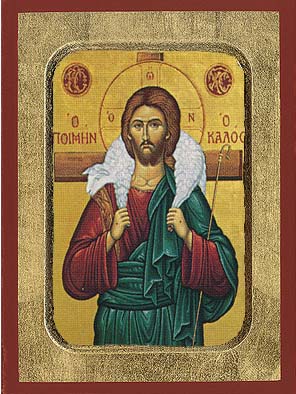
Theosis is achieved only by Συνεργία – synergy and cooperation between man and God, finite and infinite. When we possess spiritual knowledge, natural contemplation will reveal God’s purpose, instead of entangling us in passions. It will allow us to see the principles beneath the surface and understand how the material universe is connected to God:

The intellect reaps true knowledge from natural contemplation when, in a way that conforms to nature, it unites the itself by means of the intelligence.

St. Maximos further illustrates how unity comes about by making use of Hezekiah, and the story of his blocking of the springs outside the city, as a metaphor for the relationship between soul and matter. He tells us that:

When Scripture speaks of the springs blocked up by Hezekiah outside the city (cf. 2 Chr. 32:3-4. LXX), the city signifies the soul and the springs the totality of sensible things. The waters of these springs are conceptual images of sensible things.

The city and the springs cannot achieve fulfillment, however, without synergy and cooperation between them. To achieve these, “the river that flows through the middle of the city” acts as intermediary.

St. Maximos sees the river as a metaphor for “knowledge gathered in natural contemplation from these conceptual images of sensible things.” With the intellect alert and in the state that God intended it for, can now clearly discern between truth and falsehood, good and evil. With the knowledge we acquire we can see the true essence of created things and their connection with God, free of delusion.

This knowledge passes through the middle of the soul because it links the intellect and the senses. For the knowledge of sensible things is not entirely unconnected with the noetic faculty, nor does it depend altogether on the activity of the senses.

Submitting to passions is passive. Guarding the city is active spiritual warfare. Uniting is active and transformative action.  While the river acts as “the intermediary between the intellect and the senses and between the senses and the intellect,” it also serves as an active agent of change. It “brings about the union of the two with each other,” ποιείται την προς άλληλα τούτων συνάφεια.

It is when we discern God in sensible things and are able to see connections among seemingly disparate realms that:

Ineffaceable knowledge, whose spiritual gyration around God’s infinitude is unconditioned and beyond intellection.


Active Faith, Hope and Love (St. Maximos, Various Texts on Theology, the Divine Economy, and Virtue and Vice; Second Century)

#68-77

ChristGoodShepherd2In St. John Climacos’ Ladder of Divine Ascent, we finally reach the uppermost and ultimate step of theosis through a process of purification and illumination that requires r an arduous climb of 33 steep steps. At the end of the journey, we are not rewarded by perfect wisdom, complete emptiness or absolute power but by the triad of faith, hope and love.

Similarly, St. Maximos makes a definitive declaration:

  1. Without faith, hope and love (cf. 1 Cor. 13:13) nothing sinful is totally abolished, nor is anything good fully attained.

“Faith,” he tells us, “urges the beleaguered intellect to press on towards God and encourages it by equipping it with a full range of spiritual weapons.” With faith, it becomes possible for us “bravely to withstand the spate of trials and temptations, sought or unsought.” After all, who would climb 33 long steps toward union with God without faith? Faith, therefore, is the motivation, reason and first step in our journey upwards. It enables the glimmer of the light that we begin to discern at its end.

In patristic writings, especially in St. Maximos, no element is static and solitary. They interact with each other and engender transformation.

Faith is not a passive attribute. Once it enters our hearts, belief in the Resurrection transforms us by allowing the miracle of Resurrection to materialize within us.

It “is the first resurrection within us of the God whom we have slain through our ignorance.”  This is why “faith, rightfully expressing itself through the fulfillment of the commandments…”

Hope “is the intellect’s surest pledge of divine help and promises the destruction of hostile powers.”

It is possible for hope to dwell in us and replace darkness with light because our hearts have been resurrected through faith.

The return to God clearly implies the fullest affirmation of hope in Him

Despair is characterized by darkness and shortsightedness. We simply cannot see an alternative to current misery. We are trapped in the present of our misery and are unable to visualize and believe in a future in which we will feel different than the present moment. Some will choose to take their life because they perceive the current situation as permanent.

Hope, however, “brings future things before us as if they were present, and so it assures those who are attacked by hostile powers that God, in whose name and for whose sake the saints go into battle, protects them and is in no way absent.

Love

Love in Christ is not simply a “feeling” or “emotion.” There is no “cuteness” or romance associated with it; no soft music playing in the background. It is a state of total union with God that allows us to perceive the world as unified with Him and ourselves as participants in that unity. Instead of focusing on our personal agendas, jealousies, recriminations, ambitions and other created things, “love impels [our intellect] to concentrate its whole natural power into longing for the divine.”

With love, we never again feel estranged from others and God. Love “makes it difficult or, rather, makes it utterly impossible for the intellect to estrange itself from the tender care of God.”

Love in Christ is not only present in our relationship to loved ones. Because our hearts have been purified by passions and we have heightened spiritual knowledge, we can see others through the eyes of God and recognize them as equally worthy.

 “Love is distinguished by the beauty of recognizing the equal value of all men.”

“Those who by grace have come to recognize the equal value of all men in God’s sight and who engrave His beauty on their memory, possess an ineradicable longing for divine love, for such love is always imprinting this beauty on their intellect.”

Yet in the ever-ending journey toward theosis, understanding and experience are not adequate unto themselves without action. Here St. Maximos introduces the theme of total alignment between our will and purpose, and the right ordering between the two.

Intelligence begets spiritual knowledge which, in turn, begets faith. From faith springs hope and from hope love. Yet in addition to the interrelationships among these elements, there have to be powerful drivers that cut across and move us to action: desire, will and purpose.

  1. Nothing so much as love brings together those who have been sundered and produces in them an effective union of will and purpose. Love is born in a man when his soul’s powers – that is, his intelligence, incensive power and desire – are concentrated and unified around the divine.

 Without the power of desire there is no longing, and so no love, which is the issue of longing; for the property of desire is to love something. And without the incensive power, intensifying the desire for union with what is loved, there can be no peace, for peace is truly the complete and undisturbed possession of what is desired.


On Preparing to Become a Cistern (St Maximos, Various Texts on Theology, the Divine Economy, and Virtue and Vice, Second Century, #59-63)

Next Session, Friday, March 29

Cistern“In Scripture,” St. Maximos tells us, “hearts capable of receiving the heavenly gifts of holy knowledge are called cisterns (cf. 2 Chr.26:10). To become a cistern, we need God’s Grace, in addition to our own efforts.  Yet not everyone is worthy of God’s grace.

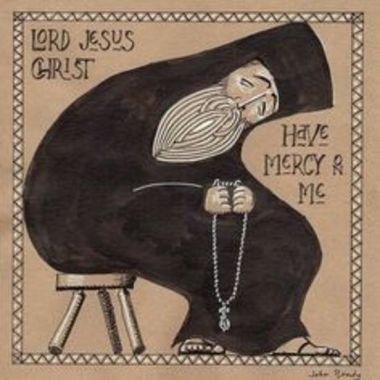
In previous passages in the same chapter, we learned that “while every valley shall be filled,” not every valley is qualified to be filled (#53).

Similarly, while we all have the capacity to receive spiritual knowledge, not every heart has the capabilities to do so and become cisterns.

According to the dictionary: “Capacity is the ability that exists at present whilst capability refers to the higher level of ability that could be demonstrated under the right conditions.”  We are caught between God-given given ability and the potential of higher capabilities for fulfilling and directing this ability to God.

In these few paragraphs and elsewhere, St. Maximos talks about how to break this logjam and prepare for God to dwell within us and transform us into cisterns.

To become cisterns, we need God’s grace. To be worthy of his grace, however, we need to purify our souls from passions and choose a life of virtue.

This is not simply a matter of performing virtuous acts, however, or follow the Lord “superficially.” Rather it is a matter of a complete and transformative re-orientation. It shifts the presence of God from the margins (when your chores are done, and you are not busy) to the center of your life. God is now your sole focus, frame of reference and cherished destination. There is not a moment when you do not remember God’s presence and discern his principles under every created thing.

  1. So long as the intellect continuously remembers God, it seeks the Lord through contemplation, not superficially but in the fear of the Lord,

St. Maximos frequently contrasts a life on the surface, limited to what one can see and sense, to a God-driven life of endless depth in which we can enter “hill-country’ (Deut. 11:11” —  the higher form of the spiritual contemplation of nature. Those who are being made into cisterns will achieve this if God teaches them “the qualities of the commandments and reveals to them the true inner essences of created beings.”

In this new life, nothing is a mere commodity because we can discern the underlying reasons and principles of the existence of every created thing.

When we see the essence of things beneath the surface, everything around us is transformed and we can see the higher purpose of things. Suffering is a bridge to God. Ambition or passion is not a mere personality characteristic to be leveraged for profit but a tool for doing God’s will. The particulars—a bird’s song, sunny day or a boring chore– are not random, disconnected phenomena. In them we discern shared universal principles and understand them as the interlinked building blocks and manifestations of God’s creation. Seeing the inner essence of things means that we are no longer living in a fragmented world. We perceive the connections and are, thus, connected to God. Our perception of the world is not fragmented but holistic and participatory.

To fully participate in God, however, we have to do so through both thought and action “by practicing the commandments. For he who seeks Him through contemplation without practicing the commandments does not find Him… The Lord guides to success all who combine the practice of the virtues with spiritual knowledge:”

To encourage us, St. Maximos depicts and makes concrete the rewards of this preparation:

  1. He “hew[s] out cisterns in the desert, that is to say, in the world and in human nature. He excavates the hearts of those who are worthy, clears them of their material sordidness and arrogance, and makes them deep and wide in order to receive-the divine rains of wisdom and knowledge. He does this so that they may water Christ’s flocks, those who need moral Instruction because of die immaturity of their souls.


Filling the Valley of the Soul: St Maximos the Confessor

Next session Friday, 3/22 at noon

(Various Texts on Theology, the Divine Economy, and Virtue and Vice, Second Century #51-59)

Valley

“Every valley shall be raised up, every mountain and hill made low; the rough ground shall become level, the rugged places a plain.” (Isa. 40:4)

St. Maximos alludes to Isaiah to remind us of the eternal hope of salvation.

However, not every valley shall be filled automatically, he warns, “for the text does not refer to the valley of those who have not prepared the way of the Lord and made His paths straight….By a valley is meant the flesh or soul of those who have prepared the way of the Lord and made His paths straight…”

Talking the talk without walking the walk is not adequate preparation for our soul. Performing virtuous actions for selfish, superficial reasons, while living a life of passion, will not prepare ‘the way for the Lord’ within us. We need, instead, to abstain from passions and live a life of virtue.

A foundational ingredient for our preparation is the acceptance of suffering.

In previous paragraphs, St. Maximos explains that if we limit ourselves to thinking only based on the senses, we cannot see beyond the surface and will fail to discern the underlying principles of material things. As a result, we cleave to pleasure and avoid pain. In time, we begin to perceive the sheer pursuit of pleasure and material rewards as good, and pain and suffering as bad. With spiritual knowledge, however, our vision extends beyond what is immediate and visible to what is eternal.

#34. By exercising “the power of discrimination associated with the soul which makes him cleave to glory of what is eternal as something good and avoid the corruption of what is transitory.

To prepare the valley of the soul, one must go beyond simply accepting pain to look at its inner principles and purpose and rejoice.

He who longs for the true life knows that all suffering, whether sought or unsought, brings death to sensual pleasure, the mother of death; and so he gladly accepts the harsh attacks of trials and temptations suffered against his will.

Acceptance is not passive, however, but transformative. Suffering is not a final destination or an end unto itself. By active participation and discernment, we must convert rough patches into smooth paths and springboards to a union with God.

By patiently enduring them he turns afflictions into smooth untroubled paths, unerringly leading whoever devoutly runs the divine race along them towards ‘the prize of the high calling’ (Phil. 3:14). For sensual pleasure is the mother of death and the death of such pleasure is suffering, whether freely chosen or not.

By overcoming “pain with love for spiritual knowledge, and through both virtue and knowledge, [a person] will see, according to Scripture, ‘the salvation of God’; and this will be his reward for virtue and for the efforts he has made to attain it (Isa. 40:4-5. LXX).’ “

Acceptance of sufferings requires self-restraint and dispassion. Suffering for most of us can ignite explosive anger, self-pity, jealousy, revenge and other destructive passions. Often, our lives veer off course in response to suffering as it becomes overwhelmed by rage, and driven by desires for revenge, praise, loss of faith or despair. Why add to sufferings the loss of your soul, St. Maximos seems to ask? Instead,

if a man has dedicated his intellect to the knowledge of truth, he will not allow unsought sufferings to thwart the ceaseless aspiration that leads him towards God.

St. Symeon the Theologian has similar advice:

“A person who suffers bitterly when slighted or insulted should recognize from this that he still harbors the ancient serpent in his breast. If he quietly endures the insult or responds with great humility, he weakens the serpent and lessens its hold. But if he replies acrimoniously or brazenly, he gives it strength to pour its venom into his heart and to feed mercilessly on his guts. In this way the serpent becomes increasingly powerful; it destroys his soul’s strength and his attempts to set himself right, compelling him to live for sin and to be completely dead to righteousness.”

This is how one prepares the valley to be filled with God. And “when such a valley has been filled with spiritual knowledge and virtue by the divine Logos…” then “He will walk in its paths.”

then all the spirits of false knowledge and evil are “‘abased’; for the Logos treads them down and brings them into subjection. He overthrows that cunning power which has raised itself up against human nature; He levels it as if it were high and massive mountains and hills which He uses to fill in the valleys. For the rejection of passions which are contrary to nature, and the reception of virtues which are in accordance with nature, fills up the valley-like soul and abases the exalted lordship of the evil spirits (Isa. 40:4. LXX).


Reintegrating with Our True Selves (St Maximos, Various Texts on Theology, the Divine Economy, and Virtue and Vice, 2nd Century, #37-51)

Next session on Philokalia, Friday, March 15, at noon.

The path to purification and the attainment of dispassion are not linear processes of Philokalia 2elimination and decrease. They are rather akin to peeling layers to uncover and free a hidden treasure, far more precious than what these layers contained: true spiritual knowledge and union with God.  What’s more, as St. Maximos tells us, this union is not one-dimensional and passive but participatory in that it does not abrogate self-hood. On the contrary, it frees us from distractions and delusions and “reintegrates” us with the true self that we once lost.

It is said that he who does not first reintegrate himself with his own being by rejecting those passions which are contrary to nature will not be reintegrated with the Cause of his being – that is, with God – by acquiring supranatural blessings through grace. For he who would truly unite himself with God must first separate himself mentally from created things.

What then is our true self? When driven by passions we simply do not know. We are trapped by these passions in a dream within a dream and cannot escape. We become attached to our own logic and conceptual images which we superimpose on created things and are unable to discern the underlying principles that reveal their true nature.

It is the devil’s practice maliciously to confound the forms and shapes of sensible things with our conceptual images of them. Through these forms and shapes are generated passions for the outward aspects of visible things, and our intellectual energy, being halted at the level of what pertains to sense-perception, cannot raise itself to the realm of intelligible realities. In this way the devil despoils the soul and drags it down into the turmoil of the passions.

Passions create an ever-widening spiral that increasingly closes in on us. Without discernment, we mistake evil for good. We look for ecstasy in intoxication with wine or drugs instead of a life of virtue that leads to spiritual knowledge.

The vine produces wine, the wine drunkenness and drunkenness an evil form of ecstasy. Similarly the intelligence – which is the vine – when well-nurtured and cultivated by the virtues, generates spiritual knowledge; and such knowledge produces a good form of ecstasy which enables the intellect to transcend its attachment to the senses.

We can only free ourselves by conforming ourselves to God’s will rather than our own, following a life of virtue and detaching ourselves from our own logic and conceptual images of things.

By so doing [one] places himself utterly beyond the reach of everything that seeks to entrap him, and so is not attracted through some sensory image towards the death that lies in the passions.

However, even though “the intellect has by nature the capacity to receive a spiritual knowledge of corporeal and incorporeal things,” we can only receive spiritual knowledge and union with God through Grace

Who is the person who is reintegrated with his true self? It is:

The person who with the clear eye of faith beholds the beauty of the blessings of the age to be readily obeys the command to leave his country and his kindred and his father’s house (cf. Gen. 12:1), and he abandons the flesh, the senses and sensory things, together with passionate attachments and inclinations. In times of temptation and conflict he rises above nature because he has put the Cause of nature first, just as Abraham put God before Isaac


Tree of Life and Tree of Knowledge (St Maximos the Confessor Various Texts on Theology, the Divine Economy, and Virtue and Vice, Second Century)

There will be a Philokalia session tomorrow (March 8) at noon

anna-karenina-illustrated-and-russian-editionIn Tolstoy’s Anna Karenina, we are gripped by the passionate story of the heroine who abandons an oppressive marriage to flee with her lover, Count Vronsky. We follow the triumph of passion over banal domesticity until we witness the eventual unravelling of Anna’s life that, stripped of meaning and virtue, leads to her tragic suicide. The antithesis to her character is a shy and awkward landowner, named Konstantin Dmitrich Levin, for whom farming and rural life are the greatest pleasures in life. As Anna succumbs to a downward spiral that eventually leads to death, Levin embraces Christian love and ascends upward to a union with God, transforming his life from one of loneliness and atheism to one of love, marital companionship and faith.

For St. Maximos, Anna Karenina’s course in life would represent her choice of the tree of the knowledge of good and evil (cf. Gen. 2:9), and rejection of the tree of Life. Levin, in contrast, takes a journey in the opposite direction, abandoning the tree of knowledge and embracing the tree of life.

There is “a great and unutterable difference” between these two trees, St. Maximos says. The tree of the knowledge of good and evil is “the seat of mindless impulses” while “the tree of life is the soul’s intellect, which is the seat of wisdom.”

The problem with the tree of knowledge is that, judging by our senses alone, we can only discriminate between pleasure and pain. We, therefore, naturally cleave to pleasure and avoid pain. Ironically, we live in a society that has embraced the same choice. In it avoidance of pain of any sort and the pursuit of comfort, convenience and pleasure are the ultimate goals and are treated as inviolable rights.

In contrast, by embracing the tree of life, we are able to discriminate between the eternal and the transitory. Our purpose is not simply to avoid pain and increase pleasure but to “cleave to the glory of what is eternal as something good and avoid the corruption of what is transitory as something evil.” Hence, we often choose to accept pain for a higher good.

Yet the real tragedy of limiting knowledge to the senses is not only that we succumb to passions. It is that our perception of the world becomes blurred and illusory. Our understanding becomes corrupted and distorted so that, unknowingly, we embrace death rather than life.

If a man exercises only sensory discrimination between pain and pleasure in the body, thus transgressing the divine commandment, he eats from the tree of the knowledge of good and evil, that is to say, he succumbs; to the mindless impulses that pertain to the senses; for he possesses only the body’s power of discrimination, which makes him embrace pleasure as something good and avoid pain as something evil. But if he exercises only that noetic discrimination which distinguishes between the eternal and the transitory, and so keeps the divine commandment, he eats from the tree of life, that is to say, from the wisdom that appertains to his intellect; for he exercises only the power of discrimination associated with the soul…


An even greater tragedy is when our corrupted, limited, sensual understanding forgets and reverses the true distinction between good and evil. As we immerse ourselves to the pursuit of pleasure and avoidance of pain, we see our choices—whether becoming workaholic, possessive, obsessed with praise or material good—as good, and use our intellect in the wrong way, to justify our actions.  All of us are vulnerable to this corruption of perception and lack of discrimination.

Nazi Germany justified the holocaust as economic necessity and scientific progress; ordinary citizens were in denial about the extent of the evil surrounding them; slave-owning societies saw slavery as the divine order of human relations. This is why St. Maximos sees the pursuit of pleasure as a grave danger and evil distortion of God’s intention for the capabilities he endowed us with:

He who persuades his conscience to regard the evil he is doing as good by nature reaches out with his moral faculty as with a hand and grasps the tree of life in a reprehensible manner; for he thinks that what is thoroughly evil is by nature immortal.

Anna Karenina justified her choices in terms of the freedom to love and act. It was only later that her lonely existence, on the fringes of good and decent society, and deep despair were revealed for the evil that they were.

Unquestionably, the tree of life is productive of life; the tree that is not called the tree of life, and so is not productive of life, is obviously productive of death. For only death is the opposite of life.