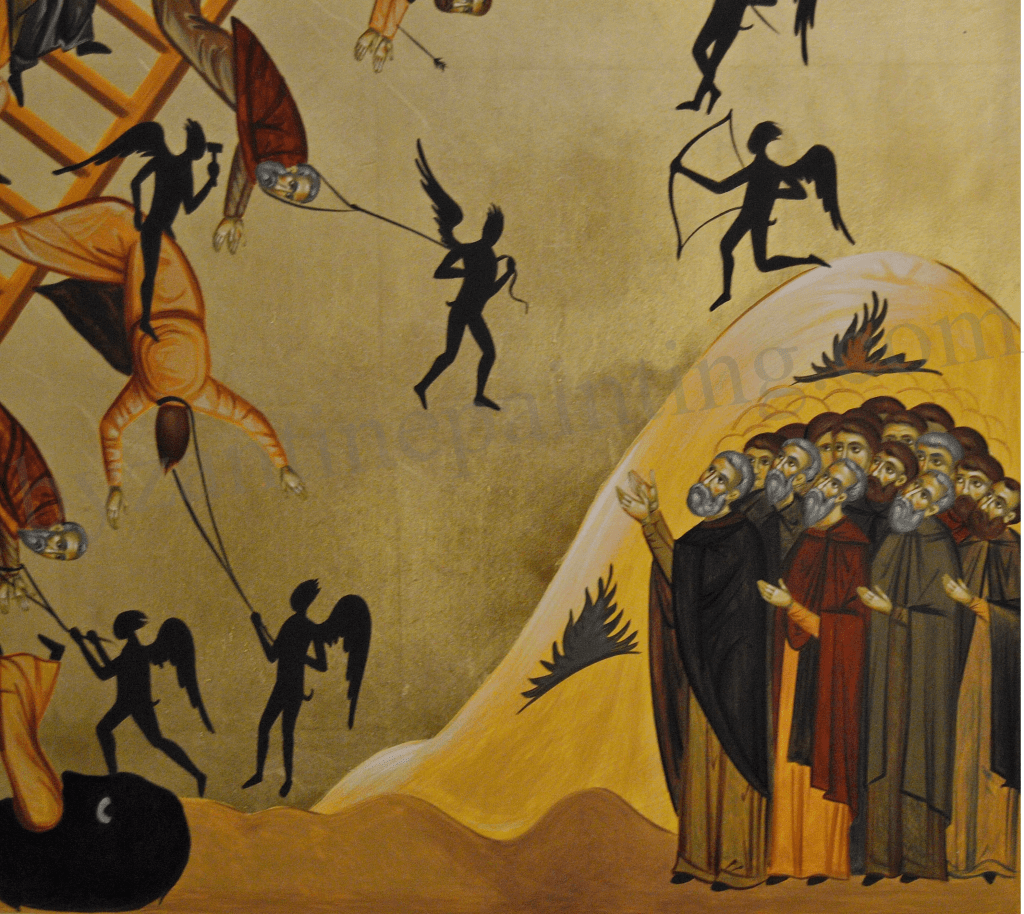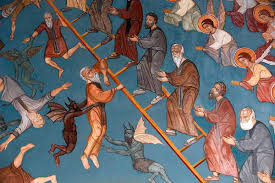
THE LADDER OF DIVINE ASCENT BY JOHN CLIMACUS

STEP #3: EXILE

The concept of exile takes us even beyond renunciation and detachment.

Exile goes beyond just leaving material things behind. It is a state of mind and manner of living in which “we live “a hidden life, an invisible intention, unseen meditation, desire for humiliation, longing for hardship, constant determination to love God, abundance of charity, renunciation of vainglory, depth of silence.”

Exile is not the result of anger, bitterness, or despair.

 It is not from hatred that we separate ourselves from our own people or places (God forbid!), but to avoid the harm which might come to us from them.

“Exile” means having a hidden life that is so different than the lives of most others, that we feel like we are speaking a foreign language.

He is an exile who, having knowledge, sits like one of foreign speech amongst people of another tongue.

An exile is a fugitive from every attachment to his own people and to strangers.

This is a step that seems difficult to put into practice because it requires us to renounce relationships that are precious to us. However, let’s consider than St. John addressed monks. Let us also consider that such texts employ narrative conventions we would call rhetorical exaggerations to make the point of their critical importance.

How do we apply these principles?

We are asked not to “associate with people of the world or approach them.” He admonishes us that even our “attachment either to some particular relative or to strangers is dangerous. Little by little it can entice us back to the world, and completely quench the fire of our contrition.”

It seems extreme but isn’t this what AA and other addiction treatment programs advise? The first step is humility in recognizing that you are powerless over substances, things, feeling, behavior, or people you have an unhealthy attachment to. Having recognized that you are vulnerable to temptation, you deliberately avoid it. You stop going to bars, hanging out with those addicted to alcohol, drugs, or unhealthy behavior. You change your habits and way of thinking step by step.

A state of exile grows out of our admission of vulnerability. In other words, it requires humility.

We have no problem in understanding physical addiction, yet isn’t sin an addiction—a state when passions drive your life and you are no longer in control of your body and soul?

St. johns advies:

“Run from places of sin as from the plague, for when fruit is not present, we have no frequent desire to eat it.”

The hardest part for us to accept is the need to renounce your family.

Look, beware, lest you be exposed to the deluge of sentiment through your attachment to the things of your home, and all that you have be drowned in the waters of earthly affection. Do not be moved by the tears of parents or friends; otherwise you will be weeping eternally. When they surround you like bees, or rather wasps, and shed tears over you, do not for one moment hesitate, but sternly fix the eye of your soul on your past actions and your death, that you may ward off one sorrow by another.

Monastics, of course, must leave their family behind and renounce the world. Yet St. John is not asking us to literally hate and abandon our families but to prioritize our values. Christians are asked to love God above all else.

The last step in the Ladder of Divine Ascent is faith, hope and love. Once you have achieved this ultimate level of complete union of God, you are capable of true love, not sentimental or romantic love. You are in a state of inner stillness in which we can truly see, listen to and love others.

Putting God first does not mean abandoning the children but, for example, facilitating their salvation rather than pushing them to pick the most prestigious college or job or to succeed a level above their peers,

St. John advises us to note the temptations that come with a life of exile. Among us is the danger of feeling so superior that we consider it our job to teach and save others.

In trying to save the careless and indolent along with themselves, many perish with them, because in course of time the fire goes out. As soon as the flame is burning within you, run; for you do not know when it will go out and leave you in darkness. Not all of us are required to save others. The divine Apostle says: ‘Each one of us shall give account of himself to God.’4 And again he  says: ‘Thou therefore who teachest another, teachest thou not thyself?’1 This is like saying: I do not know whether we must all teach others; but teach yourselves at all costs.

In pursuing exile, John advises us to avoid extremes. He also wants us to understand that the state of inner freedom that exile brings about, can also elicit passions such as pride and contempt for others. He stresses the need for humility in acknowledging our own weaknesses and vulnerabilities. Such acknowledgment of our powerlessness justifies the sacrifices he is asking for.
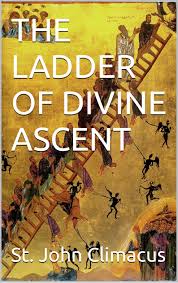
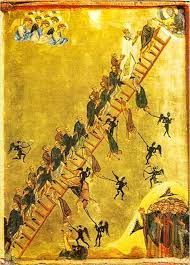
THE LADDER OF DIVINE ASCENT BY JOHN CLIMACUS

STEP #2: DETACHMENT


With Lent coming, we are leaving Philokalia for a
while to re-read the Ladder of Divine Ascent by St. John Climacus. With the
exception of the Bible, writes Bishop Kallistos Ware in the introduction of
this book, there is no other book as influential and foundational for Orthodox
spirituality as the Ladder of Divine Ascent by St. John Climacus. it embodies
the transformational journey that all Christians are capable of, and have a
right to, from the tumult of passions and fragmentation to wholeness, inner
stillness and unity with God. We use the edition, translated by Colm Luibheid
and Norman Russell. Note, however, that my quotes are from a different, online
translation. You can order the book from Amazon.

____________________________________________________

The first step in the Ladder of Divine Ascent is renunciation. The second step, detachment, takes us just a little further along our journey to deification. After renouncing the material world, we must also abandon our desire for it so that we can “follow Christ without anxiety or hesitation…”

Renouncing the world while we feel nostalgic for it or indulge in self-pity for our deprivation, keeps us still tethered to what we renounced; still overwhelmed by the anxiety we experienced while living in the world. This path leads away from union with God and toward a state of despair.

After our renunciation of the world, the demons suggest to us that we should envy those living in the world who are merciful and compassionate and be sorry for ourselves as deprived of these virtues. The aim of our foes is, by false humility, either to make us return to the world, or, if we remain monks, to plunge us into despair. It is possible to belittle those living in the world out of conceit; and it is also possible to disparage them behind their backs in order to avoid despair and to obtain hope.

While John addresses those who actually left the secular world to live the ascetic life, we can easily extract lessons for applying the concept of detachment to our secular lives. “World” for us does not refer to our physical dwelling but our passions and addictions through which we lose control of our souls and lives. Our dilemma is not just how to leave behind the “world” while living in a monastery but how to extricate ourselves from the “world” while being of this world.

Do you ever congratulate yourself for healing your anxiety through your meditative practices or your decision to pray more or the adoption of a new healing diet or exercise regiment, even though you are still experiencing anxiety and resentment? You still can’t listen patiently because you are dying to talk and make your opinions known. You still devote considerable effort to eliciting others’ respect and admiration. You seek the beauty and peace of a silent walk in the woods, but your thoughts still race in your mind, keeping you from full immersion in the moment. This is what St. John means when he says:

The man who has come to hate the world has escaped sorrow. But he who has an attachment to anything visible is not yet delivered from grief.

He calls surface renunciation, without detachment, “sham asceticism.” In that state, we delude ourselves into focusing on our virtuous words and actions while failing to discern the signs of continuing spiritual enslavement.

We may have “planted many different plants of the virtues,” St. John tells us, but we allowed them to be watered “by vainglory as by an underground sewage pipe,” and to be “hoed by ostentation, and for manure were heaped with praise.” Weakened this way, these plants cannot be transplanted and thrive in a different, even more challenging soil.

St. John then proceeds to define for us what the “narrow way” of virtue and renunciation consists of. For monastics the “narrow way” includes “askesis” such as “mortification of the stomach, all-night standing, water in moderation, short rations of bread…”

It also contains:

…the cutting out of one’s own will, patience in annoyances, unmurmuring endurance of scorn, disregard of insults, and the habit, when wronged, of bearing it sturdily; when slandered, of not being indignant; when humiliated, not to be angry; when condemned, to be humble. Blessed are they who follow the way we have just described, for theirs is the Kingdom of Heaven.

All the above represent the elements of the Hesychastic path to theosis and the kernels of inner stillness and peace for all humans.

THE LADDER OF DIVINE ASCENT BY JOHN CLIMACUS

With Lent coming, we are leaving Philokalia for a while to re-read the Ladder of Divine Ascent by St. John Climacus.

With the exception of the Bible, writes Bishop Kallistos Ware in the introduction of this book, there is no other book as influential and foundational for Orthodox spirituality as the Ladder of Divine Ascent by St. John Climacus.

While addressed to monastics, it embodies the transformational journey that all Christians are capable of, and have a right to, from the tumult of passions and fragmentation to wholeness, inner stillness and unity with God.

We use the edition, translated by Colm Luibheid and Norman Russell. Note, however, that my quotes are from a different, online translation.

You can order the book from Amazon.

STEP ONE

Like all journeys, the Ladder of Divine Ascent consists of many steps. St. John divides our journey into 30 small steps, which he describes and helps us climb one-by-one.

With his help we travel gradually from detachment and renunciation to the acquisition of fundamental virtues, the struggle against passions and finally the cultivation of dispassion and acquisition of inner stillness. When we reach at the top of the summit, we can directly experience the love of God and become God-like.

The first step, before our real climb even begins, is renunciation of the material world as we know it: our dependence on things, indulgences, addictions to passions, assumptions that close our hearts and minds.

Those who enter this contest must renounce all things, despise all things, deride all things, and shake off all things, that they may lay a firm foundation.

St. John’s audience, of course, is other monks who have chosen to leave the world and live a life of prayer. Yet renunciation is not negation but purification. Its three pillars according to St. John are “innocence, fasting and temperance.” They do not describe a simple deficit but the shedding of artifice and the return to a child-like nature:

Let all babes in Christ begin with these virtues, taking as their model the natural babes. For you never find in them anything sly or deceitful. They have no insatiate appetite, no insatiable stomach, not a body on fire…

Hence the return to a child-like state, free from passions and anxiety is possible for all of us.

Why would a citizen of the 21st century want to deprive himself/herself in an age when self-gratification and actualization are inalienable rights? In the hesychastic (and more broadly, Christian) worldview, material gratification and abandon in passions result in slavery of the soul. Renunciation, on the other hand, paradoxically leads to freedom.

The book’s preface quotes St. Augustine as he puts forth a vision of a life in which we are in union with God.

Imagine a man in whom the tumult of the flesh goes silent, in whom the images of earth, of water, of air and of the skies cease to resound. His soul turns quiet and, self-reflecting no longer, it transcends itself. Dreams and visions end. SO too does all speech and every gesture, everything in fact which comes to be only to pass away. All these things cry out: “We did not make ourselves. It is the Eternal One who made us.”

This is the vision that makes the journey worthwhile.

Unlike other meditative traditions, the journey up the ladder is enabled by faith and love. Why would you even want to undertake such a challenging journey without this motivation, John asks?

5. All who have willingly left the things of the world, have certainly done so either for the sake of the future Kingdom, or because of the multitude of their sins, or for love of God. If they were not moved by any of these reasons their withdrawal from the world was unreasonable. But God who sets our contests waits to see what the end of our course will be.

Our journey is not a willful adventure but a disciplined process that can only be undertaken under the guidance of a spiritual father. This journey, hence, should be driven by humility rather than certainty in our own knowledge and abilities.

In the patristic mindset, life is a constant spiritual warfare and the forces of evil and darkness are real and ever present.

We have very evil and dangerous, cunning, unscrupulous foes, who hold fire in their hands and try to burn the temple of God with the flame that is in it. These foes are strong; they never sleep; they are incorporeal and invisible.

The hope for Christians is that “God belongs to all free beings. He is the life of all, the salvation of all—faithful and unfaithful, just and unjust, pious and impious, passionate and dispassionate, monks and seculars, wise and simple, healthy and sick, young and old—just as the diffusion of light, the sight of the sun, and the changes of the weather are for all alike; ‘for there is no respect of persons with God’”. Being God-lie, then, is our heritage to reclaim.

In hesychasm there is a need for direct and personal experience with God. Only through renunciation can we hear God speak to us directly without intermediaries. Renunciation opens the door to the journey of direct communion with Him.

So that we can hear his word, not in the language of the flesh, not through the speech of an angel, not by way of a rattling cloud or a mysterious parable. But Himself. The One Whom we love in everything.

.

SPIRITUAL KNOWLEDGE: ST. PETER OF DAMASKOS

(Philokalia Vol. III, G.E.H Palmer, Philip Sherrard, Kallistos Ware)

We are born, St. Petter writes, with an innate spiritual knowledge which we later lose through passions.

What is the meaning of spiritual knowledge then?

It is the ability to see things as they really are in nature, to uncover the mystery that lies beyond appearance and physical attributes.

The intellect then sees things as they are by nature ….by others it is called spiritual insight, since he who possesses it knows something at least of the hidden mysteries- that is, of God’s purpose- in the Holy Scriptures and in every created thing.

Passions, however, “darken the intellect” and confine us to the surface of things.

Living on the surface is easily exhaustible. We burn through material things, praise, career milestones etc., rapidly. We are, thus, on a frantic course of constantly replenishing the supply and yet, for many of us, a sense of emptiness remains.

The Greeks had an extraordinary understanding of the physical and intellectual realm, we are told, yet they lacked spiritual knowledge, defined here as the discernment of purpose.

Without understanding purpose, one cannot penetrate the true meaning of all things.

…for the pagan Greeks perceived many things but, as St Basil the Great has said, they were unable to discern God’s purpose in created beings, or even God Himself, since they lacked the humility and the faith of Abraham.

Viewed through the lens of spiritual insight, then, nothing is insignificant and worthless. Nothing is dismissible.  Nothing is empty. Even a crumb of bread or a boring daily routine points to a larger meaning and purpose.

 (God’s purpose) is clearly revealed in the world to come, when everything hidden is disclosed.

A significant difference between Christian and other types of meditative traditions is that the true meaning of things cannot be deciphered through our own resources and will not be revealed without faith.

The gnostic ought not to rely in any way on his own thoughts, but should always seek to confirm them in the light of divine Scripture or of the nature of things themselves. Without such confirmation, there can be no true spiritual knowledge, but only wickedness and delusion.

God and his purpose are there to be discovered—ensconced in simple and lofty things alike, in humble daily discourse and scriptural writings. All we have to do is rid ourselves of passions, assumptions and obsession with our self-interest so we can be filled with spiritual knowledge and allow for the revelation to occur.

We have all seen little children’s wonder-filled eyes as they explore the world with hope, faith and awe. Everything is new, sacred, and filled with unending mysteries and delights. Even a speck of dust is a source of wonder and reveals to them something about a vast and unknown world. This is the state of innocence we must achieve in order to be filled with spiritual knowledge.

Peter expounds on the meaning of faith. It is, he says, going beyond the visible to extrapolate the invisible.

A person is said to have faith when, on the basis of what he can see, he believes in what he cannot see.

Yet, discerning hidden mysteries is not enough if you lack faith in their creator. “But to believe in what we can see of God’s works is not the same as to believe in Him who teaches and proclaims the truth to us.”

Faith must proceed from the head to the heart. According to St. St. Peter, it is through suffering that one acquires faith, then fear, then awe, then gratitude and humility and, finally, true spiritual knowledge.  

In this way, the person who in faith endures these trials patiently will discover, once they have passed, that he has acquired spiritual knowledge, through which he knows things previously unknown to him, and that blessings have been bestowed on him. As a result, he gains humility together with love both towards God, as his benefactor, and towards his fellow-men for the healing wrought by God through them.

PATIENCE AND ENDURANCE: St. Peter of Damaskos

(Philokalia Vol. III, G.E.H Palmer, Philip Sherrard, Kallistos Ware)

When I look for an urgent answer or solution, my double “A” personality often kicks in. There have been times when, in my impatience for an immediate answer, I stayed up until dawn, doing Google research, drawing diagrams, or making lists. Even if I become exhausted and unproductive, I am sure that if I just persist a little more, I can get results within my timeline.  

How much of our inner peace do we sacrifice, in our efforts to force our agenda and sense of timing on the universe?

St. Peter advises that we apply “conscious awareness of our own hearts” to discern God’s perspective and free ourselves from the frantic pressure to bring about the results we want, when we want them.

Harmonizing our will with God’s brings about patience and endurance. Patience and endurance are not simply two of many virtues. They are, instead, the preconditions for possessing our soul. If fact, St. Peter believes that “you come into yourself when you endure with patience.”

Without patient endurance, we live in turmoil, burdened by the idea that unless we force results, nothing worthwhile will happen in our lives. We are riddled with anxiety, uncertainty, and lack of clarity as our passions obscure the true nature of things.

How many tears would I like to shed whenever I gain even a partial glimpse of myself! If I do not sin, I become elated with pride; while if I sin and am able to realize it, in my dismay I lose heart and begin to despair. If I take refuge in hope, again I become arrogant. If I weep, it feeds my presumption; if I do not weep, the passions visit me again… In my ignorance all things seem contradictory, and I cannot reconcile them.

Patience is living in God’s infinite time. It is abandoning the futile struggle of forcing our temporal time frame on a God-created universe. It is acquiring humility to put aside our own assumptions; and discernment to understand the connecting links among things that appear contradictory.

Patient endurance is not a solitary virtue but the result of a transformative process that begins with faith and fear of God. As we no longer see ourselves as the center of the world, we experience awe, humility, clarity of vision, gratitude, and inner stillness.

For if such endurance is not born in the soul out of faith, the soul cannot possess any virtue at all.

The working assumptions for most of us are that we acquire and increase knowledge through our own efforts, feel justifiable pride in it, receive recognition for it and continue to ascend levels of accomplishment until we become “experts” or wise. It thus becomes easy to judge others, become anxious about winning arguments and impose our opinions which we “know” to be wiser than others.’  

St. Peter, and other desert fathers, turn this value system on its head. Spiritual knowledge begins with acknowledgment of ignorance and the recognition of the need of God’s grace.  

For this reason it is good to say ‘I do not know’, so that we neither disbelieve what is said by an angel nor place credence in what occurs through the deceitfulness of the enemy.

Giving up the pressure of forcing results and timelines, judging, impressing, and dominating others frees us from impatience. We now live in God’s time, realizing that experience and insight may take years, rather than hours or days, and that we cannot achieve anything on our own without God’s grace.

We may wait for many years until the answer is given us, unsolicited and unperceived, in the form of some concrete action- as someone has put it with reference to the contemplation of created beings. In this way we reach the haven of active spiritual knowledge. When we see this knowledge persisting in us over many years, then we will understand that truly we have been heard and have invisibly received the answer.

God-Given Understanding: St. Peter of Damaskos

(Philokalia Vol. III, G.E.H Palmer, Philip Sherrard, Kallistos Ware)

In this chapter, St. Peter talks about the reading of scriptures and, by extension, the nature of knowledge and learning in a God-centered universe.

Reading the scriptures, he tells us, is not simply a matter of intellectual comprehension but one of “understanding.” “Understanding” takes us beyond simply deciphering words or obscure allusions to uncover “all the mysteries hidden by God in each verse of Scripture.”

The goal of reading the scriptures, then, is not textual understanding but illumination.

He who pays attention to them is illumined, while he who pays no attention is filled with darkness.

St. Peter allows that there can be multiple levels of understanding of the scriptures, and indirectly, of a God-created world depending on. These depend on::

Our ability for inner stillness “because such devotion concentrates the intellect: even if it is attentive for only a short time.” 

Our ability for patience and humility in acknowledging our human limitations and the needs of God’s grace:

“God is beyond comprehension, and His wisdom is not limited in such a way that an angel or man can grasp it in its entirety.”

    Our own intellectual readiness, ability and the experiences we bring to the text. Knowledge is not absolute or immediate but a continuing process.

    This is clear from the fact that we often understand a certain passage in the course of our contemplation, grasping one or two of the senses in which it was written; then after a while our intellect may increase in purity and be allowed to perceive other meanings, superior to the first.

    What is significant is that the various levels and types of insight we may derive at different times are not contradictory.

    For this reason, the same saint may say one thing about a certain matter today, and another tomorrow; and yet there is no contradiction, provided the hearer has knowledge and experience of the matter under discussion.

    While we may perceive only an object’s texture, color, weight, or placement, all these attributes are part of a whole and not at war with each other.

    However, to perceive the connections among seemingly disparate or conflicting attributes and the ways these mystically unite into a harmonious whole, we must move beyond intellectual knowledge to a state of union with God. It I then that we will be able to see the world through his eyes rather than our limited, fragmented perception.

    This is why the Hesychasts describe theosis as a state, characterized by simplicity and the lack of contradiction. All connections are now visible, and the world makes sense.

    New criticism which came into prominence after the 60s with thinkers like Claude Lévi-Strauss (structuralism) and Jacques Derrida (deconstructionism) focused on multiple interpretations of a literary work. Instead of looking only at the text or its author, it aimed   at deciphering how the parts (including its patterns and the reader’s perspective) combine to contribute to its meaning.

    There is a fundamental difference, however, between St. Peter’s “understanding” and new literary criticism.

    Multiple levels of understanding in scriptural reading contribute to the true meaning of the text when “everything said or done should be said or done in accordance with God’s intention…”

    In new criticism and much of modern thought there is no agreed-upon purpose and truth. Meaning is not understood as something eternal and immutable but as something constantly shifting, while there is no acknowledgement of the validity of truth.

    Knowledge, and the deciphering of meaning, in modern thought depend on the individual while, for St. Peter, understanding depends on the grace of God.

    The acquisition of mystical knowledge is like a gradual journey through multiple stages of understanding, not unlike the journey from passions to a state of theosis.

    Knowledge and learning then progress from listening in humility to the illumination of understanding the hidden mysteries to a mystical union with God in which we experience the world through his eyes. We now see what might be contradictory in human eyes, as harmonious and complementary through God’s eyes.

    St. Peter cites St Dionysios the Areopagite in his observation “that to the ancients the resurrection of the dead appeared contrary to nature, whereas to himself and to St Timothy-and in the eyes of the truth itself- it is not contrary to nature, but it transcends nature.”  St. Peter believes that such phenomena do not simply transcend nature but in “god’s eyes” they are nature.

    in God’s eyes, however, it does not transcend nature, but is quite natural; for God’s commandment is His nature.

    The ultimate level of understanding then is to go beyond our narrow human capabilities and comprehend the scriptures, and a God-created universe, through God’s eyes. Tit is through this union that the invisible threads of meaning are uncovered, and harmony is experienced.

    Dispassion of the Soul,   St. Peter of Damaskos

    (Philokalia Vol. III, G.E.H Palmer, Philip Sherrard, Kallistos Ware)

    So here we are. St. Peter has taken us to the upper rungs of the ladder that leads to union with God or theosis: dispassion.  

    Dispassion is quintessential to theosis.

    We simply cannot experience the presence of God within us if our hearts and minds are weighed down by passions—jealousy, revenge, recurrent thoughts, preoccupation with self, pursuit of other’s admiration, control or power and all other passions.

    What are passions?  “They are intense emotions that attract and hold attention,” Mitchell B. Liester writes in “Hesychasm – A Christian Path of Transcendence.” https://www.scribd.com/document/136038409/Hesychasm-A-Christian-Path-of-Transcendence

    An emotion or thought becomes a passion when it turns obsessive and veers out of control. When it is it and not we who direct our lives under God’s guidance.  

    When we are driven by our whims and passions, we are not free.

    Hesychasm is a mystical, contemplative monastic practice of the Eastern Orthodox Church, rooted in early Christianity whose goal is to excise passions and achieve inner stillness and union with God. Hesychast monks, through practice and contemplation, are on a perpetual quest for a state of dispassion.

    “Hesychia” (state of dispassion), Liester says, “is a state of detached awareness experienced during regular spiritual practice.”  

    Dispassion is not a single virtue, we are told by St. Peter. Neither is it an isolated, ecstatic moment.

    Dispassion is not a single virtue but is a name for all the virtues. A man is not merely one limb, for it is the many limbs of the body that constitute a man; and not merely the limbs, but the limbs together with the soul.”

    The cooperation and synchronicity of God’s universe are important here. Everything is connected and interdependent.

    A true state of dispassion and inner stillness cannot be simply willed by solitary acts, such as intoxication or special exercises. It requires the intervention of the Holy spirit and immersion in a virtuous way of life and thinking.

    It is, St. Peter tells us, not only “the union of many virtues,” but when “the place of the soul is taken by the Holy Spirit.”

    Dispassion is not the same as indifference or contempt. On the contrary, dispassion nurtures and enables love since it is no longer subsumed by our own self-interests, passions, and preoccupations.

    “Soulless” dispassion, driven by our ego rather than the Holy Spirit, is empty.

    For all activities described as ‘spiritual’ are soul-less without the Holy Spirit,” we are told. In fact, “unless the Holy Spirit is present can one properly speak of the all-embracing virtue of dispassion.

    Without love, inspired by the Holy Spirit, dispassion could become mere indifference, coldness, isolation and even pride.

    And if someone were to become dispassionate without the Holy Spirit, he would really be, not dispassionate, but in a state of insensitivity.

    Dispassion, in fact, “is a strange and paradoxical thing.” We are detached in that we are not driven by the whim of passions, but we still suffer, empathize with others’ pain and experience deep love. Through our dispassion we become connected because no passion is clouding our discernment and love of others.

    St. Peter contributes his own depiction of passions as slavery and dispassion as freedom – a recurrent theme in patristic writers.

    For they say that because of his amity with passions the highly impassioned person becomes like a prisoner and as one who is insensate. Sometimes because of his desire for something he rushes forward thoughtlessly like some mindless thing; The man who has attained dispassion becomes impassible out of his perfect love for God.

    How does dispassion bring us freedom?

    Which one of us doesn’t get inflated by praise and become depressed when we don’t have the success and recognition we imagined? St. Peter describes the passion-driven man as a leaf in the wind, inflating or deflating on the basis of others’ perception of him.

    The person who has achieved dispassion, however, can experience passions without allowing them to drive and overwhelm him

     Dispassion does not mean that a man feels no passions, but that he does not accept any of them. Owing to the many and various virtues, both evident and hidden, acquired by the saints, the passions have grown feeble in them and cannot easily rise up against their soul. Nor does the mind need to keep constant watch on them, because its concepts are at all times filled with study and intercourse with most excellent subjects, which are stirred n the intellect by the activity of insight. As soon as the passions begin to arise, the mind is suddenly ravished away from them by a certain insight that penetrates into the intellect, and the passions recede from it as being inactive. St. Isaac, the Syrian

    Imagine for a second, if we were simply impervious’ “to attacks from demons and vicious men.” Imagine if we could experience perceived insults, demotions, loss, misfortune, disdain from others etc. as if they “were happening to someone else, as was the case with the holy apostles and martyrs” rather than as profound disappointments, and triggers for anger, revenge and despair.

    This is the true freedom dispassion brings about.

    When he is praised he is not filled with self-elation, nor when he is insulted is he afflicted.

    What is Humility? St. Peter of Damaskos

    (Philokalia Vol. III, G.E.H Palmer, Philip Sherrard, Kallistos Ware)

    Humility is acknowledged as the greatest of all virtues, the prerequisite for salvation, “the dwelling-place of the Holy Spirit, the gateway to the kingdom of heaven, that is to say, to dispassion.”

    What is humility and how can we view it in the 21st century when we have, apparently, forgotten its original Christian meaning?

    Over the centuries many have come to equate humility with humiliation, weakness, lack of self-confidence and even contempt for oneself.

    In the Christian framework, however, humility leads to dispassion rather than self-hatred. We are freed from passion and, hence, we are no longer dependent on others’ praise or contempt to feel uplifted or humiliated.

    Strength is often viewed as success in getting our way, eliciting admiration, or imposing our will on others. While these may give temporary relief, they do not lead us to inner peace and union with God.

    Paradoxically, it is only by lowering ourselves that we are uplifted:

    …without humility his road is full of pain and his effort useless. Humility bestows complete repose upon whoever possesses it in his heart, because he has Christ dwelling within him.

    Humility is not second nature to us. St. Peter makes it clear that acquiring humility is not a passive act of resignation but a fierce fight against the grain—-against our desires, passions, habits, assumptions, and norms of thought and behavior.

    St. Peter believes that humility is achieved by first embracing suffering. Acceptance of suffering has a foundational role in the path toward theosis. This acceptance, however, is the opposite of acquiescence or hopelessness. We are active agents on our path to salvation rather than cogs in a mere transaction. We do not simply accept suffering to gain salvation as a reward, St. Peter tells us, but “to press forward actively and deliberately to embrace the sufferings of Christ.”

    That is, by accepting suffering, we gain humility and empathy and ascend to a higher level of theosis, or union with God.

    To acquire humility, one must have achieved knowledge and discrimination. St. Peter has already warned us about our vulnerability to delusion. When our mind is filled with self-absorbed thoughts, opinions, and conclusions we cannot perceive the world or ourselves clearly and dispassionately:

    But above all it is the offspring of discrimination, the virtue that illumines the farthest reaches of the intellect.

    A state of humility is also a state of continuous learning and discovery. Instead of laboring to justify ourselves, impress others and impose our will and opinion, we can look at the world with fresh,= eyes and open heart to always discover things that we do not know.

    But he who has tasted spiritual knowledge knows at least to some extent that he is ignorant, and so his knowledge becomes for him a source of humility.

    In becoming aware of his own weakness and ignorance, he recognizes that he has now learned what once he did not know; and this allows him to see that just as he used not to know these things, and was unaware that he did not know, so there are many other things which he may later be able to learn.

    The opposite of humility is pride. Unlike humility, it distances us from God as it puffs us up with delusions and invests our most precious resources in total immersion in, and reaction to, the external world. As an example of pride, Peter brings up he Pharisee who thanked God loudly for being superior to others:

    The Evangelist-or, rather, God, who knows men’s hearts- was right to say that he spoke ‘to himself’, for the Pharisee was not speaking to God. Even though orally he did seem to be speaking to God, yet God who knew his self-applauding soul says that he stood and prayed not to God but to himself.

    Without humility and the dispassion it leads us to, no matter how lofty or clever our words, we find ourselves going in endless circles, talking to no one but ourselves and never reaching our true destination.

    Knowledge or Delusion? St. Peter of Damaskos

    (Philokalia Vol. III, G.E.H Palmer, Philip Sherrard, Kallistos Ware)

    “Without knowledge no one does anything good,” says Peter of Damaskos in his chapter, “The Remembrance of Christ’s Sufferings.”

    We are told the story of a virgin who came up to an Abba while he was sitting with St. Anthony. She proudly listed all the hardships she had endured for the sake of Christ — fasting, scriptural readings, poverty and abandonment of all earthy things. Yet, when questioned by the elder, it turned out that her strict, ascetic practice had not resulted in dispassion, compassion, love, and discernment. 

    ‘Go, get to work,” admonished the elder, “you have accomplished nothing.‘

    St. Peter concludes:

    So, with this virgin: because she did not know what was really needed, she laboured in vain.

    What is it that the virgin should know?

     Let’s first keep in mind that the “spiritual knowledge” we read about in patristic writings differs a great deal from all other forms of knowledge–theoretical and empirical.

    The goal of spiritual knowledge is not merely to preserve in memory facts or ideas but to acquire discernment– the ability to distinguish between good and evil, truth and falsehood.  It is mystical knowledge, acquired through direct participation in God’s essence. It results in transformation rather than mere enrichment. Archim. Dr. Teofan Mada, considers spiritual knowledge, “knowledge in and by love.”

    The Eastern Church Fathers underlined the specificity of the christocentrical knowledge as knowledge in and by love that is a knowledge of love which binds the one who knows and the one who is known. In love and by love, one can discover the way of Truth and of the real knowledge.

    Teofan Mada, Love and Knowledge in the Patristic Tradition https://www.orthodox-theology.com/media/PDF/IJOT1.2014/Mada.pdf

    Paradoxically, achieving discernment requires that we empty, rather than add to, our intellect.  

    we withdraw our intellect from all that it has known or heard, and concentrate it on the remembrance of God…

    Thoughts, images and even colors cloud our mind. Our own will and personal interpretation of things prevent us from discerning God’s revelations and uniting with Him.   

    To be ‘in peace’ means to have no thoughts, whether bad or good, because, as Evagrios says, if the intellect perceives something, it is not in God alone, but also in itself. This is true; for since God is undetermined and indeterminable, without form or colour, the intellect that is with God alone should itself be without form or colour, free from all figuration and undistracted. Otherwise, it will be subject to demonic illusion.

    Most of us take for granted that our basic perception of objects and ideas, and the distinctions between good and evil, true and false, are self-evident to us and we are firmly in control of our reality. We are confident that the way we perceive and understand the world is correct and do not see illusion as an imminent threat.

    Imagine the level of humility and spiritual openness it must take to silence all conclusions and assumptions inside us. Yet this is the magnitude of humility required to truly empty ourselves and learn.  

    For St. Peter and the other Dessert Fathers true humility and transparency mean the willingness to admit that no true knowledge can be achieved without God’s help and, hence, that we are in danger of self-delusion at every moment in our lives.

    There is nothing astonishing in the fact that the devil assumes the form of ‘an angel of light’ (2 Cor. I I : I4), for the thoughts that he sows in us also appear to be righteous when we lack experience. Humility is the gateway to dispassion, said St John Klimakos;

    We are constantly on a precipice, requiring constant vigilance and spiritual knowledge to keep from falling. St. Peter makes mention of two disciplines for preventing delusion:

    1. Meditation on the suffering of Christ as it humbles us and joins us to Him in love.
    2. The need for a spiritual counselor, mentioned multiple times in these chapters.   

    …unless we have taken advice from someone of experience, we should not entertain any thought, whether good or bad, for we do not know which it is. For the demons take whatever shape they want and appear in this way to us, just as the human intellect is shaped by what it wants and is coloured by the forms of the things that it perceives.

    Just as the first step in Alcoholic Anonymous is to admit our powerlessness over our addiction, we must admit our powerlessness over illusion and ask for help. 

    Just as someone who lacks horticultural knowledge, on seeing the flower and thinking that it is the fruit, rushes forward to pick it, not realizing that by picking the flower he destroys the fruit, so it is here: for, as St Maximos puts it, ‘To think that one knows prevents one from advancing in knowledge. ‘2 Hence we ought to cleave to God and to do all things with discrimination. Discrimination comes from seeking advice with humility and from criticizing oneself and what one thinks and does.

    The Difference Between Pleasure and Joy, Emptiness and Stillness: St. Peter of Damaskos

    (Philokalia Vol. III, G.E.H Palmer, Philip Sherrard, Kallistos Ware)

    The mortification of passions, the title of this chapter, is difficult for secular people to grasp. We read about the dessert fathers exhorting other monks to refrain from any pleasure of material things and cannot envision the value of a joyless life.    

    By means of these the soul in its anguish renounces the joys of this world and even the food we eat.

    Let’s dig deeper into the text for the true meaning of mortification that applies to both laity and monks, the present and the past.

    Peter is not asking us to abandon a joyful and peaceful state of mind and capriciously torture ourselves. Being led by passions means a life of anguish, marked by unfulfilled longing, loneliness, jealousy, stress, torturous ambitions, anger, self-pity, obsessive thoughts of revenge, desires to control, etc.  

    It is in this state of anguish that the soul is willing to abandon all that may trigger a state of turmoil.

    When our hearts and minds are cluttered with passions, there is no room for God’s presence, no time or desire to do “good things.”

    When this happens, the soul will not be interested in any good work, but will struggle to fulfil the desires of the body and of its own indwelling passions, piling darkness upon darkness, and gladly accepting to live always in utter ignorance.

    For St. Peter and other desert fathers, however, there is a difference between pleasure and joy.

    The temporary pleasure we receive from succumbing to an impulse for quick pleasure and comfort is not equivalent to true joy.

    “Detachment is mortification,” we are told, are “not of the intellect, but of the body’s initial impulses towards pleasure and comfort.”

    The quest for comfort and pleasure dominates our worldview in our time yet, cliché though it may be, they do not contribute to lasting joy and peace.

    Lasting joy, we are told, is derived from the presence of God in you and your union with him. The road from detachment to theosis is one from anguish to joy.

    Likewise, the sense of emptiness experienced when our life’s pursuit is aimed only at material things on the surface, is the opposite of the stillness achieved when we are free from obsessions and at peace. This is when we free to contemplate, not only the visible and immediate but the things that matter most:

    “Not of created beings in this present life, but of the awesome things that take place before and after death.”

    This is when true joy sets in:

    When a man has been sufficiently illumined, however, to perceive his own faults, he never ceases mourning for himself and for all men, seeing God’s great forbearance and what sins we in our wretchedness have committed and still persist in committing. As a result of this he becomes full of gratitude, not daring to condemn anyone, shamed by the profusion of God’s blessings and the multitude of our sins.