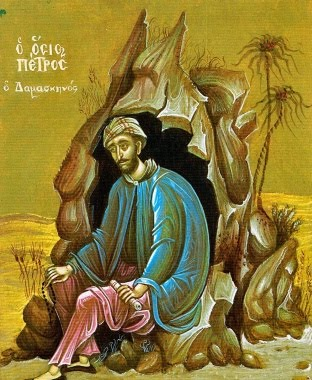
HOPE AND FAITH: St. Peter of Damaskos

(Philokalia Vol. III, G.E.H Palmer, Philip Sherrard, Kallistos Ware)

pp.224-227
HOPE

Staring out the double glass doors into my garden, I can see a tiny sparrow laboring hard to break down a huge peanut into tiny pieces that can fit in his mouth. At first, it seems impossible but after 10-15 minutes I watch him swallow the first, tiny morsel he laboriously extracted from this peanut. What propelled him to steal from the squirrels a piece the size of his little head and then spend over 20 minutes to consume it? How did he know he would succeed? St. Peter would point this out as an example of the hope God endowed us with. It is this hope that keeps despair at bay and gives purpose to our lives. One cannot simply live without hope.

For St. Peter, hope is not absolute assurance of results, but reasonable expectation born of experience. We are willing to restrain ourselves and suffer sacrifices—undergo harsh diet and exercise routines, endure sleepless nights of studying for an exam or put in extra hours at work—because we have experienced the results in ourselves or others. It is hope, then, that drives our lives beyond the confines of simple gratification of immediate needs and endows them with meaning. 

“Outwardly,” St. Peter writes, people “sacrifice immediate advantages, but in reality, even if they forfeit what they sacrifice, through their patient endurance they gain what is of far greater value.”  This is why ‘through hope were they made perfect’ ( cf. Heb. 1 1 : 39-40 ).

As Christians, our greatest hope is gaining eternal life. Yet how do we maintain such hope without having experienced salvation. “No one has risen from the dead so that we can know what rewards to expect,” St. Peter says.

The path to God, however, is not based on empirical knowledge but on faith. “We walk by faith, not by sight‘ ( 2Cor. s : 7)  says St Paul, quoted by St. Peter. We choose to leap beyond linear thinking and put our faith in Jesus Christ who experienced death and life eternal.

THE INADEQUACY OF FAITH ALONE

St. Peter does not present our journey as an intellectual process leading to a state of enlightenment. We have faith in God’s promise of eternal life and, hence, are willing to engage in the harsh, daily, unglamorous work of living a life of virtue in the hope of achieving it. St. Peter is, in fact, practical and matter of fact about what a life of virtue entails, using the mundane analogy of a businessman.

Yet just as it is impossible for someone engaged in business to make a profit on the basis of faith alone, so it is impossible for anyone to attain spiritual knowledge and repose before he has laboured in thought and action to acquire the virtues.

FAITH AND GRATITUDE

St. Peter asks us a difficult question. Why is it so difficult for us to live lives of gratitude in which we are aware of God’s gifts at every moment of the day?

He compares us to small children who take everything for granted and “do not recognize the bounty of their parents.” He sees us as “inexperienced students” who resent the effort of learning and doing homework because they do not yet recognize the value of knowledge and the difference it will make to their lives. Christ, he reminds us, shed his blood for us yet all he wants from us in return is to “choose to receive His blessings.”

Faith begets gratitude and gratitude nourishes hope.

THE BURDEN OF OUR OWN WILL

What keeps us from faith is the all-powerful pull of our own will. After a visit to my adult daughter a few weeks ago, I realized the source of the tension between us and my disappointment in the visit. Her life simply did not follow the script I had envisioned for her—from the way she conducted her social life to the way she kept house and the number of pets she had.

How many of us are terrified to let go and accept God’s will without manipulating things, judging others, controlling situations, and exerting enormous efforts to ensure that things go our way?

It is difficult to experience faith and gratitude when we are at war with God’s will—resenting, holding grudges, becoming angry and disillusioned. St. Peter sums up the paradox:

He who wishes to inherit the kingdom of heaven, yet does not patiently endure what befalls him, shows himself even more ungrateful than such a child.

STILLNESS

Hope requires stillness and, in that sense, simplicity. This means a renunciation of one’s will and the illusion of controlling the universe. No matter how much we worry about the safety of loved ones travelling or rage about the speed of modern life that makes air travel a necessity, our thoughts, complaints, and desires cannot keep their airplane safely in the air.

This is why the first virtue St. Peter advises us to acquire is stillness in the sense of renunciation oF worldly passions and, hence, simplicity.

For nothing darkens a man’s mind so much as evil, while God reveals Himself to simplicity and humility, not to toil and weariness.
FEAR AND GRATITUDE ( St. Peter of Damaskos, Philokalia, III)

pp 216-218

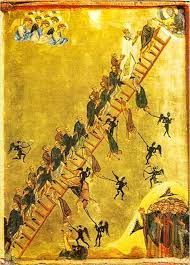
St. John Klimakos calls fear “unmanly and puerile cowardice” and lists it as one of the passions that must be overcome to ascend the ladder to God. Then why do the proverbs call fear of the Lord “the beginning of wisdom,” and St. Peter of Damaskos tells us that without fear of God “one cannot possess any blessing?”

Fear of God is different from other fears that besiege us. Loss of faith, and hence of fear of God, does not rid us from the incapacitating fears and anxieties that torture us. On the contrary, fear of God frees us from the slavery to the whims of our own will and the fears and anxieties of a heart devoid of inner stillness.

Fear of God leads to the fulness of love. Our journey to theosis, full participation in God’s person and love, begins with this fear.

St. Peter identifies two types of fear.

  1. The “introductory” or slave-like fear of God that serves to restrain us from sin. One cannot trust a toddler to be near a stove without burning himself or near harmful substances without the risk of swallowing them. It is the fear we gain with experience that prevents us from harm as adults. Similarly, “through fear of what threatens us,” St. Peter says, “we sinners may be led to repent and may seek to find deliverance from our sins. 1 Moreover, when it is active within us, this introductory fear teaches us the way that leads to life, for it is said: ‘Shun evil, and do good’ (Ps. 34 : 14).”
  2. The perfect and pure fear occurs at a more advanced spiritual state, when it is no longer a struggle to live a life of virtue. We now experience fear, not because we are afraid of punishment for our sins but because, having experienced God’s love and true nature, we cannot imagine a life without this proximity to him. We are able to perceive our fragility and are afraid of losing the ecstatic joy we have felt in his presence.  “The person who has been purified continues to feel fear, not because he sins, but because, being human, he is changeable and prone to evil. In his humility, the further he advances through the acquisition of virtues, the more he fears.

At the state of perfect fear, we have undergone profound spiritual transformation. Rid of passions, we have gained the spiritual clarity and discernment to perceive our own vulnerabilities. Instead of avoiding grief, suffering and fear at all costs, Christian thought embraces them as gateways to joy and salvation.

The more a man struggles to do good, the more fear grows in him, until it shows him his slightest faults, those which he thought of as nothing while he was still in the darkness of ignorance. When fear in this way has become perfect, he himself becomes perfect through inward grief: he no longer desires to sin but, fearing the return of passions, he remains in this pure fear invulnerable.

We are filled with gratitude for the gift of this joy and with humility, realizing that it can be lost to us in a flash.

The man seized by spiritual joy is astounded by the many blessings that God in his grace has bestowed on him, and he loves his Benefactor.

I well remember my decision to become an atheist at the age of 11, eager to rid myself of the fear of punishment by God. Yet, St. Peter forces us to reconsider fear and reflect on the kind of lives we might lead, without any fear of God.  

In today’s secular worldview, for example, the notion of “gift” is replaced by the notion of “deservedness.”  We worked hard all our lives and deserve a luxury car. I am worth this upscale apartment or expensive make up. If we “deserve” the good things in our life, why be grateful? And if we are worthy of them, then there must be people who are not worthy.

But he who obdurately indulges in luxury and splendour, like the rich man (cf.Luke 16 : 19 ), thinks that those consumed by fear and facing trials and temptation suffer in this way because of their sins, and in his comfort and complacency he despises them.

In St. Peter’s worldview, loss of fear of God leads to division, complacency, delusion, and entitlement. Perfect fear of God engenders humility, and lives lived in gratitude.  

IN THE COMPANY OF SAINTS: STILLNESS AND HUMILITY IN TRUE KNOWLEDGE ( St. Peter of Damaskos, Philokalia, III)

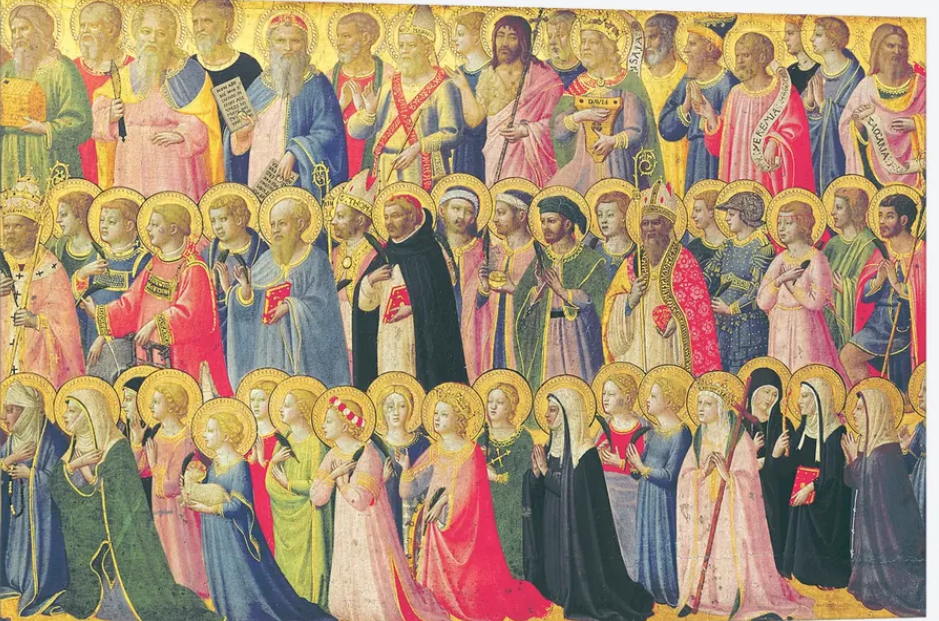
First, St Peter of Damaskos wants you to know that salvation is possible for everyone—lay persons or monastics, rich or poor, young, or old—in any circumstances. 

I have said something about the righteous men of old who were saved in the midst of great wealth and among sinners and unbelievers, although they were by nature the same as us… I have also mentioned details from the lives of us monks, so that we may know that we can be saved in any situation.

Our human tragedy is not sin alone but the lack of will “to attain perfection.”

Think of a day in our lives. Most of us are motivated by the desire to succeed, control, accumulate, achieve, secure others’ admiration, or check off items on our to-do list, rather than by a longing for salvation.

St. Peter also wants you to know that help for the salvation of our souls is all around us if we have the inner stillness and humility to discern it.  These two are, in fact, prerequisites for “the understanding of the mysteries hidden in the divine Scriptures and in all creation.”

We must remember, too, that stillness is the highest gift of all, and that without it we cannot be purified and come to know our weakness and the trickery of the demons; neither will we be able to understand the power of God and His providence from the divine words that we read and sing.

Without humility, we cannot open our hearts and eyes to “draw upon the greater experience and knowledge of good and evil” that the saints wrote about.  Our minds are clouded by a labyrinth of revolving thoughts and rigid preconceptions.

We are incapable of perceiving, let alone utilizing, the help God richly provides for our salvation.  Certainty in our own knowledge and our scripts for what life should be like, we are left alone and exhausted as we struggle to impose our own will and draw only on ourselves for help.

Abandoning our own will means that we are no longer exiled by a “dividing wall;” no longer tossed about by passions in contradictory directions.

I have also mentioned details from the lives of us monks, so that we may know that we can be saved in any situation, provided we renounce our own will. Indeed, unless we do this, we cannot find rest, nor can we gain either knowledge of God’s will or practice in fulfilling it. For our own will is a dividing wall, separating us from God.

St. Peter urges us to abandon lives of isolation and anxiety, and become united with a harmonious confluence of people, sources of learning and divine grace that God makes available.

He reassures us that we are not left unaided but are surrounded by saints and supported by an enormous trove of accumulated knowledge: “it has been granted to us to learn about the meaning of these things from the saints.”

While in patristic texts there is an emphasis on practice vs. abstract theology, Peter emphasizes both. In fact, he stresses the value of books, specifically, as pathways to salvation.

Moreover, it increases our wonder at and comprehension of God’s ineffable love: how by means of pen and ink He has provided for the salvation of our souls and has given us so many writings and teachers of the Orthodox faith.

Abandoning our will also means that we leave behind our temporal, sequential notions of time to enter a different dimension:

For Sunday is called ‘day one’ and not the first day of the week, says St John Chrysostom; such is the way in which it is singled out and described prophetically in the Old Testament. It is not simply enumerated with the other days of the week, such as the second day and the rest.

This is not simply a call for rote memorization but one for entering sacred time. In liturgy, for example, past events are re-experienced over and over again in the present. The texts for the Matins of Holy Friday, sung on Holy Thursday, for example, mourn Christ’s crucifixion today and not two thousand years ago.

Today He who hung the earth upon the waters is hung on the tree,

The King of the angels is decked with a crown of thorns.

He who wraps the heavens in clouds is wrapped in the purple of mockery.

St. Peter invites us to abandon our will and become integrated with the shared universe God has created for our salvation in the eternal sacred Today. This is a universe populated by clues for God’s presence, spiritual guides, symbols and tools for uniting with God.

In the world drawn by St. Peter, everything points to something else so that all is integrated and connected to enable us to achieve salvation. Greg Peters refers to the textual integration as “intertextuality.” 

When reading texts like those penned by Peter of Damascus, it is good to work with the assumption that Peter employed a literary technique now known as. This technique, as defined by Julia Kristeva, is the theory that “Every text builds itself as a mosaic of quotations, every text is absorption and transformation of another text” https://acst-unity-production-realm-eng-uploads.s3.amazonaws.com/uploads/file_attachment/attachment/9af8a01d-d6b5-4b30-861e-56009bde3ccd/Peter_of_Damascus_and_Early_Christian_Sp.pdf

True knowledge of God and salvation consist of interrelated pieces whose presence and connections can only be deciphered when our souls are still and free of the tyranny of our own will.

LEARNING IN HUMILITY: St. Peter of Damaskos (Philokalia, III)

In our perception of ourselves and the world, our knowledge, and the ability to learn, are unquestionable. This is why our conviction in the righteousness of our positions can be so firm that it justifies wars, alienation, division, and even hatred.

Peter of Damascus does not dispute our God-given capability to learn. He simply states that true knowledge cannot take place without humility.

Without humility we may read the Scriptures the same way we read fiction or the newspaper, with the same expectations for linear narrative and logical culmination of “plots.”  The danger is to “search the Scriptures simply with our minds and then out of pride think that we have grasped something.”

It is interesting that Peter brings up the frequent repetition in sacred texts. Reading only with “our minds,” and depending only on ourselves alone, will make us question the choice of “needless” repetitions in the text and make us impatient. Taking the time to understand the context, and leaving our ego behind to turn to God, will reveal meaning behind what, on the surface, appears to be redundant.

Divine Scripture often repeats the same words, yet this is not to be regarded as verbosity. On the contrary, by means of this frequent repetition it unexpectedly and compassionately draws even those who are very slow in grasping things to an awareness and understanding of what is being said; and it ensures that a particular saying does not escape notice because of its fleetingness and brevity.

In oral traditions around the world, there is frequent repetition of words, refrains and themes. In ritual poetry and song, repetitions—and even non-sensical words—are meant to transport you beyond words and objects, beyond yourself, to a level of spiritual engrossment.

In other words, our knowledge can be false if we rely only on ourselves and the framework of experiences to draw conclusions. Humility allows the emptying of self and, hence, openness of mind. It allows us to put ourselves in the shoes of others and listen without agenda or preconceptions. It requires that we eschew quick judgments and reactions and take the time to understand the contexts of culture, history, society, traditions, and community and to ask for help.

Reading the scriptures is not simply an act of following the narrative literally or transposing our own habits and assumptions into the text, but one of searching to understand the hidden mysteries behind the text.

For there are many mysteries hidden in the divine Scriptures, and we do not know God’s meaning in what is said there.

Above all, learning in humility is based on the understanding that we cannot know deeply on our own efforts alone, but only through the gift of God and the Holy Spirit.

Learning without humility results in what St. Peter calls spurious knowledge.

Spurious knowledge, or ‘knowledge falsely so called’ (1 Tim. 6 : 2o),is that which a man possesses when he thinks he knows what he has never known. It is worse than complete ignorance, says St John Chrysostom, in that its victim will not accept correction from any teacher because he thinks that this worst kind of ignorance is in fact something excellent.

This essay is not a discouragement to learning but a humble acknowledgement of the impossibility of obtaining true knowledge without setting aside our ego, abandoning our certainties and seeking God’s help.

Knowledge led by pride can lead to delusion. How many times do we search for data that support our point of view?  How many times do we seek to be surrounded by those whose views and actions justify and support our own?

When reading the scriptures, we cannot penetrate the true meaning of the mysteries or experience a connection with God unless our ability to learn is harnessed to humility. We have to suspend dependence on words, ideas, logical sequences and factual learning processes and question the certainty in our interpretation to learn through immersion in humility and real-life practice:

For this reason, the fathers say that we ought to search the Scriptures assiduously, in humility and with the counsel of experienced men, learning not merely theoretically but by putting into practice what we read; and that we ought not to inquire at all into what is passed over in silence by Holy Scripture.

The man who has been enabled by grace to acquire spiritual knowledge should struggle to study the divine Scriptures and this knowledge with deep dedication, humility, attention and fear of God; for unless he does this he will be deprived of his knowledge and threatened with punishment, as unworthy of what God has given him, in the same way as Saul was deprived of his kingdom, as St Maximos explains.

WHAT IS FAITH? St. Peter of Damaskos (Philokalia, III)

pp. 164-167

“Faith,” St. Peter tells us, is “the foundation of all blessings, the door to God’s mysteries, unflagging defeat of our enemies.”  He calls it “the most necessary of all the virtues,” and the prerequisite for God to dwell “within our soul.”  

What exactly does faith mean? We commonly think of it as the absolute certainty that there is God. This certainty involves mind and matter. You believe because it has been proven to you, by means you understand and beyond reasonable doubt.

St. Peter does not try to convince us through logical arguments. Instead, he talks about a different, experiential dimension of faith and its role as the requirement for inner stillness and union with God.  

“The man of faith,” he tells us, “acts, not as one endowed with free will, but as a beast that is led by the will of God.”

Is he, then, denying the existence of free will?

St. Peter further explains:   

If it is that I should experience temptation so as to learn humility, again I am with Thee. Of myself, there is absolutely nothing I can do.

Faith here is the belief in a universe inhabited by God in which everything is designed with meaning and purpose, even when these are not immediately apparent to us.

Do what Thou wilt to Thy creature; for I believe that, being good, Thou bestowest blessings on me, even if I do not recognize that they are for my benefit.

This assumption of God’s absolute goodness and higher purpose is a choice rather than a loss of free will. We can always choose to rebel against affliction or to express our pain through vengeance, anger and rejection of God. Yet we choose to believe because we discern His goodness and purpose even if we cannot rationally understand them.

Faith, then, represents a radical acceptance of God’s will.

I do not dare to ask for relief in any of my battles, even if I am weak and utterly exhausted: for I do not know what is good for me.

We cannot despair or become enraged in the face of pain, because we believe deeply that, even if we are not able to detect it, there is a reason and a benefit to be derived even from the greatest sorrow.

Acquiring faith is not akin to becoming unquestioning, zombie-like beings. It involves a continuous process in which, even doubt and struggle are part of the journey.

But in whatever way Thou desirest have mercy on me. I have sinned: have mercy on me as Thou knowest. I believe, Lord, that Thou hearest this my pitiable cry, ‘Help Thou my unbelief’ (Mark 9 : 24),

For St. Peter, there are two types of faith: that of hearsay and that of contemplation.

Faith from “hearsay is derived from our reading and understanding of the scriptures and leads to virtues. From this level of devotion stems a superior faith of contemplation and unity with God.

There is no longer a “we” and “He” because we have return to our true nature and become God-like. We have become who God has always wanted us to be.  

For the Divine is infinite and uncircumscribed, and the intellect that returns to itself must be in a similar state, so that through grace it may experience the indwelling of the Holy Spirit. ‘For we walk by faith, not by sight,’ says St Paul (2 Cor. S : 7).

Through faith we are “united with God spiritually” and can experience “perfect love.” Our faith now requires no effort or physical proof because we inhabit an ecstatic state that does not require the help of visual images, words, senses and motion.

The intellect itself has the sense that it is seen, even though at that time it is utterly impossible for it to see anything, for it is imageless, formless, colourless, undisturbed, undistracted, motionless, matterless, entirely transcending all the things that can be apprehended and perceived in the created world. It communes with God in deep peace and with perfect calm, having only God in mind, until it is seized with rapture and found worthy tb say the Lord’s Prayer as it should be said…

Instead of abandoning free will, we have freely aligned our will with that of God.

The Stillness of True Virtue: St. Peter of Damaskos, Philokalia III

pp. 162-164

“To heal a person,” St. Peter tells us, “is the greatest thing one can do and excels all other virtue, because among the virtues there is nothing higher or more perfect than love for one’s neighbour.”

He devotes this small chapter to the acquisition of virtues.

What is virtue in Christian thought?  References to virtues extolled in the scriptures, the ten commandments and other spiritual writings readily come to mind: love thy neighbor as thyself, thou shalt not take the name of the Lord thy God in vain, honor your father and mother, do not kill, be humble…

We think the meaning is evident and self-contained. There is no mystery to be uncovered here. Yet, something in the next paragraph transfixed me when I thought of its application. St. Peter asks us to do more than love:

The sign of this love is not just that one does not keep for oneself anything of which another has need, but also that, as the Lord enjoins, one should joyfully endure death for his sake (cf. John 1� : 1 3), looking on it as a debt we have to pay.

How is it possible to endure death for a neighbor? Is this a metaphoric exaggeration just to make a point or a virtue to be applied literally?   

My irritating next-door neighbors come to mind. I must admit that I dislike them for their aloofness, unfriendliness, and constant suspicion of everyone. Okay, so I can see myself working hard to curb my negative feelings and even say good morning to them with a big smile on my face. But give my life for them? Come on!

My thoughts seem completely normal to me. They are the norm! Who would blame you if you didn’t jump into a raging fire to save a stranger? Self-sacrifice and disregard for one’s life are not intrinsic to the framework that is consider “normal,” through which we see the world. “Normalcy” consists of interrelated assumptions that build on each other, for example:

  • My time is important and not to be wasted on things or people who do not deserve it.
  • My feelings and priorities take precedence over those of others.
  • I have a right to my happiness and comfort and will protect them as needed.
  • I react to life—showing love to those who love me and treat me well and “cancelling” out those who are disagreeable or stand in my way. Why waste efforts on those who do not appreciate me?

Yet, the virtues that St. Peter describes are not contained within our ordinary framework.  In fact, they stretch us beyond what is comfortable and expected.  

And this is as it should be: for we should love our neighbour to the point of dying for him, not only because nature requires this of us, but also because of the precious blood poured out for us by Christ who commanded us to love in this way.

According to St. Peter, then, Christ is asking us to go beyond nature; beyond what is habitual or expected; beyond what we can conceive or understand.  

The virtues that save are not just acts or words emanating from us. They require a transformation of self, a state of gratitude, selflessness, stillness, dispassion, and faith. which is achieved by transcending nature. Above all, they require the grace of God, not simply our own will.

The first thought that leaps to mind when I wake up in the morning is a review of my to-do list and agenda. Being preoccupied with ourselves—our plans, agendas, resentments, anxieties, others’ admiration, or acceptance– is a form of “self-love.” A focus on ourselves leaves little room for love for others and God.

“Do not love yourself, says St Maximos, and you will love God; do not pander to your ego, and you will love your brother. “

Virtue requires dispassion and inner stillness that replace destructive passions such as, anger, resentment and control.  

…nothing so darkens the mind as evil, and nothing so enlightens the intellect as spiritual reading in stillness.

St. Peter returns to the theme of balance between extremes that his chapter on discernment unveiled for us. He urges us to adopt “the royal way,” and resist being tossed from high to low through passions and reactions to others’ actions or words.

There is no shorter way to Christ- that is to say, to dispassion and the wisdom of the Spirit- than the royal way that avoids both excess and deficiency in all things; nor is any virtue more capable of comprehending the divine will than humility and the abandoning of every personal thought and desire.

He asks us to go beyond nature and replace human passions– discontent, jealousy, ambition, and entitlement—with a state of gratitude. Instead of rejecting, forgetting, or discounting what we have we are filled with awe and appreciation for all things.

Nothing so augments the blessings bestowed on us as our recognition of , temptations.

This is not an impersonal process of meditation and inner stillness that can be reached in any context. St. Peter depicts a concrete and personalized discipline rooted in faith of Christ, and hence hope, and made possible by the grace of God. Speaking of our ability to empathize with and sacrifice for others, St. Peter says:

Such love comes through hope; and to hope is to believe unhesitatingly that one will surely attain what one hopes for. This in tum is born of a firm faith, where one has no concern whatsoever for one’s own life or death, but casts all care upon God (cf. 1 Pet. s : 7),

In a state of stillness, gratitude, intellectual restraint, faith, and hope, we transcend common human passions and become transformed ourselves. Virtues are no longer “add-ons” to our ordinary life but logical expressions of our spiritual state. Choices that seem unrealistic, irrational, or unnatural now will appear logical and self-evident when considered from a completely new understanding and perspective.

In a state of virtue and grace, we can experience true Christian love; a love that is unfettered, unconditional, unafraid, unashamed, and complete.

DISCRIMINATION WITHOUT DESPAIR

St. Peter of Damaskos, Philokalia III

pp. 158-161

“If by the grace of God you have received the gift of discrimination,” St. Peter writes,” you should in great humility do everything you can to guard it, so that you do nothing without it.

Interestingly, the warning applies to both virtuous and sinful persons.

Why is discrimination, or discernment, so important and what does it mean in the patristic context?

We are told by many patristic writers that knowledge, contemplation and even prayer are not enough for one’s salvation. We are shown countless examples of virtuous men for whom prayer, fasting, deprivation and other virtues become so obsessive that the spirit of the action is forgotten, and love and inner peace have no room to take root.  

It seems that discerning and embodying the right balance is the most difficult of tasks for us humans. Extremes of exercise, job performance, healthy diets, radical ideologies, lifestyles, advocacy positions, among other forces, are dominating our lives today, dividing people into antagonistic camps.  

Discernment goes beyond virtue and sin. It encompasses the universal balance that exists in a world inhabited by God.” “For him who possesses it,” writes St Peter, “discrimination is a light illuminating the right moment, the proposed action, the form it takes….”

Without the light, we live in confused labyrinths of contradictory forces and invisible threats. Perhaps, we engage in good intentions and actions but cannot curb our impatience, and thus fail because our timing is wrong.  Perhaps, we delude ourselves, believing that we aspire to modest and reasonable professional goals, missing signs such as anxiety, irritability and depression that may indicate a transformation of aspirations into obsessions that leave no room for family, inner stillness and even joy.

Without discrimination it is easy to lose sight of the difference between good and evil, right, or wrong. Some of us keep vacillating between conflicting values and opinions, for example. Others may justify something that feels good at the time even though our conscience signals that it is destructive. Perhaps we sometimes persuade ourselves that adultery, injustice to others or overeating is justifiable because it fits with a new, modern set of morals, or is the result of an abusive spouse or parents, or it represents the pleasure we deserve at this point in our lives, etc.

Then discrimination reveals the nature of things, their use, quantity and variety, as well as the divine purpose and meaning in each passage of the Holy Scriptures.

St. Peter puts specific actions and decisions in a holistic and dynamic context, centuries before psychology unveiled the social, historical, subconscious, and behavioral forces behind our actions.

A destructive choice is not born suddenly and without context. Before adultery, St. Peter tells us, there are licentious thoughts. The devil makes us negligent of small, trivial things that in time lead to sin. Discrimination helps us discern the small steps and actions that, though imperceptible, lead to sin and despair over time.

Without discrimination, small, seemingly harmless transgressions take root and become entrenched habits. “As St Basil the Great says, a persistent habit acquires all the strength of nature.”

With discrimination we can discern the roots of good and evil in small, nuanced details that escape others’ sight.

On its possessor it confers spiritual insight, as both Moses and St John Klimakos say: such a man foresees the hidden designs of the enemy and foils them before they are put into operation.”

Another quality of discrimination, St. Peter tells us, is that it “is born of humility.   Unless you have relinquished control and acknowledged your own shortcomings, you will not have the peace of mind and selfless clarity to discern the true nature of things.

“When a person is full of such anxiety, he cannot even see himself.”

For Christians, discerning the truth and accepting our own limitations and the will of God should never lead to despair. No matter how great our pain we can restore our spirit through repentance. No matter how grave the crisis facing us, we can maintain inner peace through acceptance and hope, and recognize nuggets of opportunity amidst disaster. Despair, giving up on any effort at repentance and any hope of salvation, is the ultimate of sins.

Despair is a twisted form of pride in which we have set up ourself and ego above God. St. Peter angrily confronts the despairing man, asking him how he could possibly think that God is so powerless that he is unable to save him.

Is He, who for your sake created the great universe that you behold, incapable of saving your soul?

In a world in which we are tossed about by myriads of forces and choices, we are saved by the ability to clearly discern right from wrong and uncover the true nature of everything around us. Yet, discernment cannot take root in the midst of anxiety, turmoil, anger or preoccupation with self.

If those attacked by many passions of soul and body endure patiently, do not out of negligence surrender their free will, and do not despair, they are saved. Similarly, he who has attained the state of dispassion, freedom from fear and lightness of heart, quickly falls if he does not confess God’s grace continually by not judging anyone.

Beyond Intellection and Thought: The Eighth Stage of Contemplation, St. Peter of Damaskos, Philokalia III

When we prepare for prayer, we usually think of what to say: what to ask forgiveness for, what petitions to make, what to be thankful for.

In the apophatic theology of hesychasm, we think of shedding: relinquishing oneself, the world, delusions, even the effort of forming words and thinking of how to use them to persuade and communicate. This is what St. Peter calls “pure prayer” which is “the highest form of prayer.” It is a prayer that leaves behind words, images, or sounds to enter a complete and mystical union with of God.

Through the eighth stage of contemplation, we are led upwards to the vision of what pertains to God by means of the second kind of prayer, the pure prayer proper to the contemplative. In it the intellect is seized during the transport of prayer by a divine longing, and it no longer knows anything at all of this world, as both St Maximos4 and St John of Damaskos confirm. Not only does the intellect forget all things, but it forgets itself as well.

As long as we direct and edit our prayer, we maintain control. Evagrios, quotes by St. Peter, makes the point “that so long as the intellect is still conscious of itself, it abides, not in God alone, but also in itself.”   

How do we free ourselves from ourselves so that we can dwell in God rather than only speak to him? Through humility, St Peter declares. Humility in thought requires the acknowledgment of the limitations of our intellect: “recognition of the inadequacy of human language to describe God.”

How could we, humans, understand the essence of God through our intellect alone, when he cannot be contained within, and be limited by, human experiences and capabilities?  God lies beyond the content of words; beyond the analogies or images we conjure up to describe him.

In our ignorance, however, we should not identify God in Himself with His divine attributes, such as His goodness, bountifulness, justice, holiness, light, fire, being, nature, power, wisdom and the others of which St Dionysios the Areopagite speaks. 2 God in Himself is not among any of the things that the intellect is capable of defining, for He is undetermined and undeterminable… For He is beyond intellection and thought, and is known only to Himself, one God in three hypostases, unoriginate, unending, beyond goodness, above all praise.

Instead of trying to fit God into what we know and understand, we enter pure prayer–quieting the thoughts that crowd our mind, relinquishing the control of how to best communicate and persuade, forgetting about ourselves and the world.

St. Peter warns us of the danger of delusion and falsehood when knowledge is not accompanied by humility.

When we read the scriptures, for example, we may see the text rife with the conflicts and contradictions we have always experienced in our world. This is because our understanding of what we read is limited by our own values, motivations, opinions, and experiences.  If we remove our personal opinions and impressions, however, we will be able to perceive that, as St. Peter tells us, there are no contradictions in the scriptures. The spiritually advanced sees no contradictions because he/she detects the hidden connections among segments that appear contradictory and sees in the larger scheme of things, how everything is mutually supported and linked toward the same purpose.

But he whose intellect is still unenlightened thinks that the Holy Scriptures are contradictory. Yet there is no contradiction in the Holy Scriptures: God forbid that there should be.

The appearance of contradiction is due to our ignorance. We ought not to find fault with the Scriptures, but to the limit of our capacity we should attend to them as they are…

St. Peter gives the Greeks and Jews as examples of intellect divorced from humility:

For the Greeks and Jews refused to admit that they did not understand, but out of conceit and self- satisfaction they found fault with the Scriptures and with the natural order of things and interpreted them as they saw fit and not according to the will of God. As a result, they were led into delusion and gave themselves over to every kind of evil.

The result of the 8th stage of contemplation is not a body of knowledge but a state of theosis—complete union with God.

“The person who searches for the meaning of the Scriptures will not put forward his own opinion, bad or good,” St. Peter tells us.

Do you ever wonder how much of our understanding of the world around us is delusional– reading our opinions and desires into others? 

When we write an analytical text or present an argument, we typically formulate a hypothesis, based on our understanding of things we observe and know from experience, and look for quotes that back it up. Don’t we all look for support of our opinions, tastes and ideas when picking friends, choosing a channel or publication? Don’t we sometimes become impatient, wishing that the other party could hurry up and finish a sentence so we can express our views that, surely, will put theirs to shame?

St. Peter asks:

What kind of knowledge can result from adapting the meaning of the Scriptures to suit one’s own likes and from daring to alter their words? The true sage is he who regards the text as authoritative and discovers, through the wisdom of the Spirit, the hidden mysteries to which the divine Scriptures bear witness.

Without humility and the shedding of self, we cannot advance beyond our own assumptions and experiences, to understand and connect with others and dwell in God.

Humans as God’s Co-Creators: The Sixth Stage of Contemplation (continued), St. Peter of Damaskos, Philokalia III

In this portion of the sixth stage of contemplation, St. Peter unveils for us our potential for both wonder and demise.

The intellect, being spiritual, is capable of every spiritual perception when it purifies itself for God, according to St Gregory the Theologian.

He urges us to contemplate our human nature “with wonder, conscious that [our] intellect, being infinite, is the image of the invisible God.”

We have already been told that, with a purified intellect, we can suddenly see the true nature and order of things: “the equilibrium, the proportion, the beauty, the rhythm, the union, the harmony, the usefulness, the concordance, the variety, the delightfulness, the stability, the motion, the colours, the shapes, the forms, the reversion of things to their source, permanence in the midst of corruption.”  All this is revealed to us so that our entire perception of the world and ourselves is transformed.

Everything around us engages us in a process of continued revelation. The Scriptures, for example, “speak to us of the most astonishing things” when we look beyond words and ink:

by means of words and letters-through fragments of inanimate ink-God has revealed such great mysteries to us in the Holy Scriptures

When we see all things as they truly are, we suddenly perceive the universe and ourselves as whole. We are able to realize “how, by virtue of His wisdom, opposites do not destroy one another.”

Man, however, does not remain simply a discerning observer. First, when our intellect is “taken up into God,” it is capable of imitating God ’s order, harmony and complementarity without being pulled into all directions by conflicts, contradictions and uncertainty.

…we should marvel at how the intellect can preserve any thought or idea, and how an earlier thought need not be modified by later thoughts, or a later thought or a later thought injured by earlier ones. On the contrary, the mind like a treasure house tirelessly stores all thoughts.

We have the capacity to duplicate the order we now discern in God’s creation. We are able to see the thread that links together things that appear to be opposite on the surface. We now understand…

that there is nothing incidental or evil in creation, and that even what takes place against God’s will is miraculously changed by God into something good.

Even beyond imitating God, however, St. Peter sees humans as His co-creators, albeit in a minor role.  This is because, not only can we store and organize thoughts, but we can also express them:

And these thoughts, whether new or long held in store, the intellect when it wishes can express in language; yet although words are always coming from it, it is never exhausted.

Through art, we are told, we can bring to light the true nature of things that we detect beneath the surface, transforming them into song, poetry, painting, speech and myriads of daily expressions of beauty. Peter quotes St. Gregory the Theologian:

 He perceives, too, how God’s goodness and wisdom, His strength and forethought, which are concealed in created things, are brought to light by man’s artistic powers.

Peter reminds us also for our potential for demise through pride:

it is wrong to think, as some do, that the soul is an emanation from the supraessential Godhead, for this is impossible. As St John Chrysostom says, ‘In order to prevent the human intellect from thinking that it is God, God has subjected it to ignorance and forgetfulness, so that in this way it may acquire humility.’

When we readily acknowledge our ignorance, however, and contemplate in humility, our view of the creation and of ourselves is transformed and made whole.

In these few paragraphs, St. Peter shares his amazement and wonder that we are gifted with the capacity to participate in God’s creation by transforming understanding into art and intellect into prayer.

Discerning Beauty Amidst Imperfection: Peter of Damaskos, 6th Stage of Contemplation, Philokalia, vol.3

In the first pages of this chapter, St. Peter of Damaskos defines the 6th stage of contemplation as that in which “one begins to look without passion on the beauty of created things.” Beyond this advanced state of thought, however, he conveys a message of extraordinary hope in which we can contemplate the universe dispassionately yet without demonizing the forces and objects that would prevent us from doing so.

To put things in context, he presents to us “three categories of thought: human, demonic, and angelic.”

When we think on the human level, we simply identify what we see, without being able to put things in perspective or decipher the deeper meaning of things beyond the surface.

Demonic thought, on the other hand, envelops all things we see, in passion and confusion. Objects may evoke greed or envy, for example. People become objects of our desire or hatred, opportunities for social advancement or obstacles to our ambitions. We are trapped inside our passions. We can only see the world through a very narrow lens and miss the beauty and cohesion of a universe inhabited by God.

Angelic thought, however, “consists in the dispassionate contemplation of things, which is spiritual knowledge proper.

Imagine a world experienced in a state of inner stillness in which we pause the frantic pace of ceaseless hustle and see objects and living beings for themselves rather than as tools for our convenience and objects of our passions. Imagine if, even when gazing at man’s depravity, we can also perceive the miracle and beauty of his creation. Imagine the luxury of a dispassionate mind when, freed of the burden of our own will and agendas, we can take the time to uncover beauty in ordinary things and seemingly uninteresting people.

By thus contemplating dispassionately the beauty and use of each thing, he who is illumined is filled with love for the Creator.

Next, St. Peter, introduces nuance in our choices and the need for balance and discernment. Love distorted by passion, he tells us, is not proper love.

For if we do not love things as they should be loved, but love them more than we love God, then we are no different from idolators, as St Maximos says.

Yet, having distinguished between proper and improper love, Peter establishes even a more powerful theme, one of hope, reconciliation, and personal responsibility. While aiming at achieving angelic thought, he says, we must ensure that we are not pulled to the extremes in either direction:

But if, on the other hand, we hate and despise things, failing to perceive that they were created ‘wholly good and beautiful’ (Gen. 1 : 31), we provoke the anger of God.

Demonizing the things that tempt us and the choices that differ from ours will prevent us from inner stillness and, hence, the discovery of beauty. High principles and political positions, however lofty they may be, pose a risk of filling us with anger, hatred or anxiety when we see them as indicators of our superiority over others.

Instead of judging and demonizing, “we should look on man with wonder,” St. Peter advises, “conscious that his intellect, being infinite, is the image of the invisible God.”

He brings up the example of gold. Gold, he explains, is not evil in itself, but only in the way it is used.

…so far as gold is a perishable and earthly thing, it is not to be preferred to the commandments of God; yet as something created by God and useful for bodily life and for salvation, it deserves, not our hatred, but our love and self-control.

It is the same thing with the intellect. Our intellect is a gift from God that allows us to gain spiritual knowledge and live in God’s image. However, when it goes astray through pride and pseudo-confidence, it is an obstacle that keeps us from unity with God and humans. St. Peter here asks for discernment, balance and reconciliation:

In this way, the intellect does not go above its true goal out of pride or self-esteem, thinking it understands things merely through its own power of thought; nor does it fall below its true goal, prevented by ignorance from attaining perfection. It does not veer to the right through rejecting and hating created things, or to the left through mindless affection for them and attachment to them.

How often do we get caught in passionate discussions in which our conflict with others’ opinions grows exponentially as one party reacts to the other and their sense of self-righteousness increases. The simple thought of the possibility that we may be wrong never occurs to us. In the middle of a heated exchange, we lose all curiosity about what exactly others think and why. We are driven by the desire to dominate and win at all costs. As a path to dispassion, St. Peter advises us to mistrust our own passionate opinions. We must avoid the pride in our ability to rely solely on own intellectual power to make decisions. We must exercise our intellect in humility.

St. Peter gives us a hopeful view of the universe that affirms the beauty God endows us with:

Whoever is aware of all this recognizes that there is nothing incidental or evil in creation, and that even what takes place against God’s will is miraculously changed by God into something good.

By thus contemplating dispassionately the beauty and use of each thing, he who is illumined is filled with love for the Creator.